
By Deborah Danan
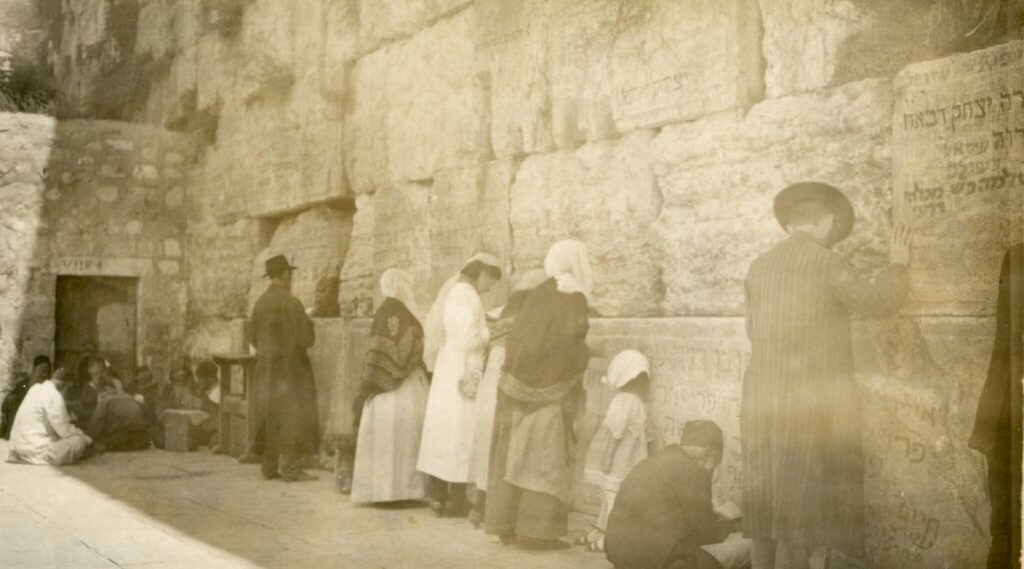
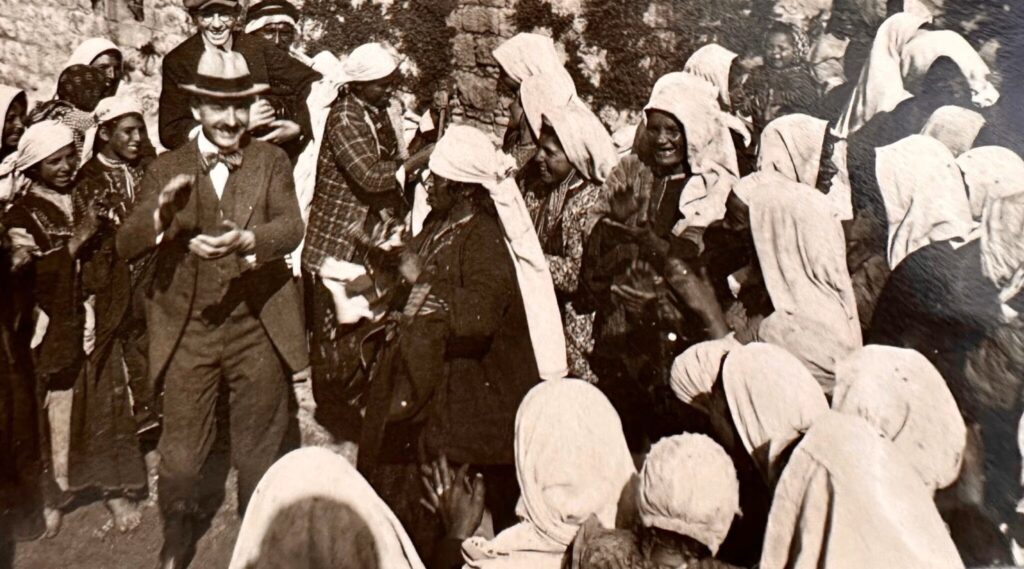
When discovering a long-forgotten photo album last year in his parents’ Montreal basement, Dr. David O. Freedman found nearly 100 pages of century-old pictures from his grandfather’s time spent in British Mandate Palestine.
The sepia images capture Jerusalem street scenes, market stalls and holy sites.
The photographs were not only a century-old and in near-perfect condition, but included figures who would later become central to Jewish medical and political history.
Among them were Israel’s future first president, Chaim Weizmann, Jerusalem ophthalmologist Abraham Ticho, malaria researcher Israel Kligler, future British prime minister Winston Churchill, and Herbert Samuel, Britain’s first high commissioner for Palestine.
A professor emeritus of infectious diseases at the University of Alabama at Birmingham, Freedman said he knew he “struck gold” when stumbling across the album, which was untouched for decades.
“I realized in disbelief I was looking at extraordinary images of Jerusalem,” he said.
Though Freedman said the album showed his grandfather’s “passion for skillful, impromptu photography,” it was the images of a site that epitomizes endurance that are having the broadest impact.
Freedman’s pictures of the Kotel, the Western Wall, has inspired a public appeal by the Tower of David Jerusalem Museum. The museum is asking people to look through their own old family albums and attics for photographs, postcards and other visual materials that could help expand the historical record of Judaism’s holiest site.
The request comes ahead of a major exhibition opening next year at the museum marking the 60th anniversary of 1967’s Six Day War.
Although the Kotel is now one of the most photographed sites on the planet, museum curators say the visual record of earlier decades remains surprisingly fragmented, with many of the most intimate images likely still tucked away in private collections and family albums.
“The Western Wall, the Kotel, in its simplest form, is a structure of ancient stones,” the museum’s director, Eilat Lieber, said in a statement. “Yet its true meaning has never resided in the stones alone — it has been shaped and elevated by the countless individuals who have stood before it over the centuries.”
Next year’s exhibition, titled “Eyes on the Wall” and curated by Dr. Shimon Lev and Yael Brandt, will be the first large-scale exhibition dedicated entirely to the Kotel, the museum said, and will trace its transformation over nearly two millennia.
It will be one of the major exhibitions staged by the Tower of David Museum since it reopened in 2023 after a $50 million renovation of its ancient citadel complex.
The wall — the exposed section of an ancient retaining wall around the Temple Mount, the site of the biblical Jewish temples — has long been Judaism’s most sacred places of prayer and pilgrimage.
From 1948 until the the Six Day War, when Israel captured the Old City and East Jerusalem from Jordan, Jews were barred from worshipping there.
Among its most iconic images was David Rubinger’s photograph of three Israeli paratroopers standing at the wall shortly after its capture, looking upward in a mixture of awe and disbelief. That photo of Israeli soldiers Zion Karasenti, Yitzhak Yifat and Haim Oshri was at the Kotel was taken 59 years ago this week.
David Freedman’s grandfather, Dr. Abraham Orkin Freedman, was a Canadian physician, Zionist activist and founder of Montreal’s Jewish General Hospital. He took his photographs before the holy site was so contested.
He arrived in Palestine in July of 1920 just as Britain was replacing military rule with a civil administration, and stayed until 1922, serving during that period as managing director of Hadassah Hospital.
David Freedman said the timing of the album’s discovery gives it much of its historical value, with photographs capturing people in the streets, as well as the terrain and buildings of Jerusalem during the nascent years of the British Mandate.
Among the images Freedman uncovered was a photograph of women praying side by side with men at the oldest part of the Kotel, a scene far removed from the gender-separated prayer sections at the site today.
The question of mixed-gender prayer at the Kotel remains politically charged, with a recent High Court order to advance the egalitarian section followed by Knesset moves to strengthen Chief Rabbinate control over prayer at the site.

After recognizing the album’s significance, Freedman met with family members, who decided collectively to give it to the Tower of David Jerusalem Museum for safekeeping, research and public access.
Freedman said his family is proud the album had found “a new home, not many meters from where my grandfather once stood.”
“Eyes On the Wall” co-curator Shimon Lev said he hopes the museum’s appeal will bring more discoveries like Freedman’s into public view, expanding the visual record of the Kotel beyond official archives.
“There is something profoundly moving in the moment when an intimate private photograph transcends its original purpose and becomes an important historical testimony,” he said.
Deborah Danan wrote this article for the JTA global Jewish media source.
Opposition leader Yair Lapid spoke at Thursday's Jerusalem rally, which drew 10,000 participants and 2,000 police officers.

The Jerusalem Orchestra East & West, which arranged the program for young musicians, blends Western orchestral music with Middle Eastern traditions.
A former college campus activist, Veksler will speak at Chizuk Amuno on June 8 at the Ruth and Jay Lenrow Visiting Scholar-in-Residence for Combating Antisemitism.
Spending on "hasbara" should be “like investing in jets, bombs and missile interceptors,” argues Israel’s foreign minister.