
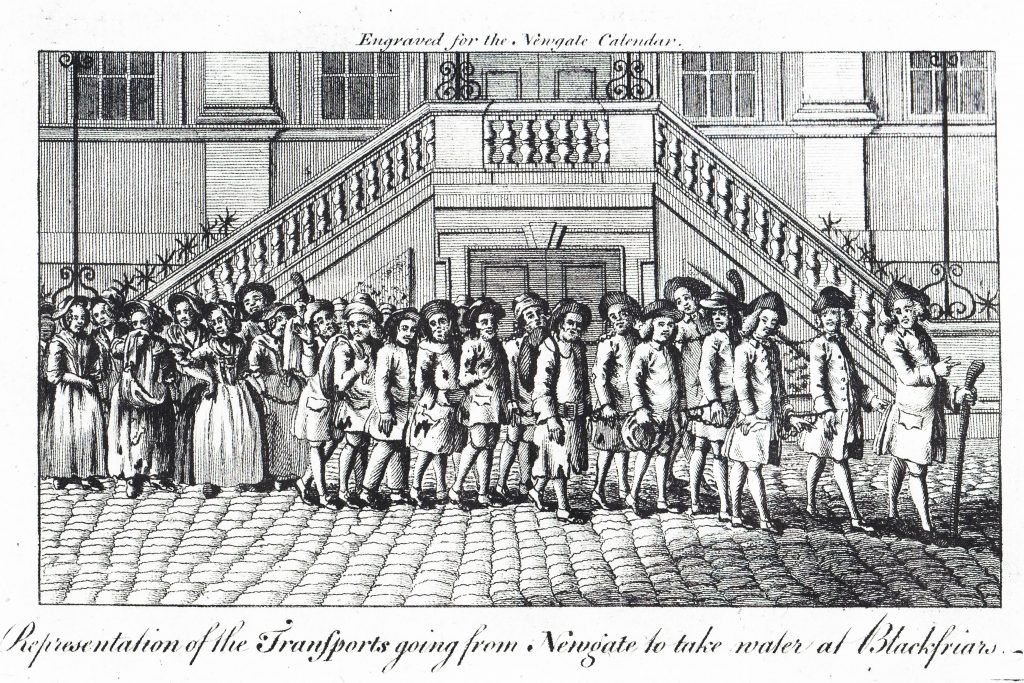
Recalling the mysterious case of Solomon Gabriel, the runaway ‘convict servant man.’
On July 2, 1764, a pair of men residing in what was then known as Baltimore Town placed a classified advertisement in the Maryland Gazette. Their “convict servant man,” Solomon Gabriel, had run away. They promised to give “whoever brings the said fellow back” a reward of 40 shillings, or if traveling more than 20 miles, five pounds.
The “said fellow” happened to be Baltimore’s first known Jewish resident. A London house painter, Gabriel had been sentenced to “transportation” for stealing a pocketbook. He landed in Baltimore in late 1763 and endured several months of servitude before running off.
Gabriel’s story was not unusual during that period. Until the American Revolution, felons convicted of non-capital offenses in Great Britain were regularly transported to the American Colonies, where they typically worked as servants for a term of seven years. The British convict population contained many Jews from London, and at least 250 Jewish malefactors were sent to Maryland and Virginia from around 1720 to 1775.
Often skilled in such trades as tailoring and metalwork, most Jewish convict laborers found themselves sold to masters living in urban settings, where such skills were in the greatest demand. Many fled before their period of servitude ended, usually to Philadelphia or New York, with the aim of returning to England.
So what exactly do we know about the man who, based on current research, was Baltimore’s first recorded Jew? A good deal, thanks to the Maryland Gazette advertisement.
A “thick well-set Fellow” of about five-foot three-inches, Gabriel had a “swarthy Complexion” and a “down Look.” His head of curly, sandy-colored hair was “almost bald on the Top.” Although an Englishman, Gabriel reportedly spoke “very good Dutch.” Though a painter by trade, he could pass as a butcher, in fact “a very good one.” The versatile Gabriel managed to abscond with two shirts (one white, one checked), two coats (one brown, one blue and paint-spackled), two pairs of stockings (one black, one brown), a pair of leather breeches, shoes with yellow buckles, and a narrow-brimmed felt hat.
Chances are that Gabriel never returned to Baltimore, so he doesn’t qualify as a founder of the city’s Jewish community. That would await more permanent settlers. But he is an important figure nonetheless, as representative of a class of people often overlooked in American Jewish history.
His status as Baltimore’s first identified Jew (to date) also speaks to the city’s history: Baltimore lagged behind most other East Coast seaports in attracting a significant Jewish presence because the town, though founded in 1729, didn’t really emerge as a commercial hub until a decade or so before the American Revolution.
Indeed, during the same year that Gabriel beat a hasty retreat, Moses Mordecai arrived in Baltimore — though his stay was brief. The merchant, who had sold buttons and belt buckles in Annapolis and Fredericktown (today’s Frederick), operated in Baltimore for a short time in 1764. Mordecai represented a coming wave of Jewish residents, as an improved business climate strengthened the city’s appeal to entrepreneurs.
Between 1760 and 1770, Baltimore went from an “obscure village” to “the most important center of Maryland’s trade,” as one historian notes. The city finally started to attract Jewish merchants such as Jacob Hart, who arrived in 1768 after emigrating from his native Bavaria. Benjamin Levy, scion of a prominent New York family, came from Philadelphia around 1770. By 1773, he was selling West Indian imports, wines and spirits, fancy groceries, and dry goods from a store on Market and Calvert streets.
From such roots would Baltimore’s Jewish community grow. But the Solomon Gabriels of the world should not be forgotten. The sandy-haired painter/butcher’s odyssey took him from London, the world’s most bustling metropolis, to a Baltimore just beginning to wake up — and from thence to parts unknown.
Such a journey was undertaken by many Jews even more anonymous than Gabriel. Fortunately, he made his mark in the historical record, enabling us to capture an otherwise lost story of Jews and of Baltimore.
Eric L. Goldstein and Deborah R. Weiner are co-authors of “On Middle Ground: A History of the Jews of Baltimore” (Johns Hopkins University Press).

As he gets ready to leave for California, Rabbi Daniel Cotzin Burg looks back on his time in Baltimore and his 10 years writing for Jmore.

Michael Olesker pays tribute to WJZ’s retiring Marty Bass, a longtime fixture on local TV screens.

The Orioles' weak defense plays a major role in the nightly carnage, writes Michael Olesker.