
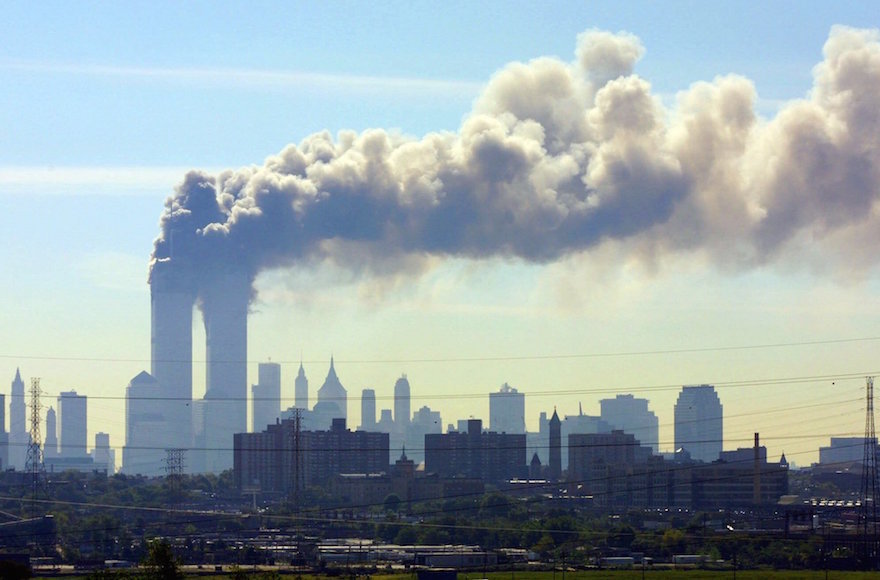
In the immediate aftermath of the terrorist attacks 20 years ago, I drove up to New York City and found myself utterly unprepared for the first evidence of the mass murders of Sept. 11, 2001.
I was still on the New Jersey Turnpike, somewhere around Jersey City, still miles before the tunnel into Manhattan. But I looked to my right, toward the distant spot where the twin towers of the World Trade Center had stood until a few days earlier.
In the sky above the destruction was the black cloud shown repeatedly on television. The cloud was a mix of chemicals and pulverized cement and metal and glass, the heavenly reminder of the mass grave below. But the television coverage hadn’t captured the full destruction — or the sheer, overpowering enormity of the cloud itself.
And I heard the sound of a voice coming from somewhere, screaming wildly. The voice turned out to be my own: pure reflex, involuntary, the shocked sound of the first comprehension of what had truly struck America.
And then it got worse.
In downtown Manhattan, people wandered about with dazed, haunted expressions on their faces and photographs of lost loved ones in their hands.
“Have you seen my husband?” they asked any nearby stranger. “This is his picture.”
“Have you seen my wife?”
“Have you seen my father?”
There were photos taped everywhere to windows and trees, to light poles and walls. There were identifying captions under these photos. And the captions said these people were missing. This was an expression of hope, unconnected to painful fact.
One of those “missing” was Vita Marino, who worked on the 104th floor of the second World Trade Center building.
Vita, 48, was married to my wife’s first cousin, Jonathan Dodge. They had two little girls, Monica and Claudia. When the first tower was hit, Vita called home to say she was all right. Outside her office window, the Statue of Liberty glistened in the morning sun. Vita said she would leave her building right away.
Then, before she could run to safety, the second terrorist plane arrived.
She was still officially listed among the missing when I reached New York three days after the attacks. But many in New York were now casting aside illusions of finding loved ones.
A city cop I interviewed on Canal Street said there were 70 names of police officers posted on a precinct wall. He knew about 50 of them. All were gone. A fireman said half of his company was wiped out.
Vita’s family held no illusions. I found Jonathan outside their apartment building later that afternoon.
“What can I say?” I muttered.
“Yisgadal, v’yiskadash,” he replied.
The opening words of the Mourner’s Kaddish, the final surrender to the reality that his wife of 18 years was gone.
America was just beginning to learn the new realities of life back then. We were warned to fear all incoming mail, which might contain traces of anthrax. We dealt with new security conditions at airports and government buildings. We entered two wars. One of them took nearly 20 years before we pulled out of it.
There’s another scene from New York that stays with me two decades later. I was walking through the park at Union Square, not far from the devastation. There was a statue of George Washington on a horse, with his arm raised as though leading a battle charge.
But people had chalked all over the horse: “Love, Love, Love.” Nearby were papier-mâché doves of peace. And someone had hung out a banner with a line from Gandhi: “Peace will not come out of a clash of arms but justice lived.”
Whether you agree with such sentiments in response to mass murder isn’t the point here: it’s that, in America, we value the debate itself. We’re not like those who flew the death planes and insist on one way of seeing the world, or else.
That black cloud over lower Manhattan eventually blew away. America remains. Those barbarians who ordered the death planes are still living in caves. Or lying in graves.
A former Baltimore Sun columnist and WJZ-TV commentator, Michael Olesker is the author of six books. His most recent, “Front Stoops in the Fifties: Baltimore Legends Come of Age,” was reissued in paperback by the Johns Hopkins University Press.

As he gets ready to leave for California, Rabbi Daniel Cotzin Burg looks back on his time in Baltimore and his 10 years writing for Jmore.
Michael Olesker pays tribute to WJZ’s retiring Marty Bass, a longtime fixture on local TV screens.

The Orioles' weak defense plays a major role in the nightly carnage, writes Michael Olesker.