
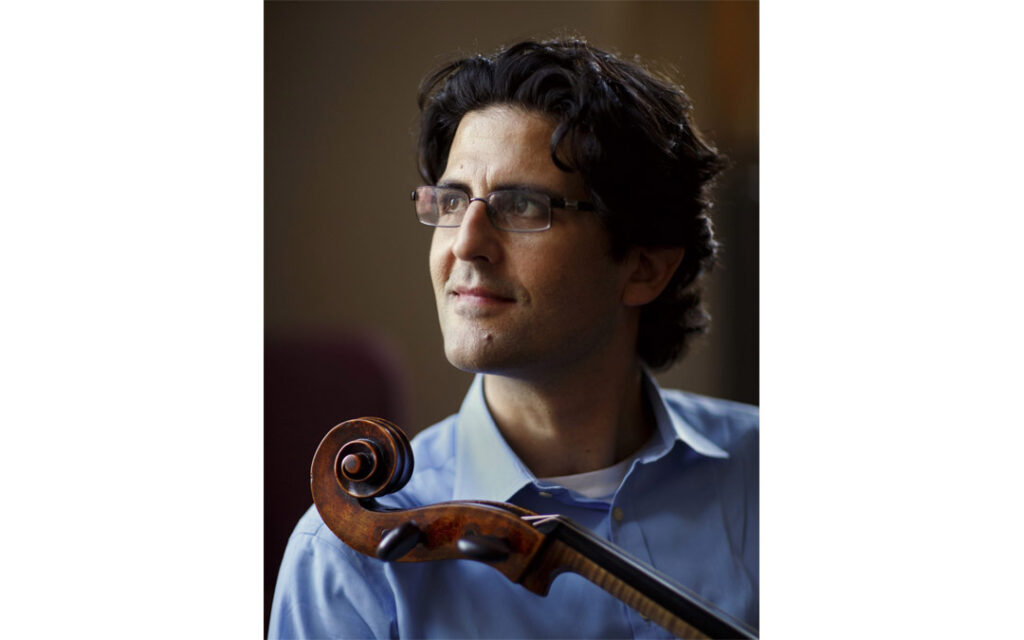
Sometime after the pandemic winds down, a lucky child in Baltimore City will likely become the recipient of a very special cello.
The cello, an 1850 German-made instrument from Czechoslovakia, was recently donated to Israeli-born cellist, teacher and conductor Amit Peled for his new program, “Every Child Deserves a Voice.”
The donors, Holocaust survivors Ned Spindel and his late wife, Shulamit Spindel, were determined that the cello — which belonged to Shulamit and survived the Holocaust with her — should be placed in Jewish hands and continue to make music into the future.
Peled, 49, a Pikesville resident and founder of Mount Vernon Virtuosi, a Baltimore-based chamber orchestra, says he was humbled when learning about the donation, which was facilitated by his friend Jaap van Wesel, a Dutch Jew who lives in Rockville.
Similarly, Van Wesel says he was “touched” when he heard Peled’s plans for “Every Child Deserves a Voice,” and thought the program would be a good fit for the donation.
“I wanted it not only because I’m Jewish and I play cello, but also because of the mission of the orchestra and what we can do with it,” says Peled, who founded Mount Vernon Virtuosi in 2018 with the goal of providing “the highest quality classical music possible” to the community at no charge.
“I really believe that it shouldn’t be [about] ticket sales,” says Peled, whose neighbors call him “the Jewish Yo-Yo Ma” because of the free outdoor community concerts he has played for them during the pandemic.
Peled also hoped the orchestra would create well-paying jobs to keep his talented students in Baltimore after they completed graduate school at the Peabody Institute of the Johns Hopkins University, where he has taught for the past 19 years.
“I didn’t want to let them go away with all this extraordinary talent,” says Peled. “When I started this, I thought, ‘You know, maybe I’ll do a concert or two.’ Now, it’s 2022, and we’re still alive and we have four or five projects every year.”
The orchestra’s success inspired Peled to do more. Recently, he expanded the orchestra’s offerings to include “Every Child Deserves a Voice,” a program that sends orchestra members into Baltimore City schools where they teach underserved children to play orchestral instruments.
“My musicians get paid to teach music to kids who normally would never even dream of playing,” says Peled. “Not only that but we also teach them for free and we provide free instruments.”
Just before the start of 2022, van Wesel, who was already scheduled to travel overseas, arranged to bring the cello to Baltimore from Israel, where the Spindels settled after the Holocaust. The instrument was beautiful but required restoration due to its age. So Peled visited Perrin & Associates Fine Violins in Mount Vernon, where the cello was restored.
Currently, the instrument is being used by Peled’s former graduate student Joseph Staten, a Peabody alumnus and principal cellist of the Mount Vernon Virtuosi. Although Staten is not Jewish, he was inspired to study with Peled after hearing him play “Prayer,” the first movement of Jewish composer Ernest Bloch’s 1924 piece, “From Jewish Life,” on YouTube.
Peled says that after the pandemic, the Spindel cello will probably be used by a young student in the program. And he acknowledges that the student may or may not be a Jewish child. But that’s really beside the point, he says.
“What I’m intending to do with the cello is not just to make sure that the person is Jewish but make sure that the cello is alive and playing and it’s under my wing. So, it could be a kid from a neighborhood here that doesn’t have money and will play,” says Peled.
“My mission is to keep the memory of the Holocaust alive. And it’s not necessarily to keep it alive with people who know about it. It’s [to teach] people who have no idea what it is and no idea what Judaism is,” he says. “If I can find an African-American kid that will never be able to afford cello lessons and may never even know about Judaism, maybe he’ll learn to play this cello and maybe to play [Bloch’s] ‘Prayer’ eventually and to know what the Holocaust meant. And maybe one day that kid will even have students and tell them what the Holocaust means. Through that, we continue [the Spindels’] legacy.”
The BCO, founded in 1984, will perform the works of Frank Zappa, Beethoven, Mason Bates and Karena Ingram.

For more than 130 years, Sol Levinson & Bros. has been woven into the fabric of Baltimore’s Jewish community.
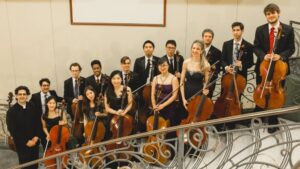
Led by local Israel-American cellist Amit Peled, the Mount Vernon Virtuosi aims to inspire people beyond musical enjoyment.
A former college campus activist, Veksler will speak at Chizuk Amuno on June 8 at the Ruth and Jay Lenrow Visiting Scholar-in-Residence for Combating Antisemitism.