
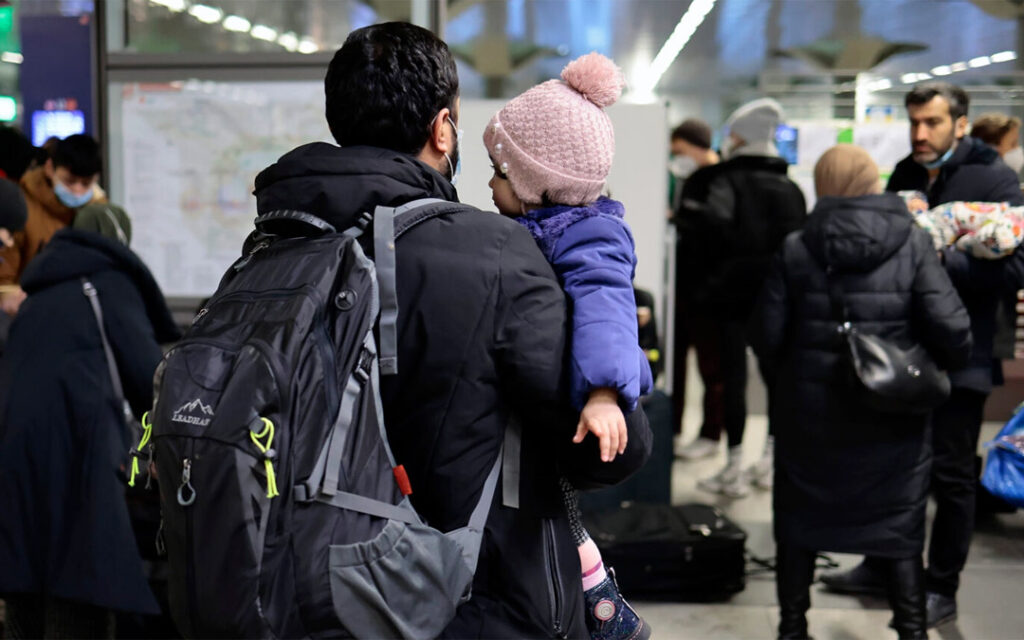
In the ruins of Ukraine, all humanity learns an unsettling lesson about itself: from the comfort of our living rooms, we can take it.
We’re learning that we can stomach almost anything from thousands of miles away, including the slaughter of innocents and the destruction of entire cities.
We can watch all of this and somehow not be ashamed of ourselves as fellow human beings.
But how?
How do we look in our collective mirror and realize we’re part of the same species as both the Russian barbarians and the desperate Ukrainians, and not want to ask ourselves, “Is this how far humanity has come from the era of cavemen?”
Now, we’re back at the entrance to the cave as the Russian madman Putin hints at nuclear possibilities. His words hold the world at bay.
Do we let his bluffs stand as the last word?
We all understand the thin line humanity walks between the ongoing horrors of Ukraine and the possibility of nuclear obliteration of all mankind.
So I’m not calling for America to begin exchanging bombs with Moscow. I’m only muttering, quite helplessly, about the grief we all feel over Ukraine and asking a question.
How long can we look into the faces of the suffering and the bodies of those sprawled in the streets of Ukraine and the mass graves, and not ask ourselves, “Is this the best we can do?”
Ukraine’s inspiring leader, Zelensky, reminds us of Churchill during the Nazi bombing of London. He begs the West for more weapons. Yes, by all means, give him more weapons as fast as we can, but knowing, even as we send them, that this prolongs the mass killing.
So we walk this tightrope because we know the darker options at risk. Send weapons, but stay physically uninvolved. One finger hovering over a nuclear button, and we risk the end of all life on Earth.
It’s the same option John Kennedy faced 60 years ago during the Cuban missile crisis.
The end of humanity itself hovered over every tick of the clock back then. But as the Soviet Union’s Nikita Khrushchev began covering Cuba with nuclear missiles, Kennedy said, Stop now. Turn back. Or we’re going to war.
He said this when going to war was considered a mutual suicide pact.
Just as it is today.
Putin knows this, just as Khrushchev knew it. Joe Biden knows this, just as Kennedy knew it.
But Kennedy was declaring, there are certain lines you cannot cross. Kennedy and Khrushchev would have gone one-on-one with the bombs.
But not Biden and Putin. Biden has the vast majority of the world’s population on our side — and Ukraine’s.
Putin has struggled to defeat outmanned, pitifully overmatched Ukraine. Does he really imagine he could take on the forces of every NATO nation?
How is it possible, after all this horror, that the line hasn’t been crossed where America, and our NATO allies, and every leader of nations with a conscience, can’t join in chorus and say, Enough.
Enough with the barbarism. Get out now, Putin, or we’re coming after you, all of us, with everything we have.
And Putin, still struggling with brave Ukraine, will have to decide, Is this the West issuing its own bluff? Do I really want to roll the dice and maybe face the military wrath of almost the entire civilized world?
Or does the civilized world — a world that has told itself “Never again” since the ashes of the Holocaust and World War II –continue watching the agony of innocents while we ask ourselves, Is this the best we can do?
Michael Olesker’s newest book, “Boogie: Life on A Merry-Go-Round,” will be published this spring. It’s the life story of Baltimore legend Leonard “Boogie” Weinglass, an original “Diner” guy who grew up to create the Merry-Go-Round clothing chain and donate millions to charity.

As he gets ready to leave for California, Rabbi Daniel Cotzin Burg looks back on his time in Baltimore and his 10 years writing for Jmore.

Michael Olesker pays tribute to WJZ’s retiring Marty Bass, a longtime fixture on local TV screens.

The Orioles' weak defense plays a major role in the nightly carnage, writes Michael Olesker.