
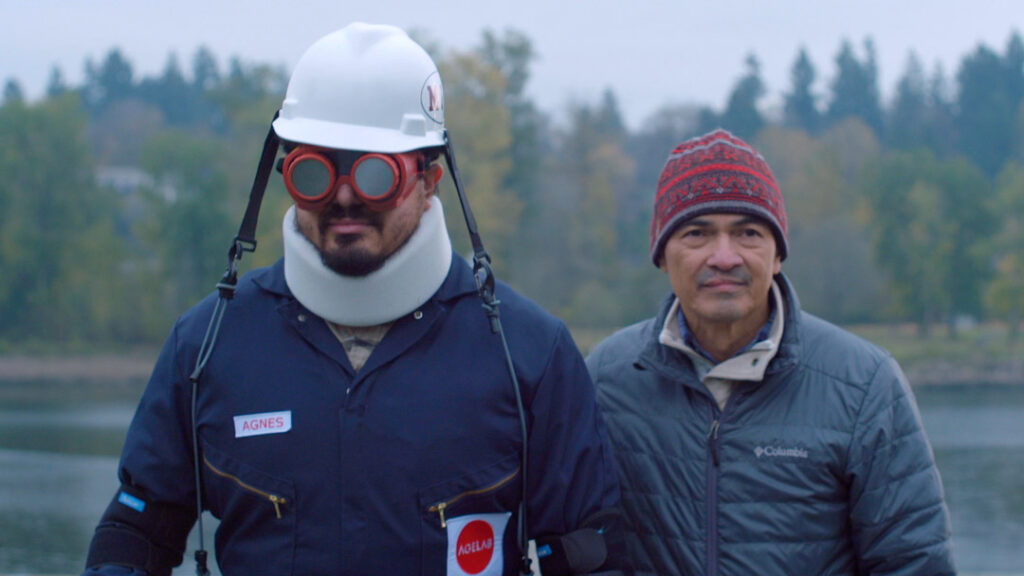
What would you say if you could meet yourself in the future?
Next Tuesday evening, March 1, AgeWell Baltimore will host the virtual program “Look Into Your Future,” featuring a screening and live-panel discussion of the award-winning documentary “Fast-Forward.” Narrated by actress Rosario Dawson, the 2021 film follows adult children and their parents as they “travel through time” to meet their future selves and face the consequences of aging.
A new initiative of The Associated: Jewish Federation of Baltimore and its constituent agencies, AgeWell offers older adults, their family members and caregivers comprehensive and easy access to more than 40 community resources and programs through one main network.
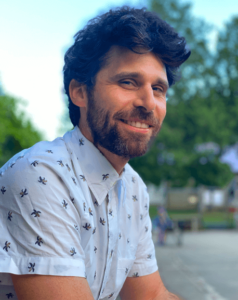
Jmore recently caught up with Michael Eric Hurtig, 39, the New York-based director of “Fast-Forward,” to discuss the film and upcoming panel discussion.
Jmore: In ‘Fast-Forward,’ participants simulate their future by using an MIT-developed aging suit. What interested you in this particular topic?
Hurtig: As a filmmaker I’ve long been fascinated with the narrative of time travel, the idea that you can travel into the past or future and bring back some special knowledge.
Once we came across the AGNES [Age Gain Now Empathy System] aging suit, I realized that as a documentary filmmaker, I could use this tool in a novel way to address the topic of aging.
While researching films in this subject area, we saw many beautiful films — very well-made and extraordinary, but a lot of them very difficult to watch.
Why?
Because nobody wants to think about aging. So we tried our best to create something a little more palatable, something bright and fun that could transcend the topic.
We also wanted to create a hybrid documentary/reality TV feel for the film because a lot of audiences are watching reality TV these days. In the film, we placed people in artificial situations — like putting people into the aging suit or having a participant go to an exercise class — that have a more reality TV feel. It’s a documentary with a different style, a broad piece meant to give people a more holistic perspective on somewhat difficult topics.
One point raised in the film is that social isolation is a huge risk factor for those in the aging population. In light of the pandemic, do you feel that message is more important than ever?
We wanted to create a film that was evergreen, so you could watch it now and then again in five years, and it would still be relevant, even if there would be changes to the health care system or medicine.
I had an interesting conversation with Ellen Goodman, one of the experts featured in the film. She talked about how older adults are one of the nation’s greatest resources. They have experience and wisdom to contribute. But they are being asked to stay away, stay home because they’re the most vulnerable.
At the same time, given their experience and what they have lived through, these older generations have an added resilience that younger people might not have, despite the effects of isolation and other negative effects.
This is one of the important things about ‘Fast-Forward,’ showing viewers it’s not all gloom and doom, because generally when people look to the future they focus on the negative. But you don’t necessarily become older and turn into a cranky person.
One of the experts in the film mentions that what’s unspoken between parents and their adult children can lead to further challenges once the parents start aging.
Younger people have told me after they have watched the film that ‘it made me want to call my parents and talk to them about this.’ Or parents have said, ‘I tried to talk to my kids about this stuff and they don’t want to talk about it because they think I’ll be here forever.’
I think the film is good at demonstrating how there can be different paths to different conversations that can be easier and more akin to the feeling of ‘What do you want for lunch?’ than ‘What are your greatest wishes for the end of your life?’
I think that’s one of the cool things about the film. We cover so many different topic areas. There are many different ideas and there are different approaches required for different kinds of relationships.
I was struck by the variety of health care and intervention staff involved in the film. There seems to be a great diversity in the kinds of support available. Was one of your goals to educate people about the kinds of support out there for the aging population?
We tried to tailor each person’s story to offer a diversity of perspectives. At one point, we had considered doing the film with all the families together. But by traveling and finding local resources, we ended up with such a diversity of perspectives and resources.
I think it was tantamount to giving everybody an immersive, 360-degree experience of all the different touchpoints, which is so hard because aging is so complex.
The 2020 Greater Baltimore Jewish Community Study found approximately 56% of our community are over the age of 50, and 26% over the age of 65. What do you hope the film’s message will bring to the Baltimore community?
I think it’s this idea that there’s this network of people working together to help everyone age together. It’s not just about having a conversation with your own family or the people who might support you as you age. It’s about building stronger community connections around the idea that we’re all doing this together.
What about your perspective has changed since creating the film?
I think that it showed us that once people can be engaged about aging in a way that isn’t all doom and gloom, they can have strong positive reactions to it As far as my personal perspective, it really helped me understand how straightforward some of these considerations can be. It made it easier to have these conversations in my own family, and I know that my parents appreciated that I approached it in a way that didn’t have to be filled with anxiety.
What are you most excited about in partnering with Baltimore’s AgeWell?
I think what’s particularly exciting is that AgeWell is a distillation of everything we try to show in the film. They have a holistic approach, and their values and approach are directly in line with what we are talking about and featuring in the film.
Register to attend the” Fast-Forward” screening at associated.org/event/agewell-baltimore-presents-look-into-your-future. For information, visit agewellbaltimore.org or call 410-500-5328.
Hanni R. Werner is a Baltimore-based freelance writer.
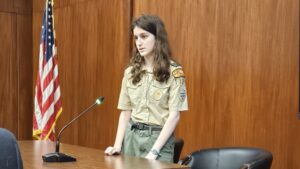
For Beth Tfiloh senior Ada Key, earning the Eagle Scout rank is about giving back and paving the way for girls in scouting.
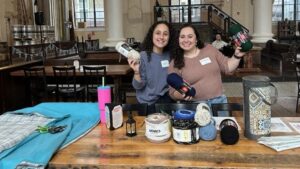
At Knit & Nosh, one of several VolunTeams run by the Macks Jewish Connection Network, young adults get together to knit scarves and hats for neighbors experiencing housing insecurity.
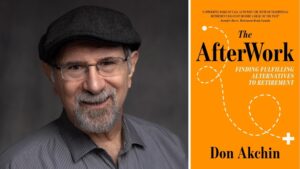
With his new book "The AfterWork," Akchin explores finding fulfilment and meaning after concluding one's professional career.
At the Community College of Baltimore County (CCBC), a growing number of students are discovering that higher education can be far more affordable than they imagined -- and in some cases, completely tuition-free.