
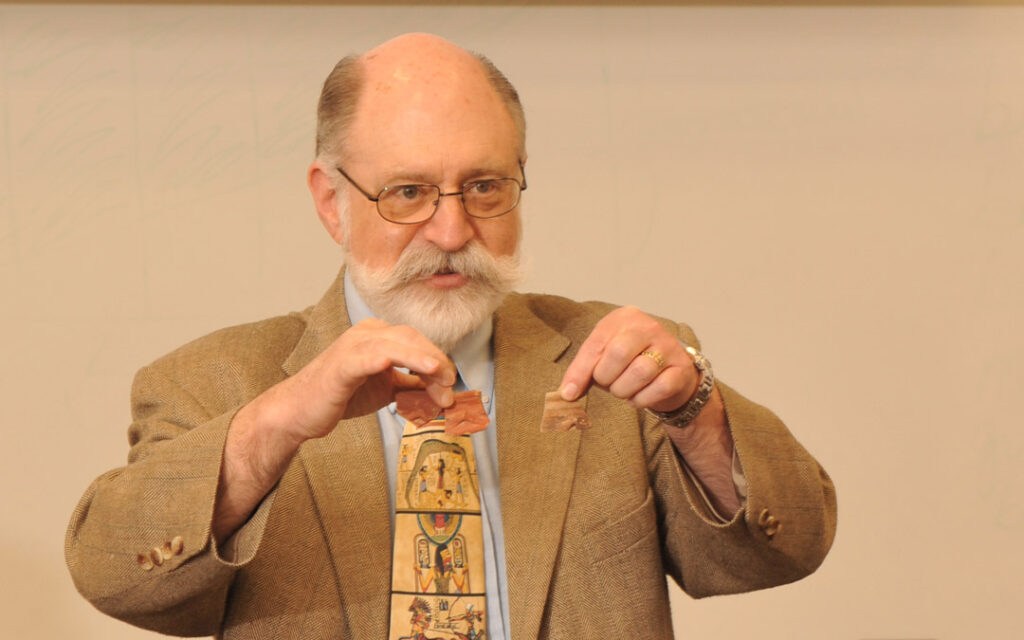
Quick multiple-choice question: which of the following describes Dr. Barry M. Gittlen?
A) Beloved and respected Baltimore Hebrew Institute at Towson University professor of biblical and archaeological studies;
B) World-renowned archaeologist;
C) Singer in Chizuk Amuno’s Kol Rinah congregational choir;
D) Retiree after 50 years of teaching;
E) All of the above
If you chose E, you are correct. And if you knew that Dr. Gittlen would rarely, if ever, give a multiple-choice test, you’re also correct.
Over the course of his long and distinguished career, Dr. Gittlen received the Baltimore Hebrew University President’s Award and was named BHU’s most popular professor. As an archaeologist, he has spent much of his professional life in search of ancient Canaanites, Israelites and Philistines at Tel Miqne-Ekron, Tell Jemmeh and other sites.
In addition to his long-term positions at BHU and Towson, Dr. Gittlen has taught at Goucher College, Ben-Gurion University of the Negev and the University of Maryland, Baltimore County.
BHI at Towson recently honored Dr. Gittlen, 79, for his half-century of teaching. The program at Chizuk Amuno Synagogue in Pikesville featured Dr. Eric H. Cline, professor of classical and Near Eastern studies at George Washington University, as well as a performance by the Kol Rinah Choir.
Jmore recently spoke with Dr. Gittlen, a Pikesville resident, in between packing up his Towson University office and heading out to his final faculty meeting.
Jmore: Why are you retiring now?
Dr. Gittlen: My family’s been after me to retire for years. I’d been thinking I’d retire at 80 but I’ve now completed 50 years of teaching, and 50 is a nice round number.
What will you miss the most?
I’ve had terrific students, and I’m sorry I won’t be around to see the current students finish their degrees. This semester, I had three classes that I love, a mix of non-majors and students I’ve had before.
I’ll miss my colleagues, and the staff across the university has always been so helpful — people in the library and the bookstore, student services, building maintenance.
You teach courses involving religion and faith. Do students ever object to your course content on the basis of their own spiritual and theological beliefs?
Occasionally, students — most recently in my ‘Genesis as Literature’ class — bring with them strong religious views that make them resistant to the course material. And I say to them, ‘I’m not asking you to deny or ignore your theology. I am asking you to put your religious beliefs in a box and put the box aside for the duration of this course. When we finish, you can throw away this new box that you got from this course, or maybe you’ll want to integrate parts of it into the box that contains your religious beliefs.’
And that approach usually works well.
You light up when discussing archaeology. What do you find so appealing about it?

Archaeology is one tool in the toolbox that helps us understand people. Contrary to popular opinion, we’re not ‘treasure hunters.’ I’m interested in historical, archaeological and literary approaches to understanding the Hebrew Bible, the Old Testament, in its ancient contexts. That includes daily life in ancient Israel, as well as Canaanite, Israelite and Philistine civilizations and their interconnections.
One way to understand those people and their motivations is to look at the archaeological remains. We know, for example, that those battles between civilizations or tribes that the writers of the Bible reported as expressing the pleasure or displeasure of God were really about economics, politics and geography, exactly the same as today.
In addition, working an archaeological dig during an Israeli summer provides the best whole body workout and weight loss plan there is.
You teach on Towson’s campus. Without taking your students to an actual dig, how do you make archaeology real to them?
I show them a lot of pictures and tell them about my own experiences. But one particularly effective assignment is ‘The Archaeology of Me.’ Each student takes and presents a series of photographs that move from an extreme closeup of something that’s important to them to increasingly wider shots that give more information about the thing itself and also a better sense of the context in which it occurs.
That’s exactly the way an archaeological dig works. You find a small item and then slowly and meticulously dig out from there to learn more about the environment in which that item existed.
What’s on your retirement agenda?

There’s a lot that I still want to write, including excavation reports and material about issues and problems that arose during digs. So I’ll be working on that.
I’ll maintain my membership in various scholarly organizations and continue to attend their conferences, but I’ll leave the leadership of those organizations to younger people who will benefit from the experience and the academic status it bestows. And I’ll still take on occasional speaking engagements.
I’ll probably spend some time at Tel Miqne and maybe some other dig sites, but I probably won’t be as hands-on as I was in my younger days.
In the short term, after I turn in my grades and clean out my office, instead of sitting on a hotel balcony looking out over the Old City of Jerusalem or standing in the tiny bucket of a crane high above the Tel Miqne dig, I’ll sit on my condo balcony with a cigar and a glass of my favorite Widow Jane bourbon and look out over Pikesville — dense woods as far as the eye can see. Trees and sky, it’s beautiful.
Contributions made in honor of Dr. Gittlen’s retirement will be designated for scholarships to students earning graduate degrees in Jewish studies or Leadership in Jewish Education and Communal Service.
Jonathan Shorr is a local freelance writer.
A Baltimore native and Pikesville resident, Freedman had the distinction of being the longest-serving employee in the history of the State of Maryland.

House Bill 661 is the culmination of a collaborative effort led by Del. Sarah S. Wolek (D-16th), Del. Jared S. Solomon (D-18th) and Sen. Shelly L. Hettleman (D-11th).

More than 100 Broadmead residents and team members recently gathered to celebrate the festival of Passover with a meaningful seder dinner.

Journalists bear a responsibility to go beyond the headlines and social media posts to understand the past and present, writes New York University student Lucia Alonso.