
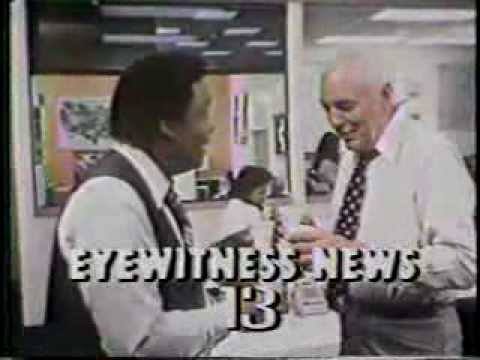
If Jerry Turner were alive today, he’d know what to say to Kari Lake. Get out of politics while you can, lady. Running a whole state is tougher than reading news from a TV teleprompter.
Turner, as longtime Baltimoreans remember, was the news anchor at WJZ’s “Eyewitness News” for about a dozen triumphant years before he died in late December of 1987.
Lake, as millions across America have learned, was a news anchor on Arizona TV stations for about two dozen years. Then she decided to run for governor of that state.
As this is written, she’s trailing her opponent, Democrat Katie Hobbs, by about 30,000 votes as the counting goes on and on and …
Good Lord, will it never end?
In his heyday, Jerry Turner was arguably the most popular local TV anchor in America. He was so popular, in fact, that serious political operatives sat him down one day and urged him to run for office.
They knew Turner’s was a voice of authority around here.
But Turner knew the difference between “voice” and “authority.”
Since she retired a year ago to take up her run for governor, Kari Lake has become a voice of anger, divisiveness and cruelty.
Buying into Donald Trump’s lies about fraud in the 2020 presidential election, and then trumpeting it relentlessly, Lake has more recently taken on tones of sheer cruelty.
What kind of person mocks Nancy Pelosi’s vulnerability in the immediate hours after the vicious attack on the Speaker of the House’s 82-year-old husband, Paul?
What kind of person declares an anti-vaccine stance at the height of the COVID epidemic? Or claims the Capitol Hill rioters aren’t being treated fairly? And declares Joe Biden’s Inauguration Day a “national day of mourning and protest”?
What kind of person?
Someone who spent a few decades reading from a TV news teleprompter and imagines such work made her an authority on politics and government.
It doesn’t, as Jerry Turner could have told her.
In his heyday, Turner was an earth force around here. WJZ’s news ratings were higher than the combined numbers of its network opponents. TV/Radio Age named Turner the No. 1 local anchor in America. Advertising Age called him the most dominant individual on any newscast in America.
But he never forgot who he was and what he was doing.
As former “Eyewitness News” producer Paul Gluck once put it, “Jerry never had any sense of self-importance, the thing that distances celebrities from other human beings. He wasn’t the Pope moving through the masses, he was Jerry bopping through the crowd.”
All of which drew political movers and shakers to him.
Turner chatted about it one night in his little office, just off the WJZ newsroom. He said he’d been approached by officials in the state’s Republican Party, who talked about his name recognition, about community trust. They were a little hazy on the precise office they wanted him to seek.
“They said, ‘You get elected, and this guy becomes racing commissioner,’” Turner said. “’And this guy gets the liquor board position.’ On and on, like that. I was just the front man for all their moves.”
“What did you say?” I asked Turner.
“I said, ‘I don’t feel comfortable with any of this.’ And I got up and walked out. Isn’t that awful? You know, I’d probably win. And the thing is, I don’t know anything. I mean, what the hell do I do? I sit up here and look into the camera and read the news. But that’s all I know. And that’d be enough.”
I scribbled Turner’s words on paper a few minutes after he said them, and tucked them away.
I wish Kari Lake could have heard them. Politics is about more than popularity. It’s about public policy, it’s about putting together the complex details of how the country will be run, and it’s about finding common ground.
We’ve had enough of TV personalities pretending they understand this. Goodbye, Donald Trump. Goodbye, Dr. Oz. And maybe, if we’re lucky, goodbye to Kari Lake, who could have learned a few things from Jerry Turner.

Michael Olesker’s latest book, “Boogie: Life on A Merry-Go-Round,” was recently published by Apprentice House. It’s the life story of Baltimore legend Leonard “Boogie” Weinglass, an original “Diner” guy who grew up to create the Merry-Go-Round clothing chain and contribute millions to charity.

House Bill 661 is the culmination of a collaborative effort led by Del. Sarah S. Wolek (D-16th), Del. Jared S. Solomon (D-18th) and Sen. Shelly L. Hettleman (D-11th).

Journalists bear a responsibility to go beyond the headlines and social media posts to understand the past and present, writes New York University student Lucia Alonso.
The Trump administration's invoking of religion is reminiscent of the words and actions of one of history's most brutal Crusaders, writes Michael Olesker.

Like thousands of communities around the country last weekend, Pikesville demonstrated its disgust with the policies of the Trump administration, writes Michael Olesker.