

This story was sponsored by and produced in partnership with The Charles Bronfman Prize, an annual prize presented to a humanitarian whose innovative work fueled by their Jewish values has significantly improved the world. This article was produced by JTA’s native content team.
By Eve Kessler
Jared Genser has extracted hostages and political prisoners from some of the world’s worst regimes and dictatorships, usually in one-off deals following years of negotiation and on a rare occasion involving large sums of money.
But Genser, a Washington, D.C.-based international human rights lawyer, says he’s concerned that piecemeal dealmaking with rogue actors simply encourages more kidnappings. So Genser is proposing a new multilateral approach to fighting hostage-taking by nations like Iran, Russia, China, Venezuela and Syria: a pact, like Article 5 of the NATO treaty, that would pledge signatories to taken collective action, including targeted sanctions and diplomatic pressure, against hostage-taking countries.
“The only way you can disrupt hostage-taking is to create dramatically draconian disincentives, up front and in advance,” said Genser, 51. “Once a hostage has been taken, it’s too late.”
Genser’s insights about hostage dilemmas are particularly salient given Israel’s current predicament. More than 230 hostages from Israel were taken captive into Gaza during Hamas’s Oct. 7 attack, and over 130 are still being held following hostage releases in November.
While Genser is not involved in the efforts to free them, his assessment is that Israel’s hostage situation is much more complicated than the state-sponsored extortion with which Genser regularly deals.
For one thing, Gaza is an active war zone. Additionally, the number of Israeli captives is tremendously high; some are presumed dead and those still alive likely are being moved from place to place. On top of it all, dealing with non-state actors such as Hamas is very different from dealing with states, according to Genser.
“You don’t have the same levers or capabilities to influence their behavior,” Genser said. With the fighting in Gaza “dramatically overshadowing everything,” he added, it’s “difficult to maintain a focus on the need to recover the hostages.”
Some things remain true, however, whether the abductor is Hamas or Iran, said Genser, now managing director of the public-affairs law firm Perseus Strategies.
“Rogue nations must be convinced that they will face severe consequences” for hostage-taking, Genser wrote in The Wall Street Journal in an opinion piece detailing his argument for a multilateral approach to fighting hostage-taking.
“If there are 50, 60, 70 countries threatening disproportionate consequences,” Genser said, rogue nations may conclude, “Well, maybe I need to move to a different strategy.’”
As things stand, Hamas calculated that it had much to gain from taking captives. In 2011, Israel freed more than 1,000 security prisoners in exchange for one Hamas-held captive, Israeli soldier Gilad Shalit. Many, including Genser, believe that deal only incentivized Hamas to take more hostages.
Genser has ample experience dealing with Islamist extremists. Last September, Genser helped free a U.S. citizen held for years in Iran’s notorious Evin Prison: Siamak Namazi (his father, Baquer Namazi, was also held hostage and freed in 2022). The son, an international business consultant from a prominent family in Shiraz, Iran, was jailed in 2014. His father, who had been living abroad, was lured back to Iran in 2016 with a promise to see his son and then was imprisoned, too.
Over the course of more than two decades, Genser has helped free 341 political prisoners, and he has been referred to by The New York Times as “The Extractor” for his success in liberating political prisoners.
Genser represents most of these clients pro bono and with the help of Freedom Now, the human rights advocacy group he established two decades ago to advocate for prisoners of conscience. Freedom Now takes up their cases at the United Nations Human Rights Commission, gives them legal suppor and advocates on their behalf in the press. Among the famous political prisoners on whose behalf Freedom Now has worked is Chinese democracy activist and Nobel Peace laureate Liu Xiaobo.
In 2010, Genser was honored by The Charles Bronfman Prize for his work to free prisoners of conscience worldwide. The prize was established in 2004 by the children of Canadian philanthropist Charles Bronfman — Ellen Bronfman Hauptman and Stephen Bronfman together with their spouses Andrew Hauptman and Claudia Blondin Bronfman — and is given to a Jewish humanitarian under the age of 50 whose work is grounded in Jewish values and benefits humanity universally.
Last September, Genser’s firm partnered with the REFORM Alliance, which works to change laws, systems and culture around probation and parole, to support the government of Costa Rica in presenting a joint statement from 74 countries on the importance of social reintegration of the formerly incarcerated as a matter of international human rights. The idea is to create global standards around measures needed to reintegrate formerly incarcerated individuals into society — including help with jobs, education, healthcare and housing. Interestingly, Genser said, both Israel and Palestine signed onto that statement.
Looking ahead, Genser said, Israel’s government has some tough decisions to make given the failure to date of its military campaign to free the hostages.
“At the end of the day, you need to cut a deal directly with the terrorists,” he said. “That means having to make very, very difficult and unpalatable choices.”
This story was sponsored by and produced in partnership with The Charles Bronfman Prize, an annual prize presented to a humanitarian whose innovative work fueled by their Jewish values has significantly improved the world. This article was produced by JTA’s native content team.

More than 100 Broadmead residents and team members recently gathered to celebrate the festival of Passover with a meaningful seder dinner.

Journalists bear a responsibility to go beyond the headlines and social media posts to understand the past and present, writes New York University student Lucia Alonso.

Despite security challenges and limited flights, hundreds have made aliyah in 2026.
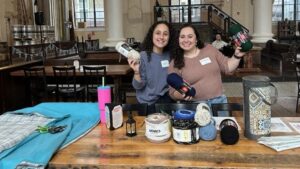
At Knit & Nosh, one of several VolunTeams run by the Macks Jewish Connection Network, young adults get together to knit scarves and hats for neighbors experiencing housing insecurity.