
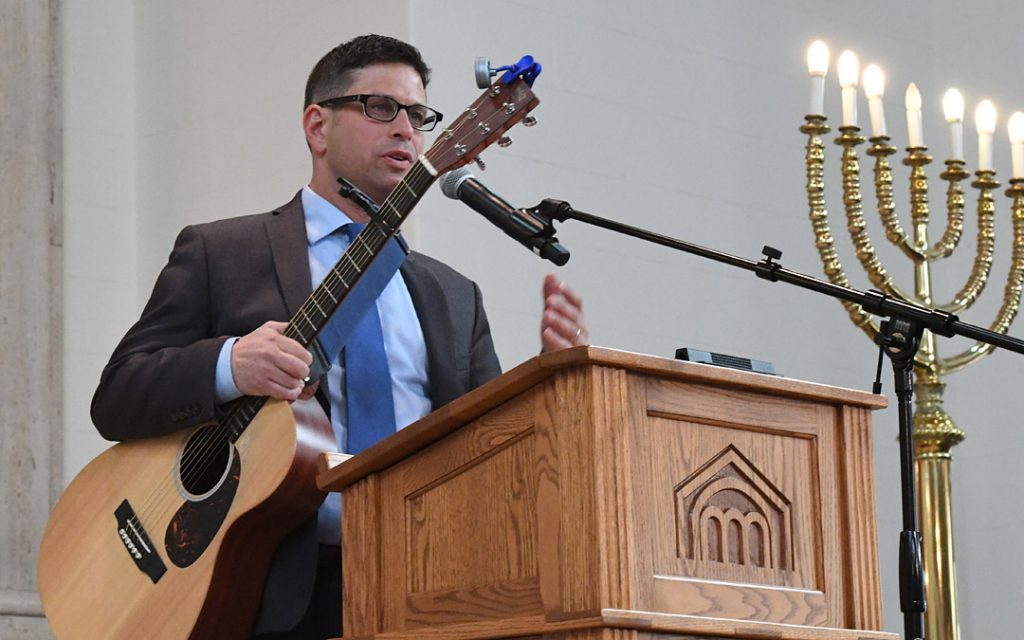
Purim in March of 2020 was a raucous affair at Beth Am. Our sanctuary was filled with participants listening to the Megillah, performing in and laughing along with the spiel, eating and drinking with merriment. The carnival that year packed our social hall with costumed children running around to various activities, completing social action projects and throwing whipped cream pies at yours truly.
Soon after Purim, the shul shut down, the world shut down. In the intervening months and years, we relied on technology to convene, interact and pray virtually, in-person gathering difficult to achieve.
It will be years, maybe decades, before we fully appreciate the impact of COVID-19, but one of the many datapoints will be the unraveling of social fabrics, the pernicious effects of long term physical separation from our fellow human beings.
Jewish tradition understands holiness as a communal enterprise. We require 10 Jews present to recite certain prayers that invoke the divine name. Some modern halachic (legal) authorities have permitted virtual minyanim (prayer quorums), but these have been accommodations for the sake of accessibility (and safety during the pandemic).
As we’ve returned to more normative in-person gatherings, all the things we used to take for granted — the embrace of a friend, singing in harmony, the stimulating buzz of a teeming bar or coffee shop — tickle our brains and awaken our souls to the power of three-dimensional interconnectedness.
I recently watched the wonderful 2016 documentary “Citizen Jane: Battle for the City.” The film details the confrontation between two mid-20th-century giants: New York city planner Robert Moses and acclaimed author/citizen-activist Jane Jacobs. Moses spent decades on a crusade of urban renewal, literally and figuratively bulldozing tenements and neighborhoods to impose top-down shiny but soulless solutions to urban problems.
Jacobs fought him every step of the way, rallying mass opposition to potentially devastating projects like the extension of Fifth Avenue through Washington Square Park and a Lower Manhattan Expressway, which would have eviscerated SoHo.
Moses thought of crumbling buildings and poverty as a cancer to be carved out. Jacobs understood the evolution of vibrant and healthy cities needs to honor the diversity of people who live there and their ability to interact.
“Under the seeming disorder of the old city, wherever the old city is working successfully, is a marvelous order for maintaining [safety and freedom],” she wrote in “The Death and Life of Great American Cities.” “This order is all composed of movement and change. … We may fancifully … liken it to the dance. … The ballet of the good city sidewalk never repeats itself from place to place, and in any one place is always replete with new improvisations.”
Recently, my wife and I took a long Shabbat afternoon stroll with a friend. We ran into congregants and neighbors sitting on stoops, walking the sidewalks, kids riding bikes in the park. Some people we knew. Others we did not. “[Cities] are not like suburbs, only denser,” writes Jacobs. “They differ from towns and suburbs in basic ways, and one of these is that cities are, by definition, full of strangers.”
Jacobs understood the need for people to be physically close. Robert Moses was not her only contemporary who lacked this understanding. Sixty years ago, famed author and futurist Arthur C. Clarke predicted the city of tomorrow: “It will be completely different. In fact, it may not even exist at all. … [Breakthroughs in communications] will make possible a world in which we can be in instant contact with each other wherever we may be. … It will be possible in that age, perhaps only fifty years from now, for a man to conduct his business from to Tahiti or Bali just as well as he could from London. … When that time comes, the whole world will have shrunk to a point and the traditional role of the city as a meeting place for man would have ceased to make any sense. … ”
Clarke thought cities would be replaced with a “global village.” In many ways, he was right about the staggering effects of communications technology. He predicted some version of the internet, among other things. But Clarke was profoundly misguided when it came to the “traditional role of the city.” The fact that we can communicate from anywhere with anyone doesn’t mean we lack a need for physical proximity to other people. We learned this the hard way from COVID. Long before that, Jewish tradition demanded we gather three times a day to utter God’s name.
At the time of this writing, we are a few days from Purim 2024. I expect Beth Am to be full once again. Our Purim spielers are nearly ready to perform. (Yes, it will be streamed for those who cannot get to shul.) The balloons for the carnival have arrived. Holiness will abound in the laughter and merriment of young and old. Perhaps the festivities will spill out onto the sidewalks of our neighborhood. Let the great dance begin!
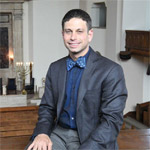
Rabbi Daniel Cotzin Burg is spiritual leader of Beth Am Synagogue in Reservoir Hill. This column and others also can be found on his blog, The Urban Rabbi.
Journalists bear a responsibility to go beyond the headlines and social media posts to understand the past and present, writes New York University student Lucia Alonso.
The Trump administration's invoking of religion is reminiscent of the words and actions of one of history's most brutal Crusaders, writes Michael Olesker.
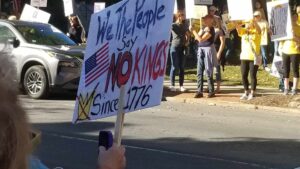
Like thousands of communities around the country last weekend, Pikesville demonstrated its disgust with the policies of the Trump administration, writes Michael Olesker.

Michael Olesker bids farewell to CBS News Radio, one of the most storied media outlets in history.