
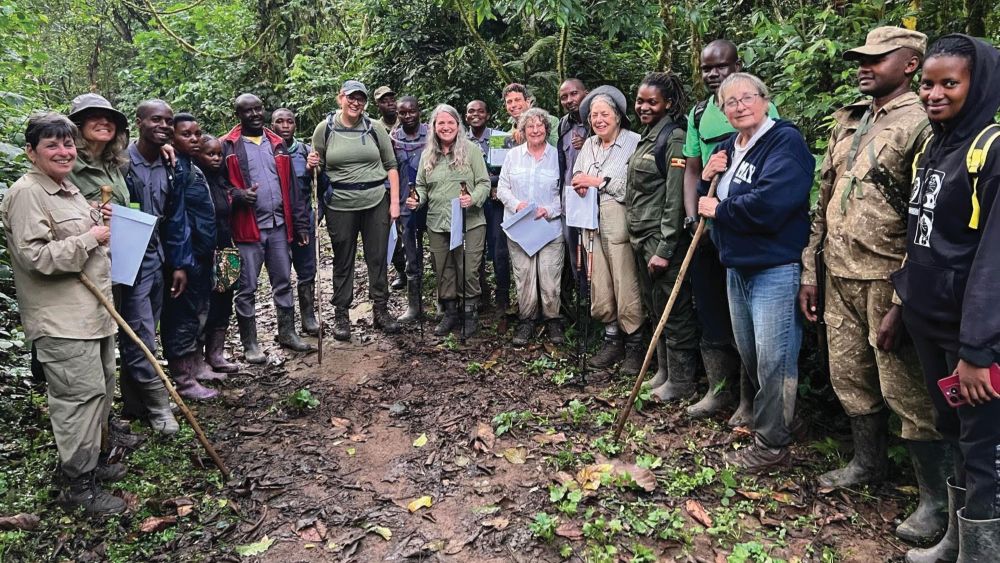
Last month, a group of us spent a magical Shabbat with the mountain gorillas of Bwindi National Park. We began the previous week with 19, praying and singing with the Abayudaya, the Jewish community of Uganda.
By the following weekend, 11 had returned home to Baltimore and eight of us continued on to the Buhoma Community Rest Camp in Bwindi, on the edge of the Impenetrable Forest. It was like a dream — a verdant façade confronted us across the valley, a vertical Tolkienian landscape of ferns and twisted vines, Ceiba and Cecropia, towering old growth mahogany.
We settled into our rooms, then circled up for Kabbalat Shabbat, candle-lighting and a homecooked meal of pumpkin soup, tilapia, chickpeas in a curry sauce, and boiled potatoes. Saturday morning, we walked into the bush and ascended 1,000 meters (well over 3,000 feet). Aside from our tour company owner, guides and porters, I, at 49, was the youngest of our Beth Am delegation. The oldest was 81. With varying degrees of assistance, we all made the climb.
The heavy rains came around 3.5 hours. We scrambled to pull ponchos over our heads, stepped over streams of fire ants, squatted on logs under the vast tree canopy — a quick Shabbat lunch while Fiona, the local ranger, went ahead to coordinate with our trackers. Finding gorillas is common, but not a given. They are wild and travel where they will. We were Shabbat guests in their home.
But find them we did. Around hour 5, we lowered our voices and donned surgical masks, a jarring reminder of the recent pandemic and also that we share over 98% of our DNA with the largest of the great apes, making disease transmission a danger to both species. For a full hour, we stood silently, surrounded by some 15 gorillas. We observed mothers nursing their babies, a one-year-old noodge his older brother as the latter laughingly attempted to beat his chest, all while the majestic silverback sat silently on a rise, arms crossed, watching over his family.
Some members of our group were Shabbat-observant. Others took photographs. For me personally, as someone who throughout the previous week had sought “the perfect shot” — of elephants, giraffes, hippos, pied kingfishers, lions, leopards and ubiquitous antelope — the experience of unmediated appreciation was surprisingly liberating.
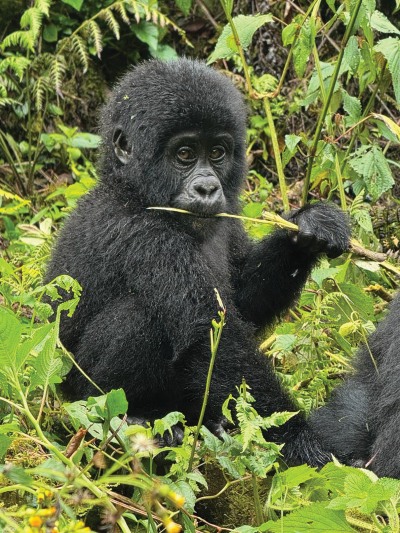
I’m grateful for our guide Paul Tamwenya who, not Jewish, captured many wonderful images that Shabbat. And believing as I do in Jewish pluralism, I appreciate that for some of our group, taking photographs of the mountain gorillas did not diminish their Shabbat experience, and may even have accentuated it.
But for me, the chance to observe them without capturing their likeness reminded me of Shabbat’s role as a counterpoint to everyday living.
Rabbi Abraham Joshua Heschel wrote the Sabbath is for turning from “the results of creation to the mystery of creation.” Jewish tradition calls traditional Shabbat practice sh’mirat shabbat, literally to “guard” or “observe” the Sabbath. Rather than a litany of restrictions, the point of abstaining from certain labors is to better appreciate our place within, not above, the created universe. It’s when we can make, unmake or capture things — and don’t — that we cultivate a sense of beingness attuned to the ultimate and singular Beingness we call God. And God, we feel, is best experienced in community; it’s why we require a minyan for prayer. Seeing those majestic gorillas in the wild alone would have been special, no doubt, but in Judaism, shared holiness is holiest.
Even more than this, collective Shabbat observance fuels our worthy collective labors the other six days of the week. The next day, we drove six hours to Lake Mburo National Park, where we embarked on our final game drive, observing more of God’s wonders from beneath the raised roofs of our safari vehicles.
Our lodge that night was at the end of a muddy, narrow road flanked by deep ditches. Dodging a stranded flatbed truck and minibus carrying Belgian bike tourists, our Toyota Land Cruiser slid from the road and tipped sideways into the embankment. Almost immediately, the Ugandan culture of collective responsibility kicked into gear.
Observing one another in distress, drivers and passengers alike worked together to free the vehicles. Afterward, against the setting sun, handshakes were exchanged and weary travelers sought rest just up the road.
On those last two days of our “Beth Am Uganda Adventure,” I was reminded how collective achievement is a biproduct of shared observance. But being Shabbat-observant is not simply about ritual, it’s about really observing, with meditative awareness, our remarkable world. Jewish observance extends well beyond Shabbat to places of work, recreation, and — yes — ditches along muddy African roads. Observance is a branch of observation. Observation is the key to collective thriving.
Rabbi Daniel Cotzin Burg is spiritual leader of Beth Am Synagogue in Reservoir Hill. This column and others also can be found on his blog, The Urban Rabbi.
The Trump administration's invoking of religion is reminiscent of the words and actions of one of history's most brutal Crusaders, writes Michael Olesker.
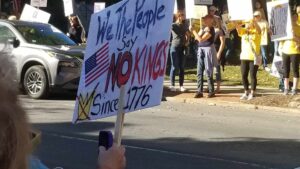
Like thousands of communities around the country last weekend, Pikesville demonstrated its disgust with the policies of the Trump administration, writes Michael Olesker.

Michael Olesker bids farewell to CBS News Radio, one of the most storied media outlets in history.
Editor-in-Chief Alan Feiler kicks off Jmore’s celebration of 250 years of Jewish history in Maryland with the legacy of Jacob Lumbrozo.