
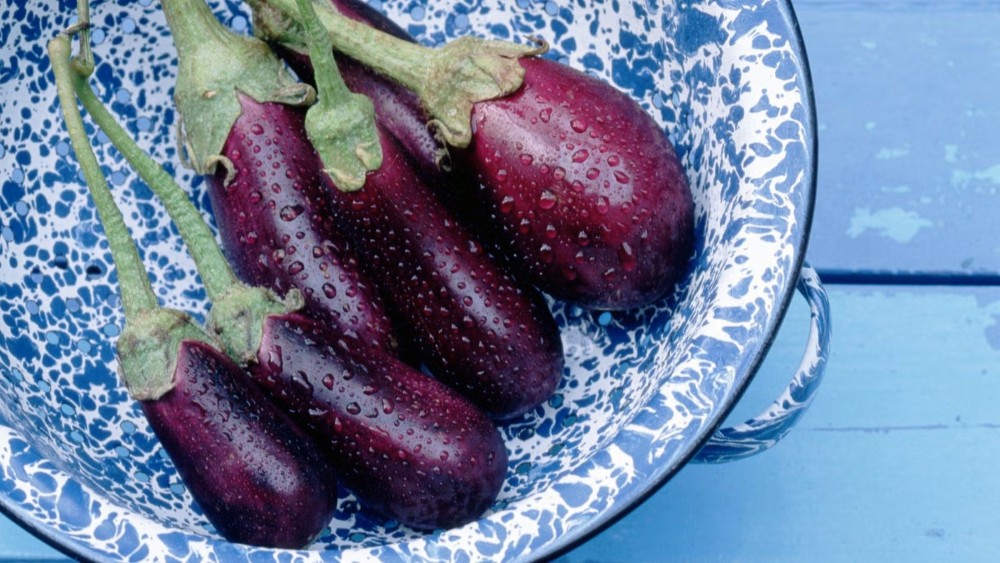
By Ronnie Fein
The Eggplant isn’t easy to love. It can be bitter and may be among the kinds of food that appeal more to grown-ups than children (at least anecdotally!).
Historically, the disdain for the eggplant runs much deeper than bitter flesh. For a long time, this vegetable was both feared and reviled.
Feared because it is a member of the nightshade family, which includes some poisonous plants like tomatoes and potatoes, that at one time were also thought to be deadly. Some Europeans thought eggplant caused epilepsy or insanity, terming it the “mad apple.”
Reviled, in part, because of antisemitism. Trace the eggplant’s history and you’ll see why:
Although its origins are probably in India, eggplant became a culinary staple in the Middle East thanks to the Caliph of Baghdad. In 825 A.D., he was about to be married and he ordered a special sauteed eggplant dish for the wedding dinner.
He named the dish buraniyya in honor of his bride, Buran. It was so delicious that the recipe became famous and has endured to this day. (Apparently, the secret to this beloved dish was Buran’s cooking tip: salt to rid the eggplant flesh of bitterness.)
Soon after, Arab traders from the Middle East brought the eggplant to Spain, where it became a favorite ingredient among the Sephardic Jews, who had been a thriving and respected people in the Iberian peninsula for centuries.
Until they weren’t.
When the Jews were exiled during the Spanish Inquisition, they fled far and wide, including to the Ottoman Empire and central Europe, bringing their love of eggplant with them.
The vegetable was readily accepted among Sicilians, who had long been a diverse cultural community and whose cuisine was heavily influenced by Middle Eastern foods. So, too, among the Ottomans.
Romania, where my family comes from, was part of the Ottoman Empire, hence my grandmother’s weekly bowl of potlagela, a Romanian eggplant salad that was a staple of my childhood, centuries later.
But in central and northern Italy and other parts of western Europe, the eggplant — and the Jews — did not fare so well. In most of Italy, the strange, unfamiliar vegetable was associated with the clannish non-Christians, who were despised, and so was “their” vegetable. In Italy, “eggplant eyes” was a pejorative term for Jews.
The disdain was set in stone in 1638, when Italian food aficionado, Antonio Frugoli, wrote “Pratica e Scalcaria,” a book about haute cuisine, in which he said that vegetables such as eggplants were fit only for peasants and Jews and therefore not worthy for the table.
According to an article by Orge Castellano in Tablet Magazine, the low regard for eggplant “persisted into the 17th century.” But actually, the association of lowly eggplant and lowly Jew hung around for another couple of centuries, until the mid-1800s, when people gradually began to realize how terrific it could be.
By 1891, Pellegrino Artusi (who some consider the father of modern Italian cuisine) wrote “La Scienza in Cucina e l’Arte di Mangiar Bene” in which he bemoaned the fact that eggplants took so long to become respected throughout Europe. He noted that it had long been regarded as the “vile food of the Jews” and that in this, as in other matters, “the Jews have shown a better flair for good things than the Christians.”
As the sage Hillel once said, “The rest is commentary.” Eggplant is now a mainstay, among the most popular vegetables (fun fact: the eggplant is actually a berry!) in Italy and elsewhere in Europe. It became a culinary star in the United States back in the 1980s when Mediterranean cuisine became au courant.
There are so many well-known eggplant recipes these days: Eggplant Parmesan, caponata, ratatouille, baba ganoush, moussaka and so on. I make them all, but my go-to hors d’oeuvre is the old Hoffman family potlagela.
For more articles like this, visit MyJewishLearning.com/The-Nosher/.
Ronnie Fein is a kosher cookbook author.

Dara Bunjon talks with culinary content creator, food stylist and photographer Kristen Hess, host of The Artful Gourmet podcast.

The ban on American booze, which came in response to the the Trump administration's tariffs against Canada, has “created a meaningful opening” for other kosher holiday wines.
A year-round favorite is reimagined for the Festival of Freedom.

Dara Bunjon talks with cookbook author, recipe developer and food consultant Chandra Ram.