
By Barbara Greenwald
For decades, Dr. Gerd W. Ehrlich’s unpublished memoir lay hidden in an old briefcase resting high on a shelf in the basement of his family’s Towson home.
Not until recently — 28 years after his death and more than eight decades after writing the manuscript — was Ehrlich’s first-person account of surviving as a Jew in Berlin under the Third Reich finally published.

Titled “Mein Leben in Nazi-Deutschland” (My Life in Nazi Germany), the memoir is considered valuable eyewitness testimony because it was written in 1945 when Ehrlich’s memories were still painfully fresh and not distorted by the passage of time. An English translation is expected to be published next year.
The book’s long-awaited publication, by the Berlin-based Foundation Memorial to the Murdered Jews of Europe, was formally marked in May at a ceremony in the German capital. The program included a staged reading of the memoir, a panel discussion, and remarks by Gerd Ehrlich’s daughter, Susan Ehrlich, who lives in Raleigh, North Carolina.
“It was a deeply reparative ceremony, in spite of today’s rising antisemitism,” said Susan Ehrlich, who attended with her husband and younger sister. “It was incredibly emotional, incredibly meaningful, and something I have to believe my dad wanted.”
Like his manuscript, Gerd Ehrlich spent part of World War II “hiding in plain sight” as part of Berlin’s Jewish underground. His book describes the inner workings of this vast resistance network of Jews and non-Jewish allies, which enabled him to adopt false identities, acquire forged papers and frequently change his residence, always staying one step ahead of the Gestapo.
“No branch [of the underground] knew the others because of possible betrayal,” said Ehrlich’s oldest daughter, Marion, a Cockeysville resident. “Only my father’s two best friends knew his real name. … `Berlin U-boats’ were what members of the underground were called.”
Like the German naval submarines, underground members had to navigate below the surface, pretending to be German citizens while constantly looking over their shoulders.
Holocaust historians estimate that 11,000 Jews went underground in Berlin during the war years. Approximately 1,400 survived while the rest were killed by allied bombings, starved or captured due to betrayal by informants.
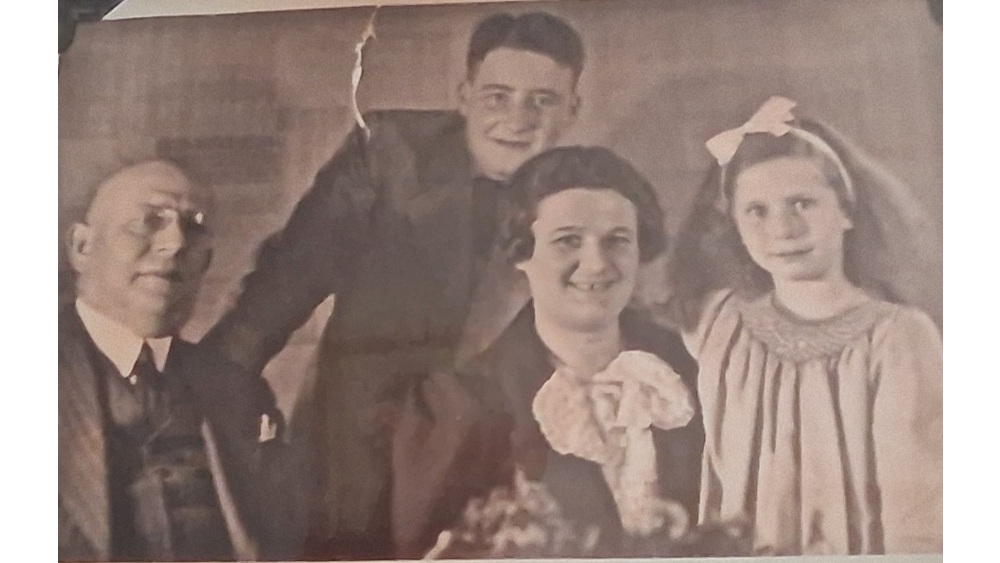
Gerd Ehrlich went into hiding in November of 1942, not long after his mother, stepfather and 14-year-old sister Marion (for whom his daughter is named) were deported to Auschwitz.
“He [once] stayed behind the maid’s room at the back of an old apartment owned by his parents’ best friends,” Marion Ehrlich said. “He had a safe place to stay, but it was in a crawl space.”
She recounted how her father broke into his own family’s shuttered apartment to steal their oriental rugs, which he sold to support himself and the underground.
In the book, Ehrlich describes growing up in a secular Jewish family that was deeply proud of its German identity. But as a teenager, he witnessed Kristallnacht, the 1938 “night of broken glass,” riding his bicycle through his native Berlin as synagogues burned to the ground.
The Nazis expelled him from high school for being Jewish and deported his father to the Sachsenhausen concentration camp. Although his father was released in 1940, he died later that year from the effects of his imprisonment.
At one point, Gerd Ehrlich was caught by the Gestapo for a curfew violation and sent to a forced labor camp outside of Berlin, where beatings were frequent and living conditions inhumane.
“His first night was spent under a dripping faucet,” Marion Ehrlich said. “His day began at 4 a.m. He had lice in his clothes and was constantly forced to exercise. He was a 19-year-old boy.”
After being released from the camp, Ehrlich went underground, believing he could not survive another bout of forced labor. But Marion Ehrlich said her father was betrayed by a fellow Jew who spied for the Nazis to avoid deportation.
“She tapped him on the shoulder and used his real name in earshot of an SS officer,” she said. Ehrlich immediately ran away, barely evading capture.
Realizing he needed to leave Berlin, Ehrlich connected with a Jewish escape network in October of 1943 and made the dangerous journey to Switzerland — first by train, then by crawling through the border zone under cover of night.
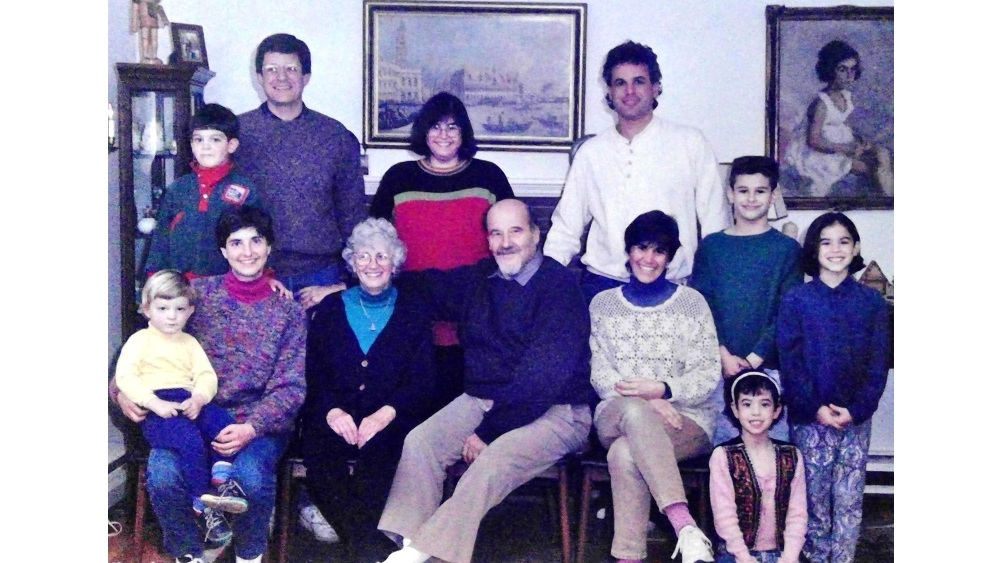
He completed his memoir in 1945, taking it with him when he immigrated to the United States the following year. He eventually married a fellow German refugee, Sibylle Gerstenberg, and resettled in Baltimore.
Ehrlich, a scholar of German language and political science, and his wife worked as college professors at such local schools as Towson University, Goucher College and Morgan State University. (Sibylle Ehrlich passed away in October of 2020 at age 94.)
Despite what he and his family endured in Germany, Gerd Ehrlich never stopped loving his homeland, say his daughters.
“When he was here in Berlin, he felt most at home,” said Susan Ehrlich at the ceremony. “Rather than erase his origins, he vowed that he would not allow the country that had deprived him of his family to also deprive him of his right to return to his birthplace.”
For information about the book, visit stiftung-denkmal.de/publikation/mein-leben-in-nazi-deutschland/.
Barbara Greenwald is a local freelance writer and editor.
* * *
Putting the Pieces Together
“Our parents never shared their Jewish identities with my sisters and me, and rarely spoke of their lives in Germany. We never knew about the train to Auschwitz that led to the murder of our paternal aunt and grandparents. We were never provided an explanation as to why they left Germany, and being children we learned to accept this silence without question.”
So spoke Dr. Gerd W. Ehrlich’s daughter, Susan Ehrlich, at the May ceremony marking the publication of her father’s memoir, “Mein Leben in Nazi-Deutschland” (My Life in Nazi Germany).
She believes her father, who passed away in July of 1998 at age 76, concealed his Jewish identity due to survivor’s guilt.
“When I figured out I was Jewish, I was a teenager,” Susan Ehrlich said, noting that an historical question she posed to her father led to a discussion of the Holocaust and his Jewish background. “Enough time had passed since his trauma, and he was becoming healthy enough to acknowledge who he was.”
Gerd Ehrlich’s wife of 46 years, Sibylle, was raised as a Protestant in Germany, even though her own mother, Olga, was born Jewish.
“My Presbyterian mother, who was an elder in the church, was really Jewish,” said Marion Ehrlich. “We all went to church on Sunday while our father played tennis. We had a Christmas tree. …
“My father never, ever talked about the war,” she said. “When we first learned about his experiences, pieces of a life we had not understood began to fall into place.”
Gerd Ehrlich did not publicly identify as Jewish and as a Holocaust survivor until his daughter Susan’s wedding to a Jewish man in 1979.
She reflected on the significance of that moment in her talk at the book publication ceremony in Berlin.
“As the decades passed, my father began to speak about the Holocaust — first in an academic, historical and philosophical way, and eventually he shared personal experiences. … I now understand how powerfulhis public declaration was as his daughter began a new life.”
—Barbara Greemwald

The new plan helps sabbath-observant Jews seeking care in the Emergency Department.

A check presentation ceremony will take place on Tuesday, Aug. 25, at the Safeway location on Smith Avenue.
A Rockville resident, Feinberg was a familiar face in MoCo politics for several decades.
Known as "Unclecation," the yearly summer getaway offers an opportunity for a group of old friends (and their growing broods) to remain connected.