

By Jenna Gottlieb
In the autumn of 1935, the Icelandic capital of Reykjavík was little more than a small fishing port of corrugated-iron houses, cod trawlers idling in the harbor and geothermal steam curling up from hot springs.
Fewer than 30,000 people lived there. There was no concert hall, no real orchestra and no conservatory worth the name.
Into this cultural chasm stepped a 22-year-old pianist from Berlin named Robert Abraham. He carried almost nothing with him and hoped no one would ask too many questions about why he left Germany.
Three years later, a Viennese conductor named Victor Urbancic disembarked with his Jewish wife, Melitta, after years of failing to find a safe harbor elsewhere in Europe.
And somewhere in between came Heinz Edelstein, a cellist and teacher from the German town of Freiburg, who arrived with his wife and two sons.
None of them chose Iceland. For a classically trained European musician fleeing the Nazis, an island near the Arctic Circle with no symphony orchestra and a government hostile to Jewish immigration was about as far from a dream destination as it got.
Yet Urbancic, Abraham and Edelstein went on to build the institutions that still define Icelandic classical music today.
Iceland is a nation that has always known how to keep its stories alive, from medieval sagas to the living oral traditions shaping its literature and language.
But its more recent history of Jewish exile has gone largely untold until now, as scholars have worked both to recover the music that Nazi persecution scattered across the globe and reconstruct an Icelandic musical history that offers a painful reminder of the country’s Holocaust history.
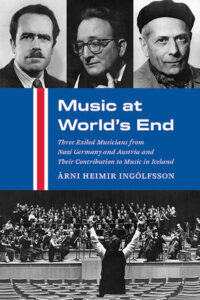
The musicians’ story is the subject of a newly translated book, “Music at World’s End: Three Refugee Musicians from Nazi Germany and Their Contribution to Iceland’s Music Life,” by Icelandic musicologist and choral conductor Árni Heimir Ingólfsson. It was published in English this year by SUNY Press, following the Icelandic edition in 2024.
The book reconstructs the three refugees’ individual pathways to Iceland.
Urbancic trained as a pianist, composer and conductor at the Vienna Conservatory, working his way through theaters in Mainz and Graz. He was raised Catholic, but his wife, Melitta, came from a Jewish family, and under the Nazis that was enough to end his career.
After doors closed on him in Switzerland and the United States, an old classmate helped him find a foothold in Iceland in 1938.
Abraham’s path was more solitary. The son of German ethnomusicologist Otto Abraham, he trained at the Berlin Hochschule für Musik before fleeing Germany in 1934. Denmark turned him down. In late 1935, he sailed alone for Iceland and was advised to settle first in the northern fishing town of Akureyri.
Edelstein’s journey looked different from the start, a father bringing his family into exile rather than a young man traveling light.
“Today, there are as many as 100 descendants of these three men living in Iceland,” said Ingólfsson.
Practical Need
At least four other Jewish musicians — including composer Viktor Ullmann, who would later die in Auschwitz — applied for Icelandic work permits around the same time and were turned away under a government that largely closed the door to Jewish immigration.
At the time, Icelandic immigration policies were restrictive, similar to Denmark’s policies before and during the war. Iceland was a poor country with economic hardship, and antisemitism also played a role.
“Iceland is small and isolated, and in a place like that, xenophobia takes root easily,” Ingólfsson said. “The country was struggling economically, which fed suspicion of foreigners, and there was a prime minister [Hermann Jónasson] who, on his own authority, closed the country to Jews entirely.”
But that same isolation created a practical need for what these three men could offer.
“Iceland was pushing toward full independence from Denmark, and we felt we needed our own institutions to be taken seriously as a nation,” Ingólfsson said. “Musically, we still had a long way to go. … These three musicians arrived at exactly the right moment, despite the antisemitism.”

One more factor may have eased their acceptance, Ingólfsson said. By the time they reached Iceland, none of the three was a practicing Jew.
Abraham was raised Protestant by his Jewish parents; he was no longer religious, according to Ingólfsson. Urbancic’s wife was Jewish, but he was not. And Edelstein was an atheist.
“That made them easier for Icelanders to accept,” Ingólfsson said.
The three were admitted based on luck, timing and getting their cases in front of the right people.
“In a way, it happened in a very Icelandic way,” said Ingólfsson. “They were lucky; instead of an automatic no, their applications were forwarded on based on people who knew people.”
Tina Frühauf of the Columbia University of New York Graduate Center, who studies Jewish music in the modern era, noted that Jewish identity across pre-Holocaust Europe was far from monolithic, meaning that many emigres had biographies like the Iceland refugees.
“Before the Holocaust, Germany had an incredibly diverse Jewish religious landscape, and that diversity carried over into the migration itself,” she said.
Willing to Start Over
What happened next still seems improbable. Urbancic became chief conductor of the Reykjavík Orchestra, the ensemble that by 1950 had grown into the Iceland Symphony Orchestra.
He led the country’s first performances of Bach’s “St. John Passion” and Mozart’s “Requiem,” and, in 1951, its first staged opera, Verdi’s “Rigoletto.”
He also taught piano and theory at the Reykjavík School of Music and played the organ in the city’s only Catholic church.
Abraham became a central figure in Icelandic choral music. He conducted the Iceland Symphony Orchestra’s first-ever concert in 1950, founded the Philharmonia Choral Society in 1959, and earned a doctorate in musicology, eventually serving as director of music for the Church of Iceland.
Edelstein, meanwhile, helped build the music schools and teaching pipelines that a country with no conservatory tradition simply didn’t have.
“They essentially created it,” Ingólfsson said of Iceland’s classical music scene. “People often ask why a country this small punches so far above its weight musically. Part of it is training, but just as important is a willingness to do the work.
“These three men set their egos aside. They were multi-talented and willing to take on any role — training orchestras, building choirs, teaching children — not just performing or conducting.”
That willingness, Ingólfsson argued, wasn’t incidental. A country with no infrastructure needed people willing to do five jobs at once, for little money and less glory.
Urbancic, Edelstein and Abraham fit that need because their old lives had already been upended. They weren’t protecting professional reputations; they were starting over.
Despite their impact, the story sat largely untold for decades, even in Iceland. Ingólfsson stumbled into it by chance.
“About 25 years ago, an editor in Iceland approached me with the idea,” he said. “I was in graduate school at Harvard, so I researched and wrote much of it during my summer break.”
He published three newspaper profiles of the men in 2001, then set the project aside for two decades before finally turning it into a full book. That meant tracking down archives, and just as often, tracking down people.
“I got in touch with the musicians’ families and met each of their children,” he said. “It’s a small world, and one connection led to another. Having that access early on made all the difference.”
One connection led somewhere unexpected. While researching Abraham, Ingólfsson learned that the young musician was once engaged to a non-Jewish woman who stayed behind in Berlin when he fled, and he sent her care packages for years.
Ingólfsson tracked down her daughter and wrote, “I’m writing a biography of your mother’s ex-boyfriend.”
“She was overjoyed,” he recalled. “I met her in Hamburg, and she handed me a box of letters. That daughter became a second grandmother to me.”
Belated Recognition
Why did the story take so long to surface? “There’s still a tendency to tell the stories of our own,” Ingólfsson said. “Yes, these men did extraordinary work, but they were foreigners. Musicology is also a fairly new field in Iceland; there are only three or four musicologists in the whole country.”
Recognition is arriving now. Weeks ago, the Exile Museum in Berlin launched a series with foreign embassies, each spotlighting a refugee story tied to their country, and Iceland was chosen to go first.
Set against the wider history of Jewish musical exile, Iceland is an extreme case of an ordinary pattern. Musicians fleeing Nazi Europe scattered unevenly across the globe, and what happened to them next often depended on little more than where an immigration officer happened to say yes.

The German musicologist Albrecht Dümling saw his research take him to Australia, where nearly 100 German-Jewish refugee musicians landed, some of whom, after fleeing the Nazis, were deported there by the British, who considered them “enemy aliens.”
“They were horrified as they had come as Jewish refugees to Britain and had hoped to be in a safe country,” he said of men sent aboard the prison ship Dunera in 1940. “They could not believe that in England they had been interned, and this was continued in Australia as well. Some were very depressed. But others saw their internment as a challenge to write songs that made clear their opposition to Hitler’s Germany.”
What separated musicians who thrived from those who vanished, Dümling said, often had less to do with talent than paperwork: Refugees in Iceland typically weren’t permitted to resume their old careers, a fate Urbancic, Edelstein and Abraham avoided only because Iceland’s need for musicians overrode the usual restrictions.
For Ingólfsson, the book is a chance to explain to the country where so much of its music actually came from.
“These men were growing desperate in the 1930s, trying everything to get out. For a classical musician, Iceland was hardly a dream destination,” he said. “And yet they turned something depressing and unfortunate into something extraordinary.”
A freelance journalist and author based in Iceland, Jenna Gottlieb wrote this article for the JTA global Jewish media source.

The history of Jewish Barcelona is fascinating and complex, and a tour of the Jewish Quarter offers a glimpse into the city’s tragic past.

The reburial came 77 years to the Hebrew date after Theodor Herzl himself was laid to rest on the Jerusalem hillside bearing his name.

A Maimonides statue in the Spanish city of Córdoba was defaced last weekend, but his teachings have an answer to hate, writes Rabbi Jeffrey K. Salkin.

The narrative against Israel's legitimacy took years to build, writes Baltimore-based branding expert Sharon Nevins.