
This article originally appeared on Hey Alma.
By Hannah Fleischman
Growing up, I always looked forward to Passover. Something about a festival dedicated to the celebration of physical and spiritual redemption from suffering struck a chord with my childhood self. Of course, it’s also a joyful remembrance of journeys and paths toward freedom.
Somewhere along the way, though, I stopped eagerly anticipating the holiday. Instead, I reserved that enthusiasm for spring break, which was usually scheduled around the same time of year. I longed for a respite from school and the constant discomfort those locker-lined hallways represented.
At the time, I mostly associated my queerness and Jewishness with hastily drawn swastikas on peer-graded assignments and muttered homophobic taunts.
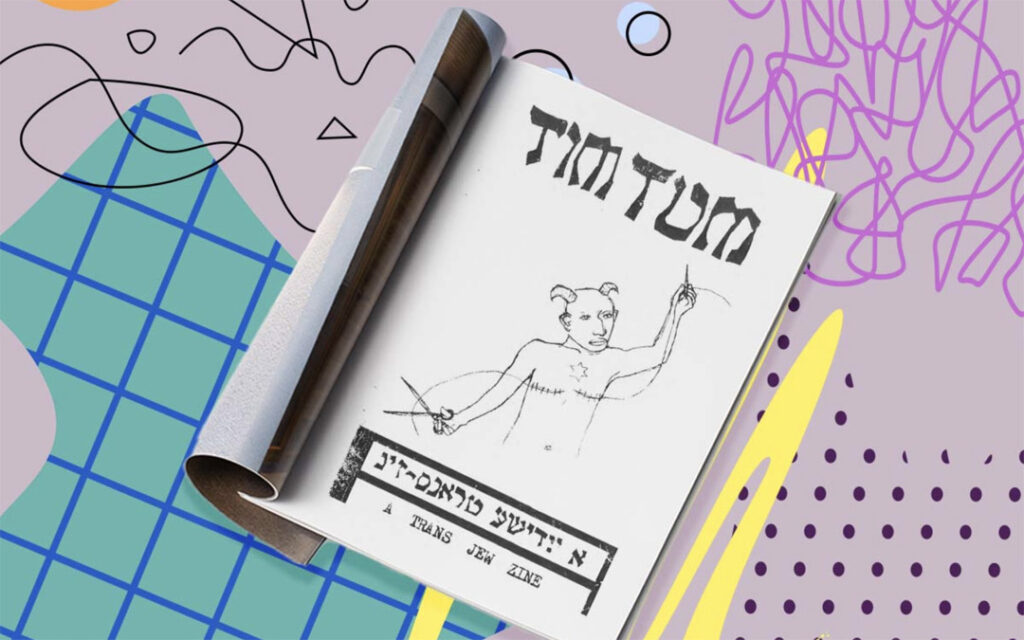
When I encountered a zine written by Micah Bazant, I began to think differently about what it meant to be queer and Jewish. Not far into their 1999 zine, “TimTum: A Trans Jew,” Bazant makes a subversive assertion. “I feel like Judaism is a secret package delivered to me through time, disguised and concealed, hidden from the enemy,” they write. “I feel a responsibility to the generations who sustained this, who died and lived as Jews. Who am I to throw away this most precious of gifts — now, when I am finally free to fully unwrap it.”
I paused over this. I went back and reread the entire page from the beginning. Then I skimmed ahead for further discussion of Bazant’s relationship with Judaism. I was enthralled. Across a series of essays, drawings, emails and prayers, Bazant provides a vital narrative of resistance. And until I read Bazant’s zine, I had never seen myself so clearly represented.
The first time I read “TimTum,” I couldn’t help but think about the tradition of reading the haggadah to guide my family’s seder during Passover. Much like haggadot tell a story of resiliency and freedom, so too does “TimTum.”
At the heart of Bazant’s zine is the assertion that suffering and oppression are not the only defining experiences tied to their queer and Jewish identities. Instead, Bazant suggests that Judaism is a way of demanding a rich, embodied existence, not just survival.
Timtum is a Yiddish word that defies simple definition and was initially derived from the Hebrew word tumtum. Rabbi Elliot Kukla, the first trans person ordained by Hebrew Union College in Los Angeles, introduced the concept of the tumtum to the general public in 2006. He encountered it at the age of 20 while studying at an Orthodox yeshiva. His teacher defined a tumtum as a “mythical beast” invented by the sages to test the limits of the law. In practice, the term tumtum was primarily used by the rabbis of the Mishnah to identify those who were neither male nor female.
Timtum usually has a negative connotation when referring to an androgynous person whose gender is not immediately obvious at first glance. But in Micah Bazant’s reimagining, a timtum can also be “a sexy, smart, creative, productive Jewish genderqueer.”
What really struck me the first time I read “TimTum” was the realization that queer, trans Jews have always existed — that the story of Passover is also a story of queer freedom. There must have been queer people among the liberated Israelites who crossed the Red Sea: These narratives are fundamentally entangled.
I realized nothing was stopping me from incorporating this information into my celebration of Passover. The word haggadah translates to telling, and this year, even after Passover ends, I’ll make sure to keep telling everyone I possibly can about the timtum.
By choosing to live fully, queer Jews resist societal norms through their continued existence.
Hannah Fleischman (they/them) is a student at Smith College majoring in sociology. They are interested in cultural politics, the study of gender and sexuality, and social psychology. Hannah was a 2019-2020 Alma Ambassador.
Many of this year's new children's books for Passover portray the holiday theme of opening one's seder table to guests.

The ban on American booze, which came in response to the the Trump administration's tariffs against Canada, has “created a meaningful opening” for other kosher holiday wines.
A year-round favorite is reimagined for the Festival of Freedom.

Everything you love about coconut macaroons baked into a soft, sliceable cake.