

What a shame about “Maestro,” Bradley Cooper’s intimate new movie portrait of the great conductor and composer Leonard Bernstein. Such production, such sensitivity, such wonderful acting.
And such a struggle to sit through the damned thing.
Cooper co-wrote and directed “Maestro,” which is now streaming on Netflix. The movie feels as if he got all the details right on all the aspects of Bernstein’s life he chose to examine. But why did he choose these particular aspects to examine?
Bernstein was one of 20th-Century America’s giants of music. He wrote, conducted, and gave us classical and Broadway. In the post-war years when Jews were bursting as never before into mainstream culture, Bernstein was a high-brow source of ethnic kvelling.
At an absurdly young 25, he took the podium of the New York Philharmonic. He was pinch-hitting for an ailing guest conductor. And with no rehearsal at all, he blew the lid off the place. He did Schumann, he did Wagner. His hair flew all over the place. He perspired like nobody in history ever previously perspired.
With all that energy, and all that drama and all that bravado, the New York Times ran his debut on the next day’s front page. Everybody couldn’t get over Lenny.
And he was just getting started.

When he wasn’t conducting, Bernstein was composing. Or he was on television, explaining to young people what classical music was all about. He seemed to usher in a whole new age of respect for music we used to call “long-hair” (before “long-hair” came to mean the Beatles and other exporters of the British rock invasion).
Bernstein wrote the stirring background music for the classic film “On the Waterfront.” He wrote the music for “On the Town,” the good-natured romp about three American sailors trying to swallow up all of New York City’s delights in one brief shore leave.
And he composed the music for “West Side Story,” which became not only a legendary Broadway show and movie (two movies, actually) but it transcended the old notions of what musical theater could say to us.
For a generation of young people dealing with changing notions of race and religion and how these were expressed in love and anger and street culture, “West Side Story” felt like something sacred had been delivered on to us.
With all this history behind Bernstein, why did Cooper & Co. choose to make a movie whose central focus was his marriage? Big deal, so Bernstein was bisexual, and his wife Felicia knew all about it. Yes, there are interesting aspects to such a relationship.
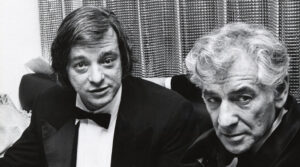
But what matters more to Bernstein’s story — such a marriage or such a remarkable musical legacy he gave us? What part of his skill, intelligence and soul helped this man create music? How did that process work — in his own brain and in collaboration with others?
You could make a movie out of the “West Side Story” creative process alone: how four gay Jewish men — Bernstein, the young lyricist Stephen Sondheim, choreographer Jerome Robbins and Arthur Laurents, who wrote the book – brought their talents and backgrounds together to create a story about the love and the self-destructive rage touching young people from different backgrounds.
What a shame about “Maestro.” So many good intentions, so much first-rate professionalism — and they chose to relate the strains of a marriage when they might have told us about the creation of sheer magic.
A former Baltimore Sun columnist and WJZ-TV commentator, Michael Olesker is the author of six books.
A Baltimore native and Pikesville resident, Freedman had the distinction of being the longest-serving employee in the history of the State of Maryland.

House Bill 661 is the culmination of a collaborative effort led by Del. Sarah S. Wolek (D-16th), Del. Jared S. Solomon (D-18th) and Sen. Shelly L. Hettleman (D-11th).

More than 100 Broadmead residents and team members recently gathered to celebrate the festival of Passover with a meaningful seder dinner.

Journalists bear a responsibility to go beyond the headlines and social media posts to understand the past and present, writes New York University student Lucia Alonso.