

When the Francis Scott Key Bridge collapsed into the cold Patapsco River last week, killing at least six and costing thousands of jobs and many millions of dollars, we were watching a sense of identity go under as well.
When we talk about the heart of the city — about images of the traditionally gritty, blue-collar, working-class community of people who make a living getting their hands dirty and their muscles strained — we’re talking about the Port of Baltimore.
Whatever image the city’s homicides and streetcorner drug traffic brought, there was still this steady picture of a port at work, vital to cities everywhere, making scruffy Baltimore a serious international player.
For years, we even had a weekly television show, hosted by The Sun’s maritime editor and future Rep. Helen Delich Bentley, called “The Port That Built A City and State.”
It was a port that a year ago reportedly handled more than 50 million tons of foreign cargo, worth more than $80 billion, and employed about 8,000 dock workers who are now looking at the grim possibility of losing their jobs.
It was, as Will Englund wrote in The Washington Post last week, a port of “sugar in and coal out, forest products in and scrap metal out, cars and light trucks in.”
But that was last week, which was another world ago, before a massive cargo ship called the Dali lost control at 1:30 in the morning on Mar. 26 and brought the bridge, and the transportation of goods all over America, into a different reality.
As Pete Buttigieg, the U.S. secretary of transportation, said while looking over the site of the disaster, the suspension of shipping traffic will impact thousands of jobs and about $2 million in wages every day.
And Gov. Wes Moore said a daily work force of about 8,000 people, including terminal, rail and tugboat operators, pilots and truckers, have been affected. Others say the number of jobs, direct and indirect, that will feel the impact could reach about 100,000.
The ship and the wreckage of the Key Bridge remain in the river, cutting off passage into the various docks that comprise the Port of Baltimore. Officials say it could be many months before ships can safely move about the port again.
For those of us who live on the far side of town from the east side’s bustle, the city’s history of ships arriving each day from distant ports could nevertheless feel as vivid as a daydream.
For years when it was fat with advertising, The Sun carried a full page of daily comings and goings, of ship’s names and their countries of origin and the lush cargo they carried.
Schoolteachers used that news to teach lessons beyond geography. There was a whole world out there, and it connected to Baltimore. We were a city that considered itself small-town in so many ways, and yet here was evidence that we were truly important to the rest of the world.
That same newspaper carried the great A. Aubrey Bodine’s photos: not only ships but those rugged men working the port, muscular and sweaty and working in tandem. They were ordinary men, our neighbors, but they helped make the city a great one.
Likewise, for those of us who live on the far side of town, the Key Bridge could seem distant as another world. But if you strolled along the water’s edge at Fort McHenry, to look east and see the bridge twinkling on a summer’s day was to understand some of the inspiration Francis Scott Key felt long ago when he gazed at that very area one night and was moved to write his poem that became the national anthem.
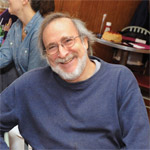
A former Baltimore Sun columnist and WJZ-TV commentator, Michael Olesker is the author of six books, including “Journeys to the Heart of Baltimore” (Johns Hopkins University Press) and “Michael Olesker’s Baltimore: If You Live Here, You’re Home” (Johns Hopkins University Press).
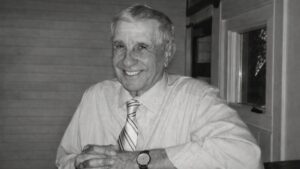
A Baltimore native and Pikesville resident, Freedman had the distinction of being the longest-serving employee in the history of the State of Maryland.
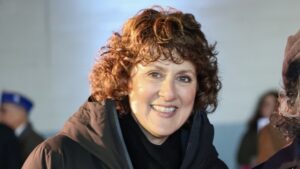
House Bill 661 is the culmination of a collaborative effort led by Del. Sarah S. Wolek (D-16th), Del. Jared S. Solomon (D-18th) and Sen. Shelly L. Hettleman (D-11th).
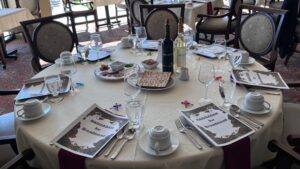
More than 100 Broadmead residents and team members recently gathered to celebrate the festival of Passover with a meaningful seder dinner.
Journalists bear a responsibility to go beyond the headlines and social media posts to understand the past and present, writes New York University student Lucia Alonso.