By Andrew Silow-Carroll
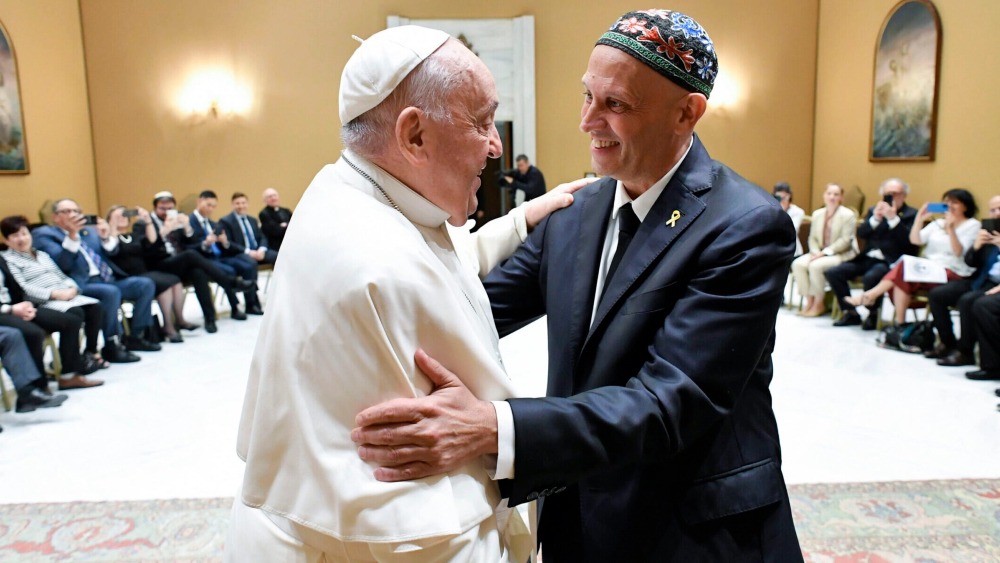
Pope Francis — who significantly advanced the Catholic Church’s relationship with Jews by promoting dialogue, reconciliation and a strong stance against antisemitism — died Monday, Apr. 21, a day after marking Easter with a public appearance at the Vatican.
He was 88.
The Vatican did not give a cause of death. Francis suffered from multiple health conditions in recent years and was hospitalized for several weeks in February with what the Vatican called a “complex clinical picture.”
But Francis had rebounded to make public appearances, and last Sunday met privately with Vice President J.D. Vance, a convert to Catholicism.
The first Jesuit and first Latin American to serve as pope, Francis assumed the leadership of the church in March of 2013 after years of building and sustaining Jewish relationships in his native Argentina. In 2010, he co-wrote, with Rabbi Abraham Skorka, “On Heaven and Earth,” a book based on their public conversations about Judaism and Catholicism.
Francis met frequently with Jewish leaders and paid a state visit to Israel in 2014. He often invoked the spirit of Nostra Aetate, the declaration promulgated by Pope Paul VI in 1965 as part of Vatican II, which repudiated centuries of anti-Jewish theology and inaugurated a new era in Catholic-Jewish relations. He controversially restricted the Latin Mass, a symbol of the pre-Vatican II church whose liturgy includes a call for the conversion of the Jews.
Francis reiterated Nostra Aetate in 2013, speaking to the International Jewish Committee on Interreligious Consultations.
“Due to our common roots, a Christian cannot be antisemitic!” the pope declared. “I had the joy of maintaining relations of sincere friendship with leaders of the Jewish world. We talked often of our respective religious identities, the image of man found in the Scriptures, and how to keep an awareness of God alive in a world now secularized in many ways. … But above all, as friends, we enjoyed each other’s company, we were all enriched through encounter and dialogue and we welcomed each other, and this helped all of us grow as people and as believers.”
Such statements sustained a relationship sometimes strained when Francis adopted positions at odds with the core concerns of many Jews.
In May of 2015, an expansion of Vatican relations with Palestinian leadership following the Palestinians’ unilateral pursuit of statehood drew criticism from Israeli and Jewish leaders, who at the time viewed direct negotiations with Israel as the only credible path to peace.
Francis also strongly defended the record of Pope Pius XII, who served during the Holocaust. Critics accuse Pius of having turned a blind eye to Jewish suffering during the Shoah, while the Vatican has long maintained he worked behind the scenes to save Jews.
In 2019, Jewish groups welcomed Francis’s announcement that the Vatican Archives covering the Pius papacy would open to researchers beginning in March of 2020.
The Israel-Hamas war, which followed the deadly Hamas attacks in Israel on Oct. 7, 2023, strained relations between Francis, Jews and Israelis. Last November, citing experts saying “what is happening in Gaza has the characteristics of a genocide,” Francis called for the charge — which Israel strenuously rejects — to be “carefully investigated.”
In December, Francis attended the inauguration of a nativity scene at the Vatican that positioned baby Jesus on a keffiyeh, or Palestinian scarf — a nod to activists who have identified Jesus, a Jew born in Roman times, as a Palestinian.
Defenders of the pope said his statements about the Israel-Hamas war were in keeping with Catholic doctrine on the value of peace and human life, and did not reflect on Francis’s commitment to fighting antisemitism. He also repeatedly called for the release of the Israeli hostages held by Hamas.
Despite the disagreements, Francis maintained warm relations with Jewish leaders involved in interfaith dialogue.
“I sorrowfully mourn the death of Pope Francis, a towering figure in our time whose leadership, compassion, and dedication to peace transcended religious boundaries,” Rabbi Arthur Schneier, who received the papal knighthood honor from Francis in New York in 2015.
The following year, Francis made his first appearance at Rome’s Great Synagogue, marking the 50th anniversary of Nostra Aetate and issuing a joint call with Rome’s chief rabbi against religious violence.
“We are clearly living in a renewed era of Catholic-Jewish relations,” Rabbi Noam Marans, the American Jewish Committee’s director of interreligious and intergroup relations, wrote in September 2017, on the eve of the pope’s second visit to the United States. “When there are disagreements, they are discussed and often resolved among friends, but even when unresolved, the conversation rarely devolves into a contretemps.”
During that visit, Jewish leaders took part in “Witness for Peace: A Multireligious Gathering with Pope Francis” at the 9/11 Memorial and Museum.
Jewish groups also appreciated Francis’s frequent pleas to his followers to heed the lessons of the Holocaust. “The memory of the Shoah and its atrocious violence must never be forgotten,” the pope said in 2018 in a message through the Vatican’s secretary of state in Berlin. “It should be a constant warning for all of us of an obligation to reconciliation, of reciprocal comprehension and love toward our ‘elder brothers,’ the Jews.”
In 2017, Pope Francis and Rabbi Skorka co-authored an introduction for a book by three Argentine doctors about the Nazi medical experiments. The essay calls the Holocaust a “hell.”
“The human arrogance exposed during the Shoah was the action of people who felt like gods, and shows the aberrant dimension in which we can fall if we forget where we came from and where we are going,” they wrote.
The pope’s friendship with Rabbi Skorka, rector of the Latin American Rabbinic Seminary, dated to 1997 when the pope, then known as Jorge Mario Bergoglio, became coadjutor bishop of the Buenos Aires archdiocese. In addition to collaborating in 2010 on their book “On Heaven and Earth,” the bishop and the rabbi appeared frequently together on Argentinian television.
In a 2013 interview with the New York Jewish Week, Rabbi Skorka said Francis had a “special relationship towards Jews and Jewishness” and a commitment to Nostra Aetate.
“From a theological point of view, according to what I spoke with him about, he and other important Catholic thinkers believe in cooperation between Jews and Christians in order to get a better world — respecting one another and sharing the challenge to bring more spirituality and justice to the world,” Rabbi Skorka said.
Friendly relations with Jewish clergy was a hallmark of his priesthood. As archbishop of Buenos Aires, Francis attended Rosh Hashanah services at the Benei Tikva Slijot synagogue in September 2007. He was the first public personality to sign a petition for justice in the 1994 AMIA bombing case, in which 85 people were killed in a terrorist attack at a Buenos Aires Jewish center. In June 2010, he visited the rebuilt AMIA building to talk with Jewish leaders.
Last year, after years of stalled investigations and charges of a cover-up, an Argentinian court ruled that Iran directed the attack, and that it was carried by Hezbollah.
In 2018, Francis renewed his commitment to fostering relations between Catholics and Jews and condemning anti-Semitism.
“Dialogue and friendship with the children of Israel are part of the life of Jesus’ disciples,” Francis wrote in “Evangelii Gaudium” (The Joy of the Gospel), described as the flagship document of his papacy. “The friendship which has grown between us makes us bitterly and sincerely regret the terrible persecutions which they have endured, and continue to endure, especially those that have involved Christians.”
Andrew Silow-Carroll wrote this article for the JTA global Jewish news source.

The Jerusalem Orchestra East & West, which arranged the program for young musicians, blends Western orchestral music with Middle Eastern traditions.
The BCO, founded in 1984, will perform the works of Frank Zappa, Beethoven, Mason Bates and Karena Ingram.

For more than 130 years, Sol Levinson & Bros. has been woven into the fabric of Baltimore’s Jewish community.