
By Grace Gilson
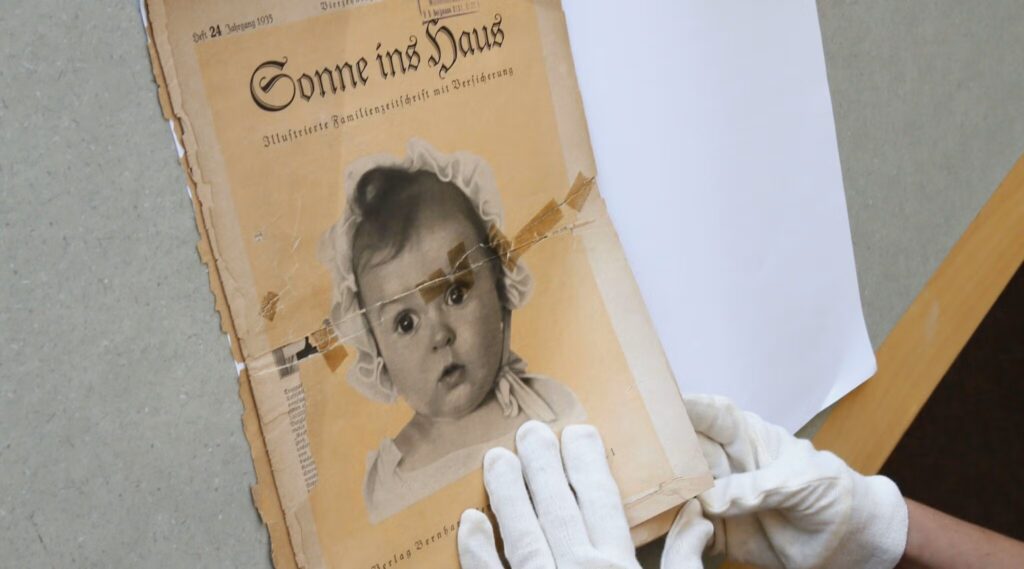
Hessy Levinsons Taft, a Jewish woman whose baby photo was selected in a 1935 competition to represent the Aryan race in Nazi Germany, died on Jan. 1 in San Francisco at the age of 91.
Born in Berlin in May of 1934 to Latvian Jewish opera singers Jacob and Polin Levinson, Taft was photographed when she was 6 months old by a German photographer, Hans Ballin.
Unbeknownst to the family, Ballin – who was of Jewish origins — later submitted her photo to a national competition overseen by Joseph Goebbels, the Nazi propaganda minister, to depict the ideal Aryan baby.
After winning the competition, Taft’s image was displayed on the cover of the Nazi magazine Sonne ins Haus (meaning Sunshine in the House), where she was identified by the family’s housekeeper.
The image was also displayed in other Nazi magazines and on postcards to celebrate Aryanism.
After being confronted by Taft’s parents, Ballin told the family that he had “deliberately wanted to slip in the little Jewess” as a joke and make the Nazis look “ridiculous,” according to The Times.
Taft’s parents then confined her indoors for fear that she would be recognized by Nazi authorities, according to Reuters.
Taft first revealed the story behind the photo publicly in 1987 in the book “Muted Voices: Jewish Survivors of Latvia Remember” (Philosophical Library) by Gertrude Schneider.
“It is the story of a Jewish baby selected by loyal Nazis to serve as an archetypal example of the Aryan race, the theory which the Nazis’ leadership seized every opportunity to promote,” Taft wrote, according to The New York Times. “I was that baby.”
“I can laugh about it now, but if the Nazis had known who I really was, I wouldn’t be alive,” she told the German language newspaper Bild.
When asked in 2014 by Yad Vashem, Israel’s national Holocaust museum and memorial, what she would say to Ballin for submitting the image, Taft said, “I would tell him, good for you for having the courage.”
In 1938, Taft’s family fled from Germany to Paris, and then escaped France in 1941 through Spain and Portugal to find safe haven in Cuba.
In 1949, her family immigrated from Cuba to New York City, where Taft studied at Barnard College and received a master’s degree in biochemistry at Columbia University.
In 1959, she married Earl Taft, a mathematics instructor with whom she had two children and four grandchildren. She taught as a professor of chemistry for three decades at St. John’s University in New York until retiring in 2016. (Earl Taft died in August of 2021.)
After donating a copy of Sonne ins Haus to Yad Vashem in 2014, Taft told the Holocaust center, “I feel a sense of revenge, good revenge.”
Grace Gilson wrote this article for the JTA global Jewish news source.

A former resident of Baltimore and central Florida, Ritt was active in the Soviet Jewry movement of the 1970s and 1980s.

For more than four decades, Goldman played a vital role in the supervision of elections in the city.

The 16-year-old sophomore succumbed to injuries sustained in a car crash last week in Cockeysville.

Spending on "hasbara" should be “like investing in jets, bombs and missile interceptors,” argues Israel’s foreign minister.