
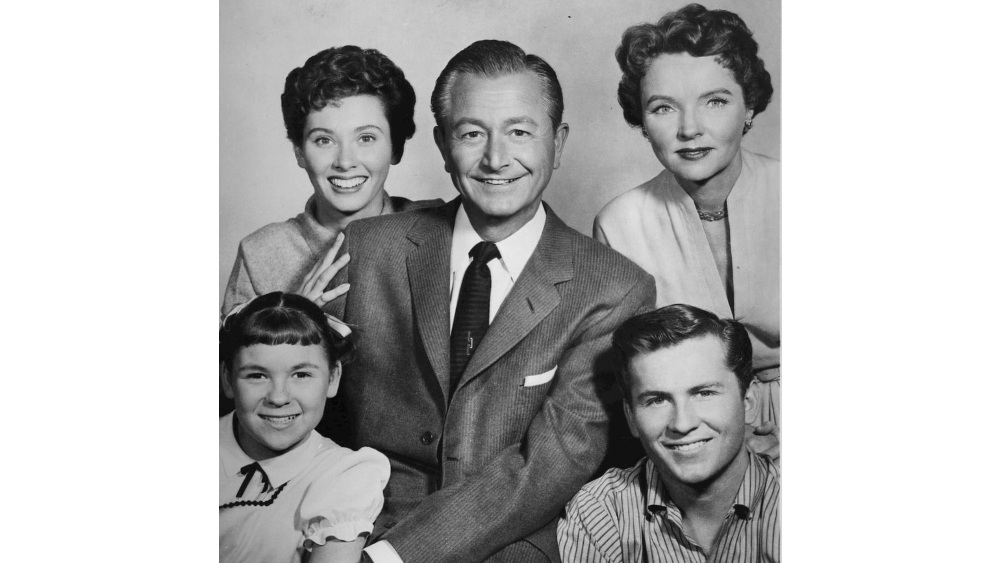
“Little” Lauren Chapin slips away, at 80, and takes with her some of the last tattered remains of post-war America’s fantasy about its own innocence.
She was Kathy Anderson, the youngest of television’s perfect middle-class family in “Father Knows Best.” As Kathy, she was giggly and wholesome and wore ribbons in her pigtails. Her dad, played by Robert Young, called her “Kitten,” and her older brother Bud, portrayed by Billy Gray, affectionately called her “Squirt.”
From ages 9 to 14, how precious was she, and how reflective was the program of 1950s American television innocence. Here’s little Kathy kissing her doting father good night.
“Don’t forget to say your prayers,” says father.
“I’ll say ‘em twice,” Kathy assures him.
Why twice?
“Forgot ‘em last night,” says Kathy.
But blessed as her television career was, and charming as her TV family was, the rest of Chapin’s life played out like the dark side of the national dream.
After “Father Knows Best” ended in 1960, Chapin wrote years later, she felt like a has-been. In her teens, she became a heroin addict. She worked as a call girl. She went to prison for check forgery and to psychiatric hospitals for breakdowns.
Later, she became an evangelical minister. As the New York Times reported, she “raised millions of dollars to help abused children and gave religious testimonials about suffering and redemption.”
In her television years, she was part of a generation of programs featuring happy middle-class families whose lives — and lifestyles — were designed to comfort viewers and prop up sponsors’ products aimed at those viewers.
Think “Ozzie and Harriet,” “Leave It to Beaver,” “The Donna Reed Show.”
Whatever “troubles” these families were solved by the end of their half-hour happy little dramas, just in time for another commercial break.
Those television families became role models for millions of Americans watching each week who told themselves, “So this is what a middle-class family looks like.”
As a “middle-class” father, Robert Young came home each day, removed his workday business suit coat and put on a sports jacket with casual patches on the elbows, which he wore to dinner each night. The mother, Jane Wyatt, wore pearls. The eldest child, Betty, played by Elinor Donohue, called her dad “Father.” He called her “Princess.”
And little Lauren said her prayers twice if, God forbid, she forgot them the previous night.
So let’s go back a dozen years to something called the Mid-Atlantic Nostalgia Convention held at the Marriott Hunt Valley Hotel, and a big-room event billed as a gathering of TV old-timers.
I went there hoping to get a story out of it. But as I wandered about, I didn’t see anybody even vaguely recognizable. So I approached a diminutive, gray-haired fellow in a baseball cap, sitting by himself, and asked if he’d seen any famous old TV stars here.
I introduced myself by name, and so did he.
“I’m Billy Gray,” he said.
He was smiling and convivial, and he said “Father Knows Best” was the last time he ever had regular acting work. A year after the show ended, in his early 20s, he was busted for possession of marijuana.
“In 1961, if they said marijuana, then people thought you were a dope fiend,” Gray said. “And so ‘Bud Anderson, Dope Fiend,’ and that was it. But I’ve lived a life, you know. I rode cycles competitively for 23 years.”
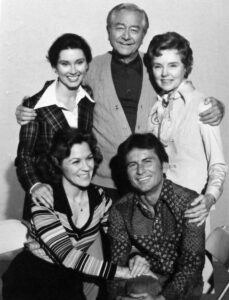
But as Bud Anderson, he was the clean-living role model for the way American boys allegedly came of age.
“I know,” Gray said. “I heard parents used to tell their kids, ‘Why can’t you be like Bud Anderson?’ Or families telling themselves, ‘Why can’t we be like that nice Anderson family?’ But what family’s going to live up to a script written by professionals?
“So you had kids who were thinking, ‘Hey, my parents aren’t like this. They must be s—.’ Well, they’re not s—, they’re just regular people.”
As Gray talked that afternoon, people began to approach him. There was one woman, small and smiling broadly, who reached out a hand, and Gray said, “How are you, honey?”
They embraced like old friends. And then the woman turned to me and said, “Hi, I’m Lauren Chapin.”
Her features had sharpened a little since her TV days, but she was still pint-sized. And she quickly started echoing Gray’s memories of the show and of that American TV era.
“My life on the show was wonderful,” she said. “On and off the air. Robert Young was wonderful to me. Jane Wyatt was wonderful. I would think, ‘Gee, I wish my family was like that.’”
It wasn’t. As Chapin wrote in a memoir years later, she was raised by a sexually abusive father and an alcoholic mother.
Holding hands now with Gray, she said, “‘Father Knows Best’ set a moral example for people to see and live up to. But nobody could measure up to that standard.”
America had a different fantasy about itself in the middle of the 20th century. We’ve grown more cynical and politically antagonistic since then.
Those ‘50s fantasies were lovely, and Chapin and Gray were a big part of them. But in the ensuing years, they each learned the distinction between fantasy and fact. And so has America.

A former Baltimore Sun columnist and WJZ-TV commentator, Michael Olesker is the author of six books, including “Journeys to the Heart of Baltimore” (Johns Hopkins University Press) and “Michael Olesker’s Baltimore: If You Live Here, You’re Home” (Johns Hopkins University).

Last weekend's Flower Mart once again demonstrated that there's nothing to fear about downtown Baltimore, writes Michael Olesker.

A junior at Roland Park Country School, Katie Grossman writes about a recent experience that spurred her to take action to fight antisemitism.
At a time when many Jews fear appearing Jewish in public, seeing Judaism depicted correctly onscreen is reassuring, writes Jewish content creator Rabbi Yael Buechler.

Cruel, inappropriate, egomanical, outrageous and bullying are all attributes that pass for presidential these days, writes Michael Olesker.