
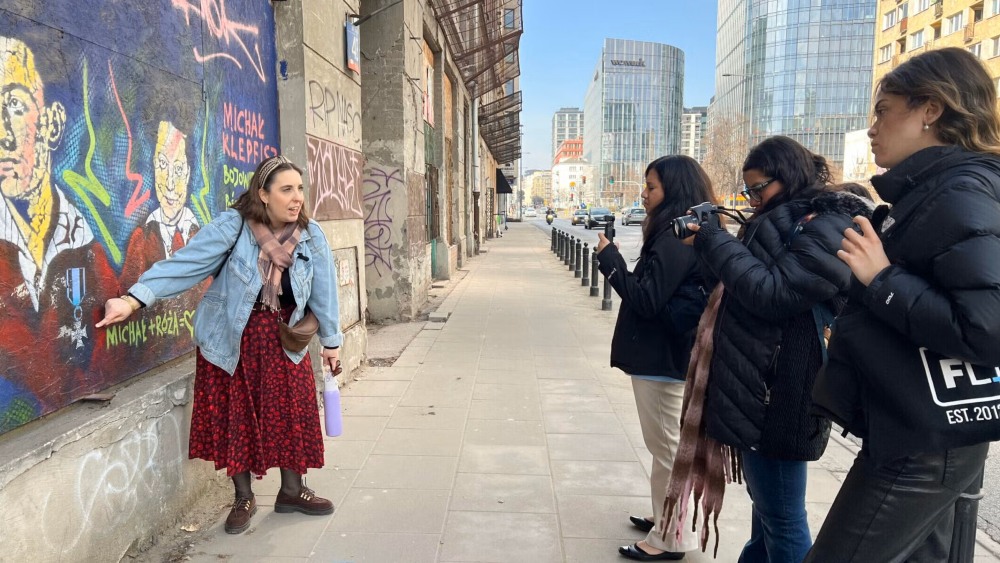
By Lucia Alonso
As a non-Jewish college student, I felt both excitement and trepidation when I got the call that I had been accepted into a news reporting tour of Israel.
Was I really ready to go to witness and write from a country reeling from war, given that the mere mention of Israel can be deeply polarizing on campuses, including my own?
The program — organized for aspiring Hispanic journalists through the nonprofit Fuente Latina — offered a chance to report on a story dominating global headlines.
But when I shared the news with friends and family, the reactions were mixed.
“Are you sure you want to do this?” some friends asked. “Are you really going to risk your future career opportunities to report on Israel, right when this crisis is happening?”
They had reason for concern. On many campuses, indicating concern about Israel and antisemitism draws immediate backlash.
After thinking it through, I decided to turn that hesitation into motivation. I wanted to prove that reporting on Israel and on antisemitism, past and present, should not be seen as a career risk.
If anything, it is both a journalistic responsibility and part of the job to report on a country firsthand and hear directly from people living through history.
This is especially true now as Jews on campus and in cities around the world face isolation, boycotts and attacks at levels not seen in decades.
Too often, opinions are shaped on social media by people with no direct connection to these places, who have never visited them or spoken to the people they write about.
As a journalism student at New York University, of Spanish and Dominican heritage, I live in a city that is home to the largest Jewish population outside of Israel. I have often wondered why a city celebrated for its ethnic diversity has also become one of the most polarized places for Jews in the United States.
Since starting school in early 2024, I have witnessed antisemitism firsthand. Numerous headlines echo the same narrative: “Columbia University leaders face scrutiny over antisemitism on campus” or “Three Jewish students sue NYU, claiming the college failed to protect them from antisemitism.”
I have come to believe that without a deeper understanding of the history and the reality of discrimination against Jews today, such hatred will continue to grow, especially amid ongoing conflicts involving Israel.
That realization brings me back to our trip to the Middle East. Unfortunately, because of the Iran war, Fuente Latina postponed our travel to Israel and instead took our group of student journalists from across the United States and Mexico to Poland.
There, we learned how a country once home to Europe’s largest Jewish population saw about 3 million Jews, roughly 90% of its prewar community, systematically murdered by the Nazis and their collaborators during the Holocaust. In total, six million Jews were killed during World War II, destroying roughly one-third of the world’s Jewish population.
I could not imagine a more powerful way to place current events in a historical context, one I hadn’t fully grasped until that moment.
Our group spent five days in Warsaw and Kraków, tracing a past we had only begun to understand. It came into sharp focus at Auschwitz-Birkenau, the largest Nazi concentration and extermination camp.
We interviewed Holocaust survivors and scholars. Irene Shashar described how she escaped the Warsaw Ghetto as a child through the sewer system. After the war, she moved to Peru before eventually rebuilding her life in Israel.
Ofer Laszewicki, the grandson of survivors, reflected on his family’s Holocaust history and the discrimination he faces as a Spanish-Israeli journalist.
Historian Yoel Schvartz offered insight into how antisemitism has evolved over time.
What surprised me most were the connections I formed with my fellow student journalists and our local guides. Many shared deeply personal stories. Our guides spoke not only about the Holocaust, but about how the devastation Poland experienced in the 20th century continues to shape the country today.
What struck me was that not all of them were Jewish. Their perspectives made clear that antisemitism does not affect only Jewish communities but reverberates far beyond them.
As a student journalist, this experience strengthened my confidence in covering complex global issues. In a short time, Fuente Latina provided us with a profound historical foundation, the opportunity to experience firsthand sites of immense tragedy, and the chance to speak with those still affected by its aftermath.
As someone living in New York City who has observed rising antisemitism over the past two years, this trip opened my eyes to perspectives often absent from college campuses and the media. The rise in antisemitism since the Oct. 7, 2023, terrorist attack on Israel is something I believe everyone needs to understand.
As I return to my daily life, I am committed to sharing what I learned through Fuente Latina and standing up against religious discrimination in all its forms. My friends had real reason to be concerned. Speaking up about antisemitism in today’s environment can quickly draw condemnation.
But journalists have a responsibility to go beyond the headlines, to report the full story and to show how the past continues to shape the present.

Lucia Alonso is a journalism student at New York University.
This article was provided by the JTA global Jewish news source.
Despite security challenges and limited flights, hundreds have made aliyah in 2026.

The Trump administration's invoking of religion is reminiscent of the words and actions of one of history's most brutal Crusaders, writes Michael Olesker.
Like thousands of communities around the country last weekend, Pikesville demonstrated its disgust with the policies of the Trump administration, writes Michael Olesker.

Michael Olesker bids farewell to CBS News Radio, one of the most storied media outlets in history.