
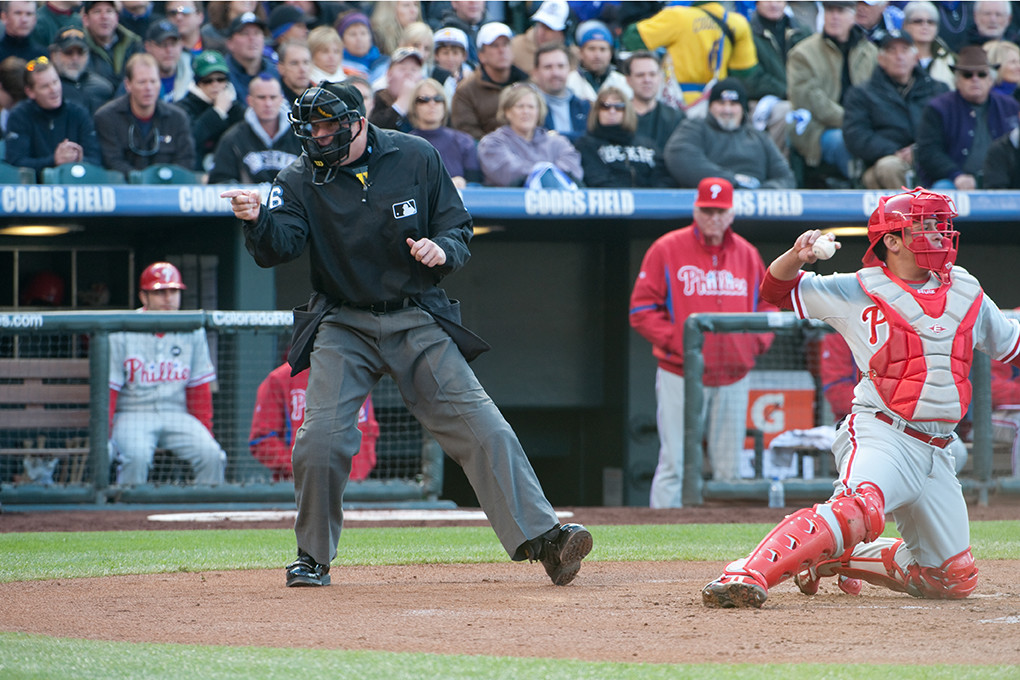
It’s time for Major League Baseball to get balls and strikes called electronically.

Baseball continues to evolve and better itself in ways that one could hardly have foreseen 40 or 50 years ago. The lowering of the pitcher’s mound in 1969; going to divisional play within the American League and National League that created pre-World Series playoffs, also in 1969; the addition of the designated hitter in 1973; and the adding of wild cards in 2012.
But the mother of all changes was implemented in 2014 — instant replay.
With all the sports going to one form or another of getting calls right, baseball was left with very little choice than to go this route. The sport was conspicuous in its lateness to this dance.
Of course, we still know that human beings are doing for the most part — say, like, 97-98 percent of the time — an excellent job.
But as much as I love today’s game, with the advent of replay, there is an irritating inconsistency growing and gnawing like an abscess within the game. Namely, the imperfect and truthfully obscure notion of what is a ball and what is a strike. And to be more on point, why can’t a more precise definition lead to an objectively true strike zone, rather than depending upon the vagaries of which man in blue is dusting off the plate in a given game?
Nowhere did this hit home more poignantly than watching the just-concluded 2016 postseason and World Series. I happened to be driving to work the morning after that stirring Game 7 victory by the Cubs, tuned into Steve Phillips and ex-Oriole Brian Roberts on “The Leadoff Spot,” and I wasn’t in the car more than 10 seconds when Roberts was railing against home plate umpire Sam Holbrook for what he perceived as an egregiously bad call on what should have called strike 3 on a 3-2 count to Carlos Santana.
Instead, Holbrook called a ball on Santana. Santana went to first, which prompted Joe Maddon to take his starter out after just 4 2/3 innings pitched. It was a bad call by Holbrook that easily could have changed history.
On that show, Roberts declared himself all in on “Robo Umps” being used for balls and strikes. For my own edification, the other day I Googled the total number of pitches thrown in an MLB season. Compliments of Baseball Reference, that number is 790,506 pitched over the roughly 2,340 MLB games played in a season.
That is an awful lot of subjectivity left in the hands of human beings on the simple and most meaningful calls in the game.
Think back to tennis and technology. That sport in the U.S. really exploded with big money on TV in the early to mid-‘70s when American brashness was introduced into the game, in the form of Jimmy Connors. He turned pro in ‘72, and we all know he begat the bratty punk John McEnroe in 1978 who was always complaining about in/out and long/short.
Without the advent of those two players and the big money they helped bring to the game via big-time TV coverage contracts for the majors, we’d probably still be calling the basic line calls by a bloated number of judges. In point of fact, we still have judges who make the initial calls, but the players have the right to challenge three times per set. If they correctly challenge, they do not lose a challenge. So in a five-set championship match, a player can challenge minimally 15 times.
Nobody talking about the idea of electronically calling balls and strikes in baseball is proposing a challenge system. Rather the idea would involve taking pictures of a hitter’s basic batting stance and compiling some sort of electronic file for that hitter, which would then allow the technology to capture in a nanosecond the location of each pitch and properly call it a ball or a strike.
Think of how much faster the game would move along. Think about how a well- defined strike zone with total predictability would assist a pitcher in lowering pitch counts.
Batters would be much more likely to swing away, knowing they couldn’t merely coax bases on balls against certain “hitters” umps. The defenses would be much more on their toes, with the knowledge that finally everyone would know the objective truth of what is a strike.
Reading about tennis’ implementation of electronic calls, one article talked about a tournament early in Andy Roddick’s career in 2001 when he pretty clearly got screwed by a critical bad call in the fifth set of a quarterfinal match in the U.S. Open against Australian Lleyton Hewitt. At the time, there was no video replay, and Roddick lost with a bitter taste in his mouth and no way to really know whether it was a good or bad call.
The article then went on to fast forward to a match in 2012, Roddick’s last season, and recounted the story of how in a similar situation a human linesman made a critical out call that would have cost Roddick a match. However, this time, with players having video challenges, after a quick and easy video review, Roddick was right and the linesman was wrong and history was changed in Roddick’s favor.
With MLB’s video replay changing the nature of how we watch and experience the game of baseball, the notion of being precisely correct on calls is like a Pandora’s box having been opened. Once opened, baseball’s chaos will not and cannot be abated without foraging further into the technological path of going all in on Robo Umpires for balls and strikes.
Stan “The Fan” Charles is the founder and publisher of PressBox.
Home plate umpire calls a strike in a Colorado Rockies, Philadelphia Phillies. Photo by Jeff Smith

The BCO, founded in 1984, will perform the works of Frank Zappa, Beethoven, Mason Bates and Karena Ingram.

For more than 130 years, Sol Levinson & Bros. has been woven into the fabric of Baltimore’s Jewish community.

A former college campus activist, Veksler will speak at Chizuk Amuno on June 8 at the Ruth and Jay Lenrow Visiting Scholar-in-Residence for Combating Antisemitism.