
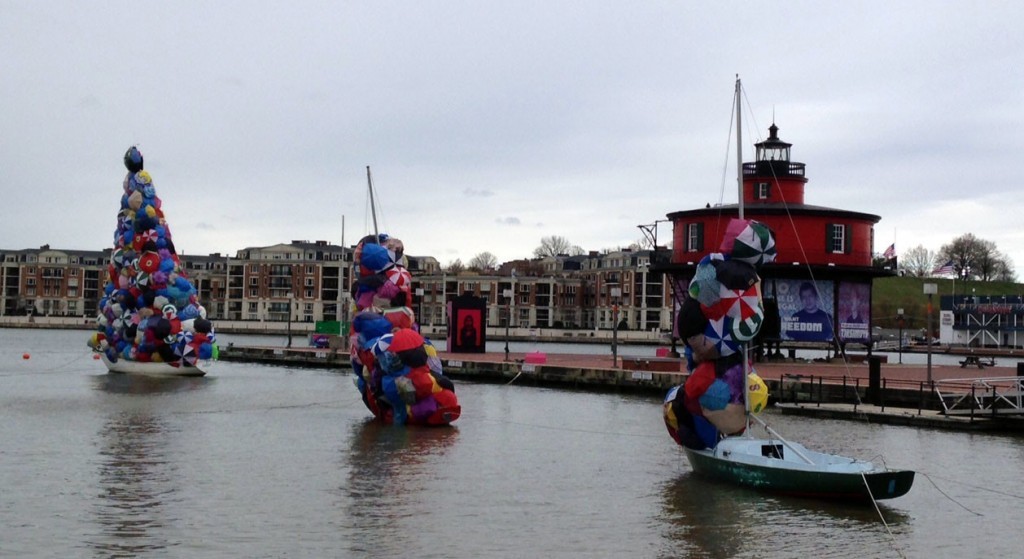
Among the saddest sights witnessed in Baltimore in recent memory was the flashing sign on the Jones Falls Expressway near the St. Paul Street exit, informing drivers these past few weeks that there was “Added Police Presence” for all those heading to the Light City festival.
The sign was intended as a comfort: you can stroll along the waterfront and not feel threatened.
You can venture into downtown Baltimore and not worry that you’re going to be attacked.
In Dante’s Inferno, the warning was: All hope abandon, ye who enter here.
In the city of Baltimore, two years after the killing of Freddie Gray and the riots that followed, the elders at City Hall felt compelled to assure us that the opposite is true: Despite all of your lingering fears, it’s OK to come back downtown, because the cops have got you covered.
All hope hold onto, ye who enter here.
The Light City show – artists showing their magic with displays of light along the downtown waterfront – reportedly attracted nearly half a million people. The exhibit extended over nine days.
The question is, how long does the anxious aftermath of Freddie Gray’s killing linger?
Over the last two years, owners of downtown bars and restaurants have almost uniformly complained of business losses from prospective customers’ lingering fears. Orioles officials have bemoaned the emotional fallout, though attendance was strong for last weekend’s series with the Yankees.
Was the Light City turnout a sign that our municipal nervousness is fading?
This magazine’s April print issue – “The Race Issue” – explores such issues, and wisely does it by asking for answers from a variety of voices, black and white.
We’re two years since the Freddie Gray disturbances, but its symptoms linger: the large economic gap between haves and have-nots, reflective of the entire country; the large economic gap between blacks and whites; the mutual suspicions between police and minorities; the ongoing gunplay, which is almost entirely played out in impoverished minority neighborhoods, where narcotics traffic flourishes and frustrations express themselves violently.
In Baltimore we have two cities: the one where we feel safe, and the one where we don’t.
But here we are, two years after Freddie Gray, and City Hall feels compelled to assure us – “Added Police Presence,” the sign said – that you can venture downtown and seek out the comforting lights.
Two years later, it’s so sad that we still need such assurance.
 A former Baltimore Sun columnist and WJZ-TV commentator, Michael Olesker is the author of six books, most recently “Front Stoops in the Fifties: Baltimore Legends Come of Age” (Johns Hopkins University Press).
Top photo: An installation from Light City Baltimore 2017 (Photo by Amanda Krotki, JMore)
As millions mourn the passing of Stephen Colbert from the airwaves, Michael Olesker looks back on the "institution" of late-night TV.
Michael Olesker pays tribute to WJZ’s retiring Marty Bass, a longtime fixture on local TV screens.
The Orioles' weak defense plays a major role in the nightly carnage, writes Michael Olesker.