
Back in the early days of 1928, the lines stretched far along North Avenue near its intersection with Pennsylvania Avenue. Even Washingtonians made the long trek journey to Baltimore’s Metropolitan Theatre to see and hear the great Al Jolson perform in the smash hit, “The Jazz Singer.”
The Met, built in 1922 as an opulent neighborhood theater with an ornate balcony, presented the first “talkie” for an unheard-of five weeks. The theater was located in a heavily Jewish area, hence the strong appeal of Jolson as a cantor’s son and his rendition of Kol Nidre.
It could be argued that The Met was a “Jewish theater,” one that catered to its neighborhood audience.
But it wasn’t the first one in Baltimore. Movie houses with Jewish clienteles and featuring cinema fare tailored for Jewish tastes once dotted the landscape in Charm City.
Across North Avenue from The Met, the gothic muses on the Beaux-Arts facade of Pennsylvania Avenue’s Arch Social Club reveal what once was the Schanze Theatre. The Schanze was built in 1912 and named after Dr. Frederick W. Schanze, the pharmacist and benefactor of the theater. Renamed the Cinema Theatre in 1941, Yiddish films were screened there for a while.
Farther down North Avenue were The Rialto and The Linden, the latter of which showed foreign films from 1954 until 1965.
In East Baltimore, Berman’s Theatre — at Baltimore and High streets, and considered the first Jewish neighborhood theater — opened in 1915 and closed seven years later.
The main downtown theaters, such as The Auditorium and The Palace, presented many Yiddish stage shows starring famed actors like Molly Picon and the Thomashefskys. In 1927, the Folly Theatre, at East Broadway and Fallsway, presented the Yiddish musical comedy “The Rebel From Kafkaz.”
Before the old Maryland Theatre at 322 W. Franklin St. was torn down in 1951, it presented “The Cantor’s Boy” by the European Yiddish Actors Ensemble.
A low-budget comedy titled “Catskill Honeymoon” opened in 1951 at the small World Theater on Lexington Street and then traveled uptown to the Gwynn Theatre on Liberty Heights and to The Avalon on Park Heights.
As the local Jewish population migrated northwest, theaters were built “uptown” to satisfy their entertainment cravings. For instance, in heavily Jewish Lower Park Heights, The Avalon opened in 1926 and occasionally played a Yiddish film like “A Vilna Legend” and “Singing in the Dark” with noted cantor and Yiddish actor Moishe Oysher. The Avalon turned to foreign films in 1961 and closed two years later.
Up the road were The Pimlico and the popular Uptown, which opened in 1941 and became a first-run house by 1962. “The Ten Commandments” left its downtown run and went directly to The Uptown in 1957.
In 1968, the underrated “Bye Bye Braverman” with George Segal played at The Uptown, the movie house at the Reisterstown Road Plaza, and the Randallstown Plaza Theater. The Uptown closed in 1975 as the Pimlico area fell on hard times.
When the Hilltop Shopping Center opened in 1949, so did The Crest, a splendid modern theater at 5425 Reisterstown Road. The Crest became a first-run theater in 1960 and presented such James Bond gems as “Thunderball” and “Diamonds Are Forever,” as well as the Jewish-themed “Exodus,” “Cast a Giant Shadow” and “Sinai Commandos.”
In 1969, The Crest also presented the documentary “Journey to Jerusalem” with Leonard Bernstein and Isaac Stern, as well as “Ben-Gurion Remembers” in 1972. The Crest closed five years later.
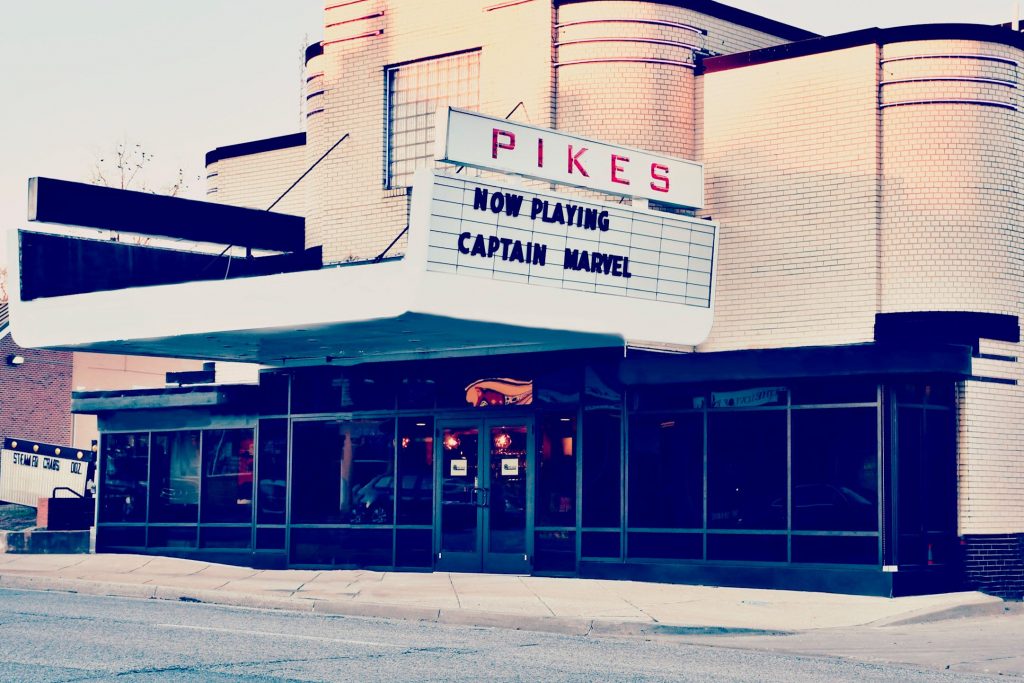
The Pikes Theatre was built for the sleepy hamlet of Pikesville back in 1938 before development exploded in the late 1950s in the suburb, which is now mostly Jewish. The Pikes became a first-run theater in 1958, featuring such classics as “The Graduate,” “The Producers,” “Blazing Saddles,” “Hester Street,” “The Frisco Kid,” “Lies My Father Told Me” and all of Woody Allen’s early films.
The original Pikes closed in 1984 but reopened last year and presents films, albeit in a much smaller, reconfigured area of the building.
Not to be forgotten in any discussion of Baltimore’s theaters is The Forest, which opened on Garrison Boulevard in 1919. It was a neighborhood house until it began showing foreign films in its final years, closing in 1961.
Howard Park’s The Gwynn on Liberty Heights Avenue opened in 1933 but was soon overshadowed by The Ambassador, an Art Deco gem that opened to great fanfare two years later across the street. The Gwynn closed in 1952.
The Ambassador became a first-run theater around 1963 and showed “Operation Eichmann” with Werner Klemperer and “Impossible on Saturday,” an Italian-French-Israeli comedy, before closing in 1968.
Among the movie houses that opened in suburban shopping complexes were those at the Liberty Court in 1964, followed by the Randallstown Plaza cinema a year later. The Liberty presented the film adaptation of Philip Roth’s “Goodbye, Columbus” in 1969. Meanwhile, The Randallstown showed “Fiddler on the Roof” exclusively in 1971 and later the Israeli musical comedy “Kazablan.”
The Randallstown movie house closed in 1986 and the Liberty Court in 1997.
The Reisterstown Road Plaza Theater opened in 1965. Among the films that played there over the years were Woody Allen’s “Play it Again, Sam” and Bob Fosse’s “Lenny,” starring Dustin Hoffman and Valerie Perrine.
Lastly, there was Pikesville’s Mini-Flick 1 & 2, which presented movies from 1973 to 1986.
The age of “Jewish theaters” is now long gone, most likely never to return. Ethnic films that cater to certain neighborhoods was a concept that worked because it was the only way those audiences could see themselves before the age of video and cable.
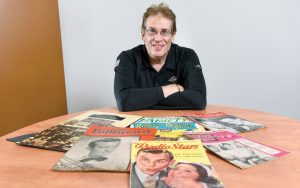
Steve Liebowitz is a Baltimore-based freelance writer and author of “Steel Pier, Atlantic City: Showplace of the Nation” (Down the Shore Publishing) and “Steel Pier” (Arcadia Publishing).

Walk around the former Jewish neighborhoods of Baltimore and you'll still find traces of Jewish life there.
Steve Liebowitz has a passion for the nightclubs, jazz clubs, ballrooms and theaters of the post-World War II period.
After an extensive renovation, the historic movie house reopens as an independent boutique theater.