
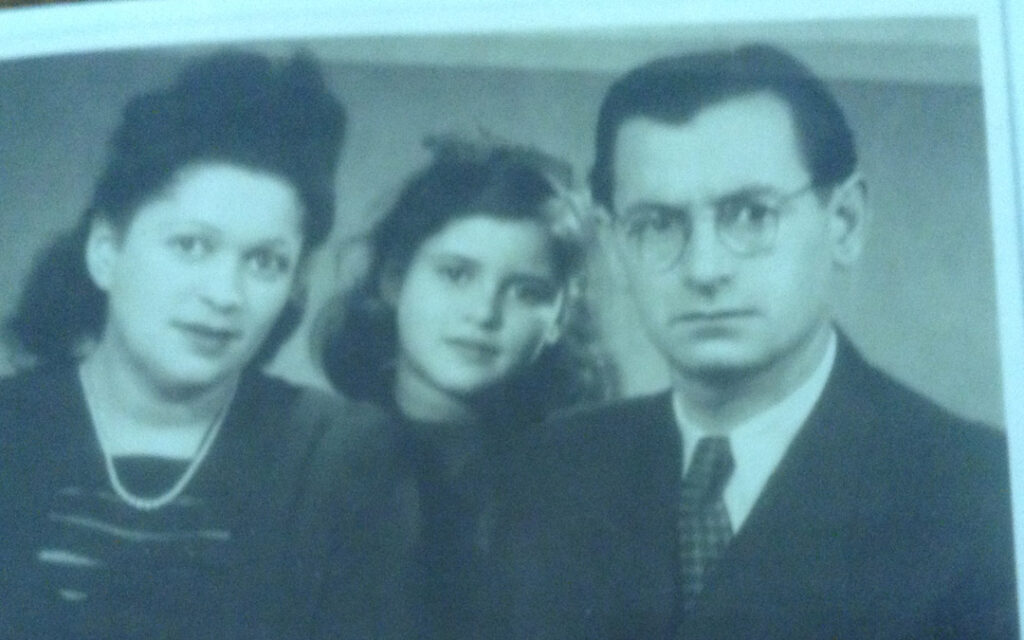
By Ruth Grill
Long ago, back in the 1940s and ‘50s, I used to dream of receiving a message in faded ink from a stranger, perhaps in a bottle washed up on the shore during a beach holiday.
Who was writing, and from where? Was he or she in trouble, needing help?
No one fantasizes this way nowadays. Messages are sent with the click of a finger. Letters are now completely obsolete.
Yet there are still echoes from a long-distant past that can take you by surprise.
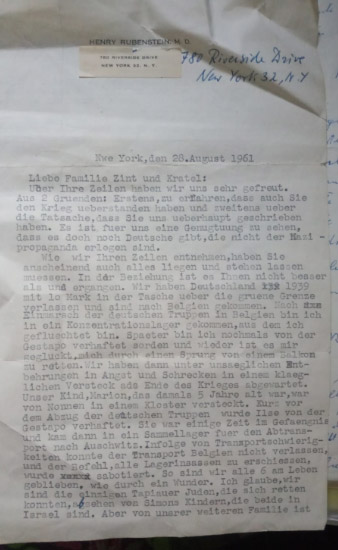
An old letter recently found its way to the email inbox of my daughter, Simone. It was written in German in 1961, addressed to old friends back in Bavaria by my long-deceased father. He wrote from New York, where he, my mother and I had relocated to in 1948.
Reading the letter, I could almost hear the tone of my father’s voice, his joy at suddenly hearing from people he knew in Germany before the Holocaust, before our flight from East Prussia in 1939. He wrote of how happy he was to hear from them and to be reminded that there were German non-Jews who rejected Hitler’s propaganda.
He included in the letter a succinct account of the terror experienced by our family during the war in Nazi-occupied Belgium. He told them of our moving from room to whatever temporary room might be available, to remain safe from the Gestapo.
He shared that my family placed me in a convent at the age of 5, since my speaking of German in the streets could be potentially lethal.
He wrote that he was interned in a work camp for two years, but eventually escaped. My aunt was scheduled for transport to Auschwitz, he informed them, but this was sabotaged by the Allies. He wrote of the murder of most of my grandparents’ generation, and that no Jew who remained in their hometown survived.
My father concluded the correspondence with a brief summary of our life in New York, and wished his old friend, “Herr K,” a happy 77th birthday.
How did I get to read this letter penned by my father six decades ago?
It seems that a man who lives in Germany went through some of his old family papers, found this letter and sent it to his cousin in America, Constance, the granddaughter of Herr und Frau Kartell, my father’s friends from so long ago. Constance spent the war in south Bavaria with her parents and now lives in Texas.
Constance, who is somewhat younger than Simone, found my daughter’s email address while researching the people listed in my father’s obituary. She found Simone’s website (simoneellin.com) and articles about being bullied as a teenager, and Constance shared with her that she was also bullied as a youngster.
So the letter’s trajectory was from the Kratels’ cousin in Germany to Constance in Texas to Simone in Baltimore to her sister, Genese, in Vermont, to me in New York.
The magic of technology!
For a woman of my generation, it is amazing how a letter like this, written a lifetime ago by my dear father, can now reach all of us in the blink of an eye. In hindsight, a message in a bottle may be a very lovely image and metaphor, but it’s so much less efficient!

Ruth Grill lives in New York and is the author of the memoir, “Davka: I Will Dance.” Her daughter, Simone Ellin, is the associate editor of Jmore.
Michael Olesker pays tribute to WJZ’s retiring Marty Bass, a longtime fixture on local TV screens.

The Orioles' weak defense plays a major role in the nightly carnage, writes Michael Olesker.

Jmore Publisher Scott Rifkin, M.D., reacts to President Donald Trump's latest poll numbers and the real force behind the growing decline of the Trump movement.

Last weekend's Flower Mart once again demonstrated that there's nothing to fear about downtown Baltimore, writes Michael Olesker.