
By Marcus M. Gilban
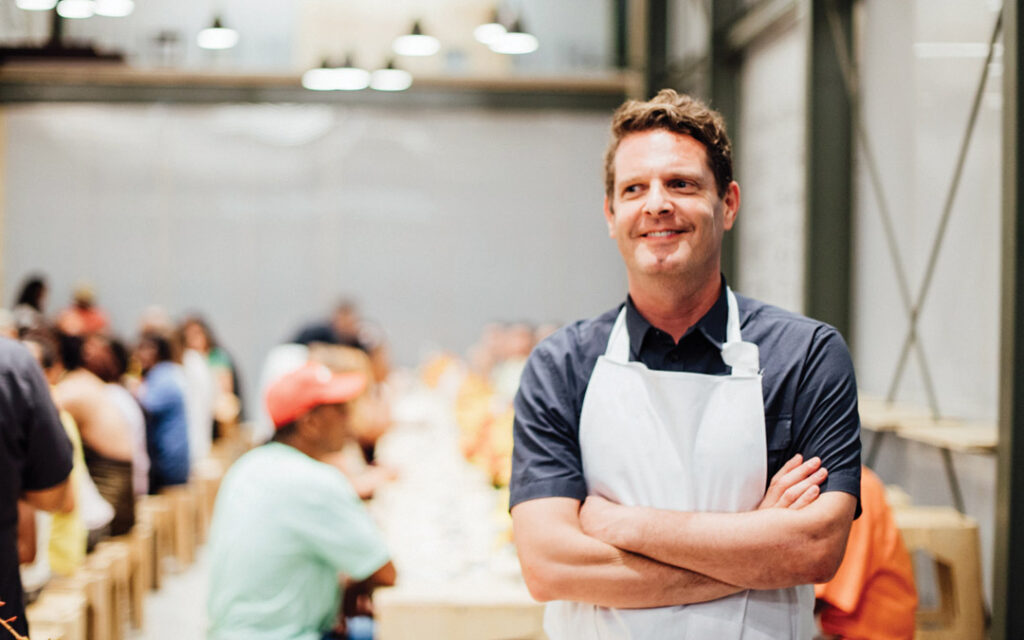
Chef David Hertz, one of the world’s leading food entrepreneurs tackling social issues, credits two places with inspiring his journey: the kibbutz experience in Israel and the Brazilian favela.
At 18, after growing up in the southern Brazilian city of Curitiba, Hertz traveled to the Hatzerim kibbutz to live among native Israelis and Jews from all over the world.
“I discovered myself and then I hit the world,” he said. “I had there the first vision that there was a bigger world and I could search for my story, whatever it was. What was supposed to be a one-year trip abroad turned into seven.”
Between the ages of 18 and 25, Hertz visited Thailand, China, Vietnam, India, England and Canada. He took his first cooking lesson in Thailand and discovered the ritual side of cooking in India. When he hit Toronto and started to work in the food delivery industry, he became inspired to become a chef, so he moved back to Brazil to attend a college of gastronomy in Sao Paulo.
Then in 2004, Hertz was invited to design a kitchen project inside the Jaguare favela, one of Brazil’s many low-income shantytowns plagued with urban violence and drug trafficking, and historically neglected by the government. He had never been inside one before.
“When I stepped into that kitchen, I saw a new world,” Hertz said. “I was inspired to do something to contribute to the reduction of violence and to share my knowledge with the young people there, who at many times felt lost, with no relation of belonging to the space.
“It became my life project, my mission.”
The next year, with the help of his apprentice Urideia Costa, he decided to create a school focused on training upcoming chefs from low-income areas, which are often plagued by malnutrition and food shortages. His organization called Gastromotiva came out of the oven.
Gastromotiva runs a network of what they call Solidarity Kitchens, of which there are now 55 across Brazil and three in Mexico. One of them operates out of Hertz’s favorite synagogue in Sao Paulo, Comunidade Shalom.
After Hertz spoke there last year, the synagogue decided to become a Solidarity Kitchen and now prepares 1,250 meals per month for homeless and vulnerable people in the area.
Now 46, Hertz later co-founded the Social Gastronomy movement, a network of local communities that work “to address social inequality, improve nutrition, and engage people to leverage their skills for social good” and address “all levels of the food production chain — from sowing and harvesting crops to preparing meals, to utilizing food waste.” He introduced it at the prestigious World Economic Forum in Davos, Switzerland, in January of 2018.
For his work on Gastromotiva, he won the 2019 Charles Bronfman Prize, which honors innovative work grounded in Jewish values and comes with $100,000. He has also worked closely with the United Nations’ World Food Program, which won last year’s Nobel Peace Prize. They have been partners in many efforts to combat global hunger, with the latest focused on alleviating the hunger crisis brought on by the COVID-19 pandemic.
By the end of 2021, the number of Solidarity Kitchens will nearly double to 108, including some in other countries in Latin America.
“Combating hunger and food waste are global challenges that require joint action. Collaborating with each other, we multiply our impact on the world. I wonder how to feed humanity with humanity,” he told the Brazilian magazine Veja last year.
These days, Hertz talks about promoting the core Jewish values of feeding the hungry and creating community, but he went through a long search for the recipe to his own Jewishness.
He initially felt like he didn’t belong to his own community at all because he is gay.
“I attended a Jewish day school, was a member of the Habonim Dror Zionist youth movement, and was engaged with all the Jewish folklore,” he said. “However, I have always felt like a fish out of water. When I came out as gay [at 25], I felt very uncomfortable. I always felt like an outsider. …
“I struggled a lot to accept the Jewishness inside of me,” Hertz said. “I always thought that I lived a deep-rooted prejudice for being gay.”
After returning to Brazil after backpacking across the world and learning to understand his own religious beliefs, it was at Comunidade Shalom, a congregation that was born as Reform and later affiliated with the Conservative movement, where Hertz found his fit.
“It brought me a new layer of Jewish identity but interpreted by myself,” he said. “I have gained a sense of belonging.”
Now living in Rio, Hertz attends an egalitarian Conservative temple where interfaith families are embraced.
“Jews usually look after Jews,” he said, “and I think we can always do much more by going beyond.”
Marcus M. Gilban writes for the JTA global Jewish news source.

The Jerusalem Orchestra East & West, which arranged the program for young musicians, blends Western orchestral music with Middle Eastern traditions.

Dara Bunjon talks with award-winning author Monica Saigal (Bhide) about her "Modern Spice" cookbook, "Papa's Butter Chicken" children's book, and more.

It doesn't get much easier than this cucumber and purple cabbage salad from Elite Jakob, perfect for a warm spring day.

Dara Bunjon talks sustainable farming, chocolate, and more with farmer, chef, educator and chocolatier Mark Mills of Chocolates and Tomatoes Farm in Middletown.