
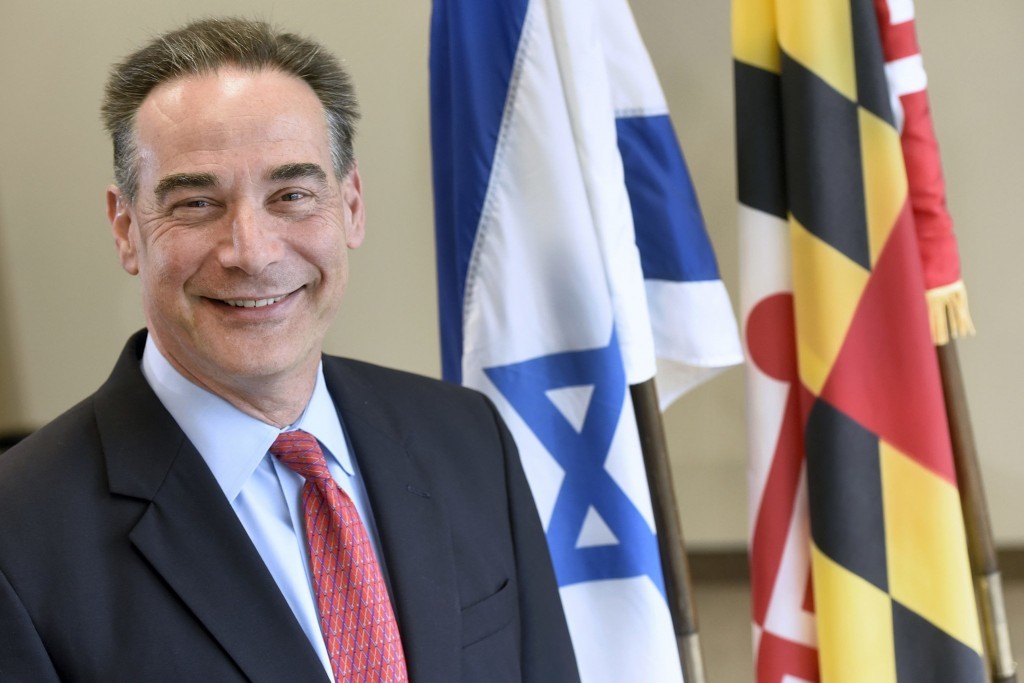
For three decades, Barry Bogage’s name has been synonymous with the work of the Maryland/Israel Development Center.
A nonprofit, the MIDC is a partnership of The Associated: Jewish Federation of Baltimore, the Maryland Department of Commerce and Israel’s Ministry of Economy and Industry. Its mission is to attract Israeli companies to Maryland and foster business collaborations while creating jobs.
A Pikesville native who lives in Columbia, Bogage, 64, recently retired from his position as the MIDC’s executive director. He was succeeded by David Speer, who previously worked as director of intelligence and analytics for the Washington/Baltimore region of Americans for Ben-Gurion University. Bogage is currently serving as an advisor to the MIDC.
On Sunday, June 12, the MIDC celebrated its 30th anniversary and Bogage’s retirement with an event in downtown Baltimore. Jmore recently spoke with Bogage about his tenure at the MIDC and the unique relationship between Maryland and Israel.
How did you first get involved with the MIDC?
Gov. [William Donald] Schaefer signed a Maryland/Israel Declaration of Cooperation with the Israeli ambassador in 1988. The declaration called for both sides to collaborate in high-tech development and business cooperation.
I was at the signing ceremony. At the time, I was working for the Howard County Department of Economic Development, and I had spent a lot of time in Israel as a student and volunteer at a kibbutz in my 20s. So when I saw that Gov. Schaefer wanted to start an economic development program with Israel, and my profession was in economic development, and in my personal life I’d spent a lot of time in Israel, I was very interested in getting that job.
It was three years later that I finally got the job, but that signing ceremony was the beginning
How was the MIDC formed?
Think back to 1988: the Soviet Union [was falling] apart, causing mass immigration of the Russian Jewish community to Israel, and super-high unemployment in Israel. So lay leaders of The Associated who were in the business world said, ‘Israel needs to create jobs. Let’s create an economic development program to help create jobs in Israel. And since Israel is emerging as a high-tech place, it will also help create jobs in Maryland.’
What are some of the benefits of this partnership?
It marries the Maryland and Israeli business communities together. In Maryland, we’ve got NIH [the National Institutes of Health], the FDA [U.S. Food and Drug Administration], Johns Hopkins, University of Maryland — very strong medical research, hospitals and so forth. Israel’s got the same thing: the Weizmann Institute, Rambam Hospital, Hadassah and so forth.
For instance, Hadassah Hospital and the University of Maryland Medical Center do a lot of collaborating. The guy who set up the Hadassah Hospital Emergency Department had worked at [the R Adams Cowley Shock Trauma Center at the University of Maryland] and modeled a lot of what they did at Hadassah off of what was being done at Shock Trauma.
Then, when Dr. Jay Perman was president of the University of Maryland, Baltimore, he went on two of our trade missions to Israel with Governors [Martin] O’Malley and [Larry] Hogan. And he signed an additional agreement with Hadassah and with the surgeon general of the IDF [Israel Defense Forces] to do more research in emergency medicine, military medicine and so forth.
There’s also a lot taking place in cybersecurity between Maryland and Israel. In Maryland, a lot of it spins off of the National Security Agency out of Fort Meade. Israel is of course very strong in cybersecurity because they have to be.
What are some other strategic partnerships people may not know about?
The big one we’ve talked about a lot is a major Israeli defense company called ELTA. They opened their North America headquarters here about 10 years ago.
There is also an Israeli biotech company called Orgenesis, and they set up a lab at Johns Hopkins that does something with self-therapy. I can’t really talk about the scientific aspects of it, but I know the Hopkins physicians were excited.
What do you consider the highlight of your MIDC career?
The ELTA deal. That was pretty big. Israel’s known as the ‘start-up nation.’ So most of the companies we work with are small start-ups, and they’re very exciting because they’ve all got some innovative twist on some technology.
But ELTA’s a big company in Israel — it’s got 3,500 employees. And it’s not very common when you get a large corporation that’s looking for a new headquarters location. But we were able to work with them and succeed.
In what way is Maryland attractive to Israeli companies?
The best thing that states and counties can do from an economic development standpoint is they’ve got to have infrastructure, competitive tax rates, good school systems. Maryland schools are ranked nationally within the top three-to-five school systems. So Maryland is sitting pretty to attract new businesses and to grow our own business community.
It’s very competitive among the states. Massachusetts, Silicon Valley — they’re known worldwide as major tech hubs, so they attract a lot of foreign companies. But Maryland, we’ve just got a lot to offer.
What have you found to be the biggest misperception about Israeli commerce?
The biggest issue is that there is a cultural difference between Americans and Israelis in how they do business. It’s often subtle and creates frustrations. My interpretation over all these years has been we’re all Western, we all dress the same, they all speak English. Why is there friction? And it’s because there are just differences in cultural things.
A guy called me and said, ‘I need your advice. I’m talking to an Israeli company about working together. But every time we talk, it seems like we get into an argument.’ And I said, ‘I bet the Israeli guy doesn’t think he’s in an argument. He’s probably just passionate. Just give it back to him. And then you can get over this hump, and the next thing you know, he’ll be inviting you to his son’s bar mitzvah.’
What’s changed in the Maryland/Israel economic development landscape over the past three decades?
When we first got started in the early ‘90s, there was the Madrid Peace Conference and everything was looking bright for a future of peace in the Middle East. The Soviet Union fell apart. Israel started growing as a high-tech country.
Then it all came to a screeching halt. There was the dot-com bust, followed by Y2K, followed by 9/11 and intifadas. It was super-slow for several years.
Then we started climbing out of it, and then there was the 2008 recession. Then we started climbing out of that, and it’s been boon years for several years again.
When I started, there were about six Israeli companies in Maryland, mostly defense companies that needed to be near D.C. By the end of the ‘90s, we had almost 50 companies. Then with the dot-com bust, 9/11, and so forth, most of them went out of business and moved back to Israel. The number collapsed to about 18. And now we have about three dozen or so Israeli companies here.
What have been the most rewarding moments of your job?
Meeting new people. With entrepreneurs, everybody’s got an amazing new twist on some technology. It can be a monumental internet kind of technology or just a new medical device that does something helpful.
Have you always been passionate about Israel?
Yes, I went to Israel for the first time as a foreign exchange student. I went to the University of Maryland, College Park, so I went in my sophomore year to Tel Aviv University for a semester, and it just kind of changed my life because I’m still doing it. I had thought I was going to go to law school and do that very common path, but I lucked out into this job.
What’s your take on MIDC’s future?
David’s a great hire. I think he’ll do great. I look forward to him keeping going what we have and expanding beyond there with his own creativity.
Hanni R. Werner is a local freelance writer.

The Jerusalem Orchestra East & West, which arranged the program for young musicians, blends Western orchestral music with Middle Eastern traditions.
A Norfolk native, Frankle worked at Sinai Hospital, Camp Airy and privately for five decades.
Esther Greenberg, Leora Match, Kathlleen St. Villier Hill and Ben Gershowitz will be recognized for the contributions to the community.
For more than five decades, Dr. Rosenstein was known by local families as a trusted and caring physician for their children.