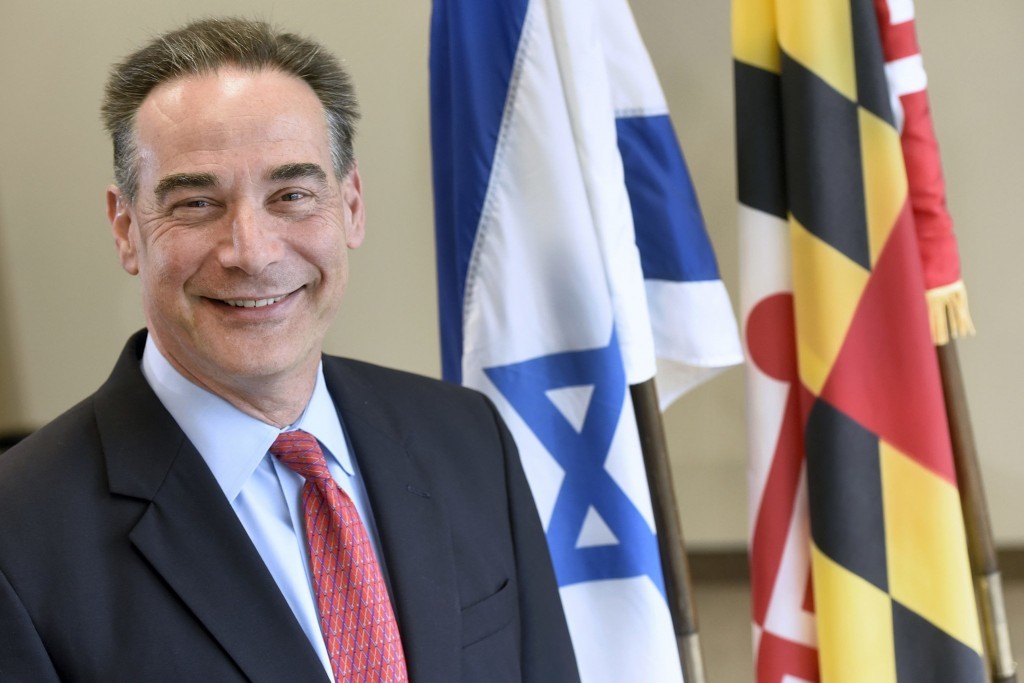
The Maryland/Israel Development Center (MIDC) will mark its 25th anniversary on May 7 with a celebration at the Baltimore Museum of Industry. Gov. Larry Hogan is slated to speak at the gala.
A nonprofit membership organization, MIDC works to promote trade deals and economic development between Maryland and Israel. The center is a public-private partnership of the Maryland Department of Commerce, Israel’s Ministry of Economy and Trade, and The Associated: Jewish Community Federation of Baltimore.
Jmore recently spoke with Barry Bogage, executive director of MIDC since its inception. He spoke of the center’s recent commercial successes and on the ever-expanding trade relationship between the Jewish state and the Old Line State.
Talk about recent wins
The big win for us, the gift that keeps on giving, was a company called ELTA Systems, a billion-dollar company that makes radar for the famous Iron Dome anti-missile system. We landed their North American headquarters in Maryland about four years ago and they just expanded in December, moving to a new facility in Annapolis Junction and tripling in size from 25 to 75 employees. So we are thrilled with that. It’s high-tech jobs, it’s manufacturing. We love being able to say that components for the Iron Dome are being manufactured in Maryland.
We also recently helped UMBC and Tel Aviv University to sign an agreement for joint research and faculty and student exchanges. Also, the University of Maryland, Baltimore has renewed an agreement with Hadassah Hospital and the surgeon general of the Israel Defense Forces to do joint research in emergency medicine.
What was MIDC’s involvement in Gov. Hogan’s visit to Israel last fall?
I’ve organized trips for all the Maryland governors since 1992. This one was a trade mission — all business meetings and a handful of government meetings. He met with ELTA, of course, and with other companies. He met with the Israeli defense company Elbit and their cybersecurity spinoff, Cyberbit, and the governor announced a deal in which Cyberbit is going to set up a cybersecurity training center in Baltimore. So that was really nice, especially with the state emphasizing cybersecurity. The governor also spoke at Tel Aviv University and had a great response there.
What draws Israeli companies to Maryland?
It’s the high-tech economy that’s here. We have two industries that are uniquely strong in Maryland and Israel — biotech and cybersecurity. In biotech, the Israeli scientists and researchers all have ties to [the National Institutes of Health] and to Baltimore research institutions. In cybersecurity, the U.S. Cyber Command and the National Security Agency are both in Maryland, and that is the heart of cybersecurity activities. So we have anchors in both of those areas.
How do Israeli ties benefit Maryland?
We are putting together two of the strongest technology communities in the world, so we get all kinds of innovation and research. We also get new deals between companies that are profitable, that drive growth. That is our ultimate goal, to bring economic development to both places by promoting trade and investment.
Has the Boycott, Divestment and Sanctions (BDS) movement impacted your work?
In my world, which is between business people and scientists and engineers, it never comes up. People want to work together, they want to be in touch with the best minds in their field. It comes up in the Jewish community, it comes up in the political realm, but we really operate in the business community and I have yet to see it have an impact there. You read the Israeli newspapers and the BDS people are trying to stop artists from coming to Israel, but they all go. BDS wants to throw a wrench in the works, but Israel’s economy is still doing really well.
What’s the biggest challenge you face?
The big challenge for us is the general challenge that everybody faces in economic development: competition from other communities. There are a lot of people who want to attract Israeli companies. Silicon Valley and Massachusetts have large clusters of Israeli companies and they have large venture capital communities. So it just makes us work harder.
It’s not that those places have better public policy to promote trade, it’s the depth of the high-tech economies that are there. That automatically puts them on the radar screen of companies looking to come to the United States. So we have to work harder to get on the screen. So we have a full-time rep in Israel, we go to the Israeli trade shows. We are waving the Maryland flag constantly in the Israeli high-tech community.
Top photo: Barry Bogage , executive director of the Maryland/Israel Development Center, (Photo by Steve Ruark)
Adam Stone is an Annapolis-based freelance writer.

The Jerusalem Orchestra East & West, which arranged the program for young musicians, blends Western orchestral music with Middle Eastern traditions.

The BCO, founded in 1984, will perform the works of Frank Zappa, Beethoven, Mason Bates and Karena Ingram.

For more than 130 years, Sol Levinson & Bros. has been woven into the fabric of Baltimore’s Jewish community.