

“He finds endless ways to digress into autobiographical tangents, usually with some crying and kibitzing …”
–The New York Times on the travel writing of Stanley Elkin (1930-1995)
Cry me a river …
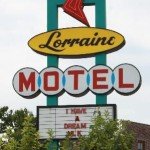
As the Shabbos Queen approached the birthplace of the late, great Johnny Ace on the banks of the mighty Mississippi, I spent the morning learning about one of the great American mitzvahs at the Lorraine Motel on Mulberry Street.
I made the visit there after a breakfast of two eggs over easy with bacon at the Arcade Restaurant, founded in 1919 by Speros Zepatos, an immigrant from Greece. Wedged below the glass counter near the register was the greatest business card of all-time: “I AM AN IMPORTANT GREEK,” it said, the fine print providing the phone number of a big wheel at the service of Memphians in need.
[I should have sent one to Peter Angelos, with a note: “This town ain’t big enough for the both of us, filarákos.”]
Sadly, I left the diner before realizing that Elvis – a teenage Shabbos goy when the Presleys lived downstairs from Rabbi Alfred Fruchter at 462 Alabama Avenue – had a favorite pre-coronation booth at the Arcade. Pity I did not break bread in that corner.
A former stronghold of the Chickasaw Nation, Memphis was my sixth stop on a month-long tour promoting a new collection of short stories, “Basilio Boullosa Stars in the Fountain of Highlandtown” (CityLit Press).
Where in years past I have crossed the continent in my Toyota pickup – sleeping in the truck on supermarket parking lots between towns where I have friends or relatives – six decades of constant reading have taken a toll on my peepers. I am no longer confident of my night vision and daytime ain’t so great either.
Thus, schlepping a suitcase packed with 50 pounds of books and one change of clothes, I traveled 3,000 miles this summer – from Baltimore to Washington to Chapel Hill to Pawley’s Island to Atlanta to Nashville to Memphis to Chicago to Ithaca to Ventnor City, N.J., to Philadelphia, and back to Crabtown — via bus, train and once, through the kindness of a new friend, by car.
Memphis was the halfway point and a weekend off from public readings. After each city, I could tell how well I’d done by how much lighter the suitcase became. By Memphis, I had sold about 50 books, giving a few away to folks who put me up along the way.
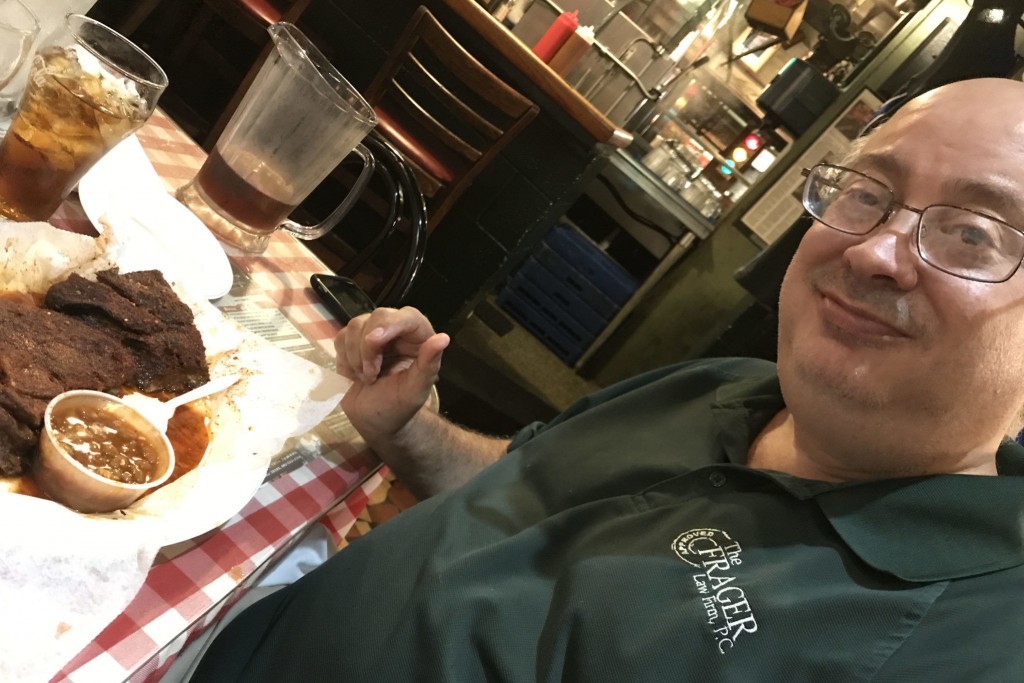
Because of a mentsch named Barry Frager – an immigration attorney and uncle of Pikesville book-maven Mordechai Frager – I was able to spend a day touring Memphis without carrying any bags at all.
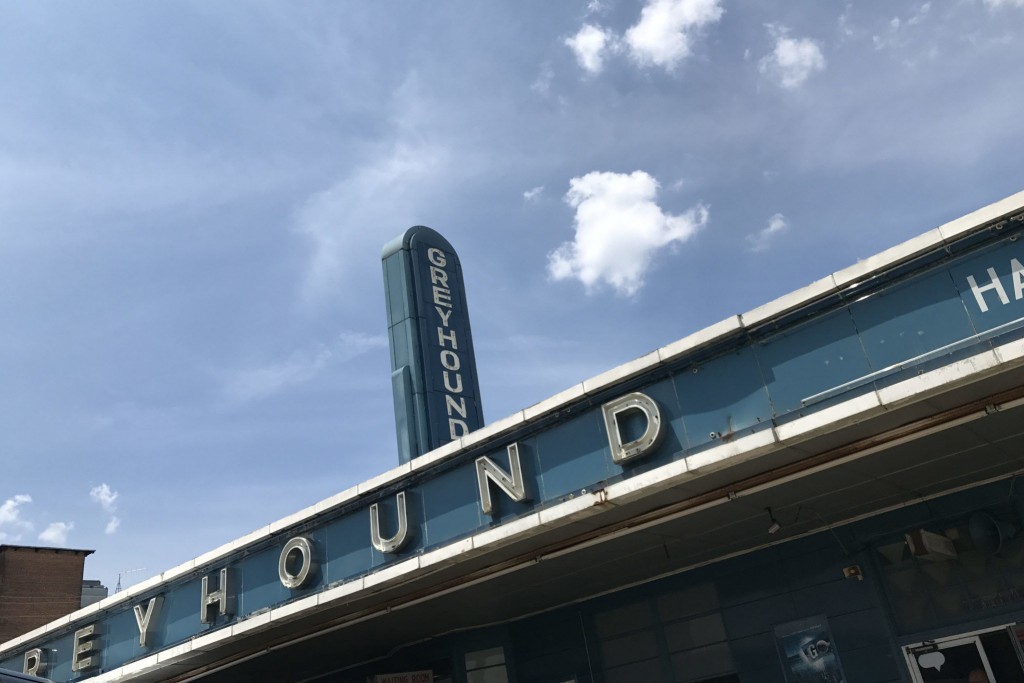
On Mordechai’s good word, Barry opened his home to a wandering storyteller whom he’d never met, had a friend pick me up at the Memphis Greyhound station (very modern, not even close to cool like the deco bus depot wasting away 90 miles east in Jackson, Tenn.), and gave a tour that only a local with deep, generational roots can.
At Charlie Vergos’ Rendezvous downtown – another Greek joint, a dungeon of dry rub and ribs where our waiter’s father waited on Barry’s dad – Frager shared a bit of advice I won’t soon forget: “Never order the small…”
But back to breakfast …
A few blocks from the Arcade Restaurant stands the Lorraine Motel. The anchor of the National Civil Rights Museum, the Lorraine is to the Rev. Martin Luther King Jr. what Ford’s Theatre is to Abraham Lincoln — the spot where the beautiful light went out.
In an exhibition hall built onto the motel – erected about 1925 as the “whites only” Windsor Hotel and sometimes called “the site of the crucifixion” – were vintage photographs taken by the late newspaperman Jim Lucas.
Titled “The Civil Rights Movement in Mississippi, 1964-to-1968,” the photos show courage, calamity and conviction, the last somberly embodied by the presence of Robert F. Kennedy (“the star of the family,” whispered one tourist) visiting Delta residents at their tar-paper shack homes.
(As the photos make clear, this is not a performance of “The Hyannis Port Blues.”)
Intertwined with it all – funeral after march after funeral after march – is a small platoon of Righteous Jews.
Lucas (1944-1980) famously photographed the search for the murdered bodies of Civil Rights martyrs Andrew Goodman and Michael “Mickey” Schwerner (both Jews from New York) who had come to Mississippi during the Freedom Summer of 1964 to register African-Americans to vote.
Along with local resident James Chaney, they were murdered in Neshoba County (Neshoba from the Choctaw word for “wolf”) and buried inside an earthen dam. Lucas also made images of the bodies arriving at the morgue.
The KKK – Kowards, Klutzes and Killers – always had it in for the African-American, but especially during the dismantling of legal segregation. Their terror extended to anyone trying to help blacks reach level ground which, in the 1960s, included many minyans worth of Jews.
(An estimated half of the white volunteers who worked as 1960s “Freedom Riders” – northerners who traveled into the Deep South by bus to go toe-to-toe with Jim Crow –were Jews.)
Southern Jews (in more peaceful times considered “honorary white Protestants,” by their Christian neighbors in Dixie) were more reticent about attracting trouble. One who wasn’t was Rabbi Perry E. Nussbaum (1908-1987), whose house and synagogue in Jackson, Miss., were dynamited in late 1967, the wreckage captured by Lucas.
Rabbi Nussbaum ministered to Freedom Riders sentenced to Mississippi’s “Parchman Farm” state prison – “Sittin’ down here on Parchman Farm,” sang Johnny Winter, “Lord, I ain’t never done no man no harm …” – and was dismayed when none of his fellow rabbis in the Magnolia State joined him.
For the rest of his life (including a brief period in Baltimore), Rabbi Nussbaum was convinced that the attack on his home and shul were not simply a response to his efforts to integrate Mississippi but an act of anti-Semitism. Arrests have never been made in the Nussbaum bombings.
Wilson Pickett wrote “The Midnight Hour” at the Lorraine Motel – which catered to well-to-do blacks during segregation – the same place where Eddie Floyd composed “Knock on Wood” (covered brilliantly by David Bowie).
My ticket to the museum ($15 for adults, $12 for kids) came courtesy of Barry Frager, who as an 8-year-old peddled 45 RPM records in his uncle’s Beale Street music store, the “Home of the Blues” operated by Ruben Cherry (1922-1976).
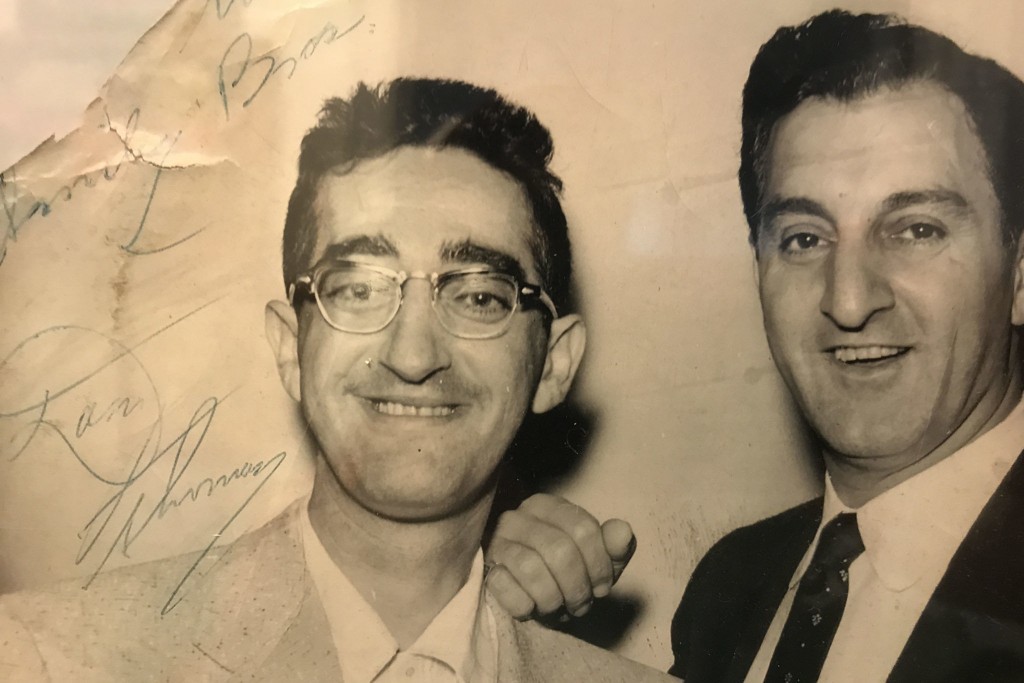
Don’t you wish your name was Ruben Cherry?
I left the museum naively disturbed about how bad things were and saddened by what scant progress has been made (not by our government but between the races) with a half-dozen postcards of iconic images in my pocket.
When I called Barry to see what was going on, he asked, “Do you want to come to Shabbos dinner tonight at my parents’ house?”
Of course, I did.
Read Part 2: Record Store Owners & Glass Blowers
Read Part 3: A Bushel and a Peck of Tall Tales
Rafael Alvarez lives in East Baltimore. He can be reached via orlo.leini@gmail.com
Top photo: Wandering writer Rafael Alvarez with the King, Walgreens, downtown Memphis (Photo by Macon Street Books)
A recent experience reminded Editor-in-chief Alan Feiler of why we cannot allow the antisemites to make us cower and hide.
Historical revisionism only jeopardizes the future, writes Editor-in-Chief Alan Feiler.
Jmore Editor-in-Chief Alan Feiler writes about what he learned during a recent visit to Paris.
Jmore Editor-in-Chief Alan Feiler remembers Temple Emanuel's longtime spiritual leader, who passed away earlier this week at age 91.