

In 2009, on the occasion of Rabbi Deborah Wechsler’s completion of 10 years of service, Chizuk Amuno prepared a new Birkon, Grace after Meals booklet, in her honor. Members of the staff, as well as lay leaders, were invited to offer commentary. At that time, I served both as a rabbi in the congregation, as well as the headmaster of Krieger Schechter Day School.
I had just returned from my 15th trip to Israel. I decided to comment on the prayer that ends with the words, “Boneh v’rahamov Yerushalayim. May God, in mercy, rebuild Jerusalem.” This is what I wrote.
I was traveling with two busloads of eighth grade students. For many, it was their first time in Israel. We were winding our way up the hills from the Dead Sea to Jerusalem. As we entered the city, we broke into a song to God, “U’v-nei Yerushalayim Ir HaKodesh bim-he-rah v’yameinu. Rebuild Jerusalem, the Holy City, speedily in our day.”
All around us, we saw new buildings going up. I had never seen so much construction! There were new apartments everywhere. We visited the new Davidson Center in the Jerusalem Archaeological Park in the Old City and the recently completed Fuchsberg Center for Conservative Judaism. And there was extensive construction near the center of town, the City of David, with its very expensive shops and residences.
“Look,” I said to myself. “Look what our people have accomplished. Look how we have changed the face of the city.”
And yet something was missing. Shalom was missing. No matter how much we built, Yerushalayim, the city of peace, was incomplete.
May God in mercy bring peace to Jerusalem speedily in our day.
I wrote that piece nine years ago. Sadly, the message continues to hold true. We continue in our liturgy to pray for God to bring peace, to grant us peace, and yet peace evades us. What more can we do?
From my study of Torah, the answer is clear. Every human being is created in God’s image. Every human being is deserving of Kavod, respect. Extending our hands and opening our hearts to other Jews, regardless of their affiliations and beliefs, as well as to Muslims and Christians, will bring Shalom. There is nothing more important.
There are dozens of organizations working for peace in Jerusalem and throughout Israel. Among these groups is the Sparks of Change Foundation. Daniel Siegel was a student at Krieger Schechter and Beth Tfiloh. When he was a sophomore at Yale, he developed a brain tumor. He died in 2010 at the age of 22.
His academic brilliance was matched by his sterling character. I had the honor of officiating at his funeral, and I heard many stories of his hesed, loving kindness, and sensitivity toward other people.
His mom and dad, Everett and Janet, his sister, Leigh, and his friend, Mirielle, established a foundation in loving memory of Daniel. It is called Sparks of Change, and it perpetuates his values.
Sparks of Change works together with Oranim College in the Galilee bringing together 11th graders from both Jewish and Arab high schools who are open to coexistence. It trains them in the knowledge and skills they need to model coexistence, and it brings them to the United States to visit both Jewish and non-Jewish schools. The first year, they came to Baltimore and D.C.
Last year, the group added Philadelphia to their itinerary. This year, there will be a second group travelling to Toronto. Next year, we plan to expand to Cape Town, South Africa.
Israeli teachers, high school students, Oranim college students, Jews and Arabs bringing hope for peace to their communities in Israel and to our communities in North America and beyond. What an inspiration to all of us! (For information, please visit their website, sparksofchangefoundation.org.)
Shalom is one of the most important of all Jewish values. Maybe that is how you will grow Jewishly. I hope you will join me in increasing Shalom in the world, small step by small step.
“For out of Zion shall go forth Torah, and the word of the Lord from Jerusalem. … Nation shall not lift up sword against nation, neither shall they learn war anymore.” (Isaiah 2:3,5)
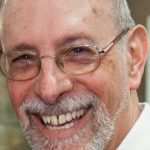
Rabbi Paul D. Schneider is on the rabbinic staff of Chizuk Amuno Congregation.
Leslie Simmons, executive vice president and chief operating officer of LifeBridge Health, will serve as interim president of Sinai and Grace Medical while a national search is conducted for Shlossman’s successor.
Schwab currently serves as president of Cumberland's historic B'er Chayim Congregation.
A former U. S. Marine, Pat Young has served as a Baltimore County Council member representing District 1 since 2022.
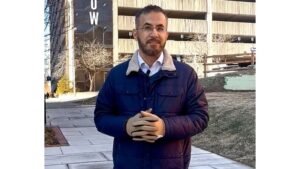
Mansoor Shams is known for carrying around a sign proclaiming, “I’m a Muslim and a U.S. Marine. Ask anything.” Now the Baltimore County Department of Recreation and Parks community engagement and outreach officer is running for Baltimore County Executive.