
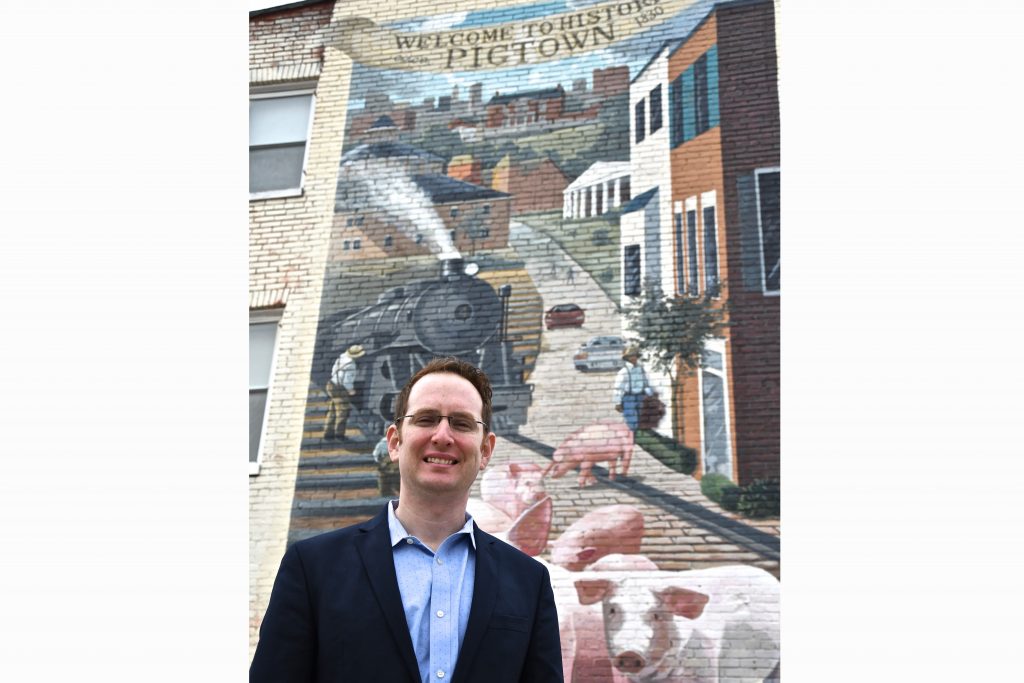
Ben Hyman helps spur economic and entrepreneurial growth in the historic Southwest Baltimore neighborhood.
Ben Hyman still laughs politely when folks ask him, ‘What’s a nice Jewish boy like you doing in a place called Pigtown?”
Hyman is executive director of Pigtown Main Street, a nonprofit committed to the economic revitalization of the Pigtown commercial corridor. Also known as Washington Village, Pigtown is located in Southwest Baltimore.
Pigtown Main Street is part of Main Street America, a network of nonprofits launched in 1980 to breathe new life into urban neighborhoods.
A Mount Washington native and Otterbein resident, Hyman, 29, recently became engaged to Sarah Schulman and belongs to Bolton Street Synagogue. He is a graduate of the Park School, the George Washington University and the Johns Hopkins University-Carey Business School.
Jmore recently spoke with Hyman – who came to Pigtown Main Street in 2012 — about his efforts to spur commercial and entrepreneurial growth in the historic area.
What’s your typical week like?
There is no typical week. But everything we do is aligned toward helping businesses succeed because that’s what drives the neighborhood change. It’s about creating jobs and investment and real estate opportunities.
How would you characterize Pigtown?
What I love about Pigtown is how dynamic it is. It breaks the mold in so many ways.
It’s a very integrated neighborhood racially, socio-economically, age — you name it. This is a neighborhood that defies stereotypes when it comes to Baltimore neighborhoods. There’s a lot going on. Last year, we recruited nine new businesses.
It’s still affordable and it’s right off of I-95 and 395, close to Carroll Park, two blocks from downtown and near the University of Maryland, Baltimore campus. This is a place that’s on the rise, and it’s convenient.
If you’re staying at the Hilton Convention Center, to get to where we’re sitting right now, it’s half the distance to come here than it is to Harborplace. But few people walk west. There’s reason for that. Everybody walks east, but we’re so much closer.
Is the perception of crime one of your biggest challenges?
When I got down here, [businesses] had bars on windows because they were so fearful of crime. I listened and understood their concerns, but I encouraged them that if there is better lighting and more inviting storefronts so people can see into your storefront — I convinced them that no bars on windows is more effective. …. By doing that, we attracted more people here.
And it’s remained that way?
Yes. We attracted business owners and residents because they saw this place as more welcoming. I get it, because people judge by looking around, they’re wondering, “Is this place safe?” So we recognize those perceptions and we fight it working with business owners and residents to create positive experiences so people will tell their friends.
We work to keep streets clean, encourage businesses to stay open later so there’s more foot traffic. I’ve always felt safe here at night. This is a safe place to be.
You recently completed a public safety study of the neighborhood?
The model is Crime Prevention through Environmental Design. It focuses on how does public safety manifest itself in neighborhoods. Usually, we think about statistics or police practices when we think about crime, but this looks at things like streetlights and what do public spaces look like where there’s criminal activity. What are conditions of buildings in the neighborhood, and what’s the correlation between boarded up buildings and crime? Then, how do we address these issues?
What we took on was something that no neighborhood, to this depth, had really pursued. Which was bringing in an internationally respected consultant to train beat cops, local residents, small business owners, city officials and grad students over four full days of training. Then, we set them free to look at issues in the neighborhood that were meaningful to them to improve public safety and to develop their own reports to address the issues.
Have they been addressed?
Lighting improvements have been made, and we have events in the park [to make it more welcoming]. We’ve done things as simple as engaging neighbors to turn porch lights on. Very few of [the recommendations] were about asking the police to do anything. We want to come up with the solutions and affect that change on our own.
What do you like most about your job?
It’s the most rewarding job I’ve ever had. This place has improved for the better in the five years I’ve been here. There’s a real opportunity for people who come in here to make a change.
We’re in a neighborhood where there really is change happening, and that is so exciting to be able to work with people to open businesses to attract investment and to come to work and see how that changes everyday. It’s addictive.
For information, visit pigtownmainstreet.org.
Melissa Gerr is a Baltimore-based freelance writer, producer at WYPR radio and host of the podcast “Knock, Knock, Who’s There?”

The new plan helps sabbath-observant Jews seeking care in the Emergency Department.

A check presentation ceremony will take place on Tuesday, Aug. 25, at the Safeway location on Smith Avenue.
A Rockville resident, Feinberg was a familiar face in MoCo politics for several decades.
Known as "Unclecation," the yearly summer getaway offers an opportunity for a group of old friends (and their growing broods) to remain connected.