
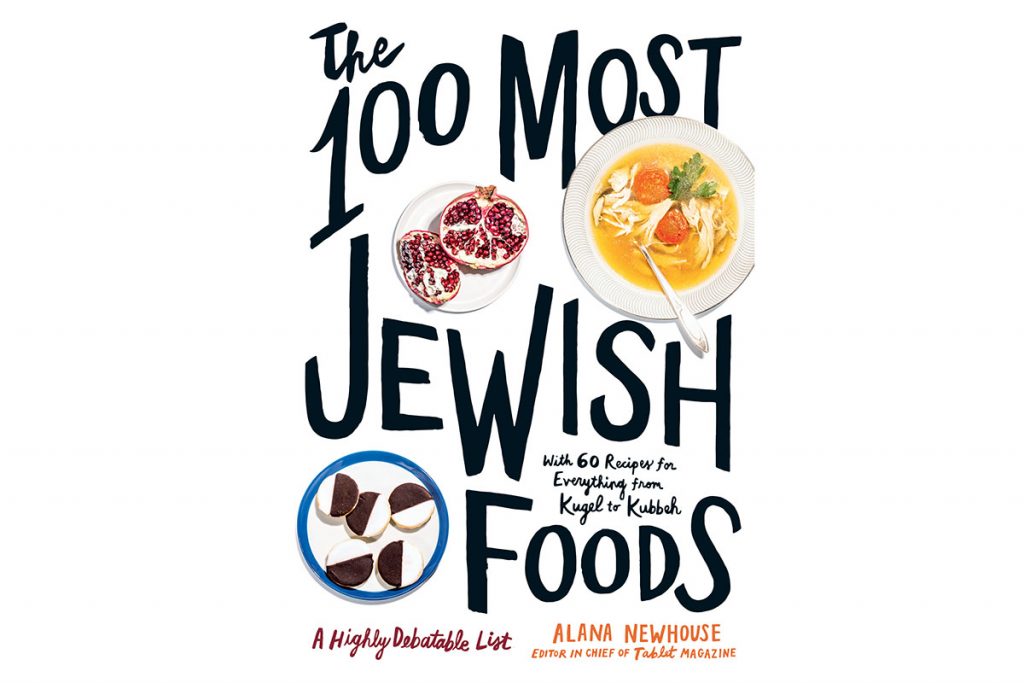
Tablet Magazine and its editor-in-chief, Alana Newhouse, have done us all a big favor. And it’s a delicious one. You, me, your grandparents, your nosy neighbors and your jealous non-Jewish foodie friends all need to pick up a copy of “The 100 Most Jewish Foods: A Highly Debatable List,” just published by Artisan.
While itdoes include “60 recipes for everything from kugel to kubbeh,” this ain’t just a cookbook. It’s also ahistory lesson, a culinary compendium and a gorgeously photographed gourmetgrab bag.
By dissecting various meals or foodstuffs, this book has captured the very essence of what it means to be Jewish. Obviously, I wanted to jump right in with bagels (“We may still stack you with lox on a Sunday morning, but you belong to all of America now,” writes Liel Leibovitz) and a personal fave: shakshuka (“It was what home tasted like, no matter where home happened to be,” Leibovitz again).
Instead, I spent a good 10 minutes staring at the delightful image-laden Table of Contents, just trying to decide what dish I wanted to know more about. Should I see what adafina is (some sort of Shabbat stew)? Or maybe get to know Yemenite breads and soup?
It doesn’t matter, you’re not going to read “The 100 Most Jewish Foods” cover-to-cover. You’re going to return to it again and again. You’re going to bring it out at dinner parties for conversation starters and to assuage arguments like we did before cellular devices. You’re going to play dinner roulette with it, closing your eyes and randomly landing on a particular page to find out what you’re cooking tonight. Maybe you’ll just use it to brush up on your schmaltz knowledge.
I set off on my journey to discover my food roots by testing myself on how many items I knew about and agreed should be on the list. There were the aforementioned bagels, babka and black-and-white cookies, of course. Challah, matzoh and gefilte fish, all present and accounted for. Oh, and you’ve got to include seltzer. (My family even has an oft-told tale about my grandmother, a nightgown and the seltzer man, but I’ll save that for another time.) But then there were also items like Bazooka gum (huh?), Hydrox (funny because it’s true), Sweet‘N Low (say what now?) and used tea bags (?!).
And, as a self-described oeuf-phile, I thought I already knew every way to eat or prepare an egg. Wrong. I learned about two new egg dishes, neither of which is particularly appealing. The first is called eyerlekh and it’s a sort of pre-egg taken from the chicken’s body. It’s considered a delicacy in certain crowds. The other is called huevos Haminados and it’s a Sephardic slow-cooked egg that involves coffee grinds, onion skins and used tea bags. Huh.

Speaking ofchickens, it’s the “one place where the Jews got it right. … Kosher chicken isso vastly superior to any treyf bird …that they’re barely birds of a feather,” writes Wayne Hoffman.
I even discovered there are some things I’ve never eaten that I think I should consume before I lose the chance, like kasha varnishkes and mina de matzoh.
In addition to several contributors from the Tablet staff, almost every name in the Jewish culinary world (or any Jew who has ever eaten or anyone who has ever eaten anything Jewy) is also here: Tom Colicchio, Joshua Malina (just go with it), Joan Nathan (“No Jewish dish – not one – is as comforting or as iconic as the matzo ball”), Ruth Reichl, Eric Ripert (who upon tasting gefilte fish says, “It’s not as bad as it’s made out to be!”), Phil Rosenthal (on Entenmann’s), Marcus Samuelsson (who remembers growing up making gravlax in Sweden), Gail Simmons (with her nostalgic homage to full-sour pickles), Michael Solomonov, Michael Twitty (ruminating on some sort of jellied calves’ feet) and Molly Yeh (“There’s simply no such thing as too much halvah”), among many, many others.

There are so many reasons to own this book. You’ll get recipes for cheese blintzes, chicken soup, stuffed cabbage, tuna salad and everything in between. You’ll read essays both touching and funny and always relatable. You’ll also learn interesting kitchen science tips (I now know how to make a matzoh ball float and what the original purpose of kosher salt was). You’ll even discover why dark chocolate is the Jewiest chocolate. Dig in to this decadent delight.
Also be sure to take a trip down the rabbit hole with this epic online treatment of “The 100 Most Jewish Foods.” We defy you not to lose an hour here.
See Richard Gorelick and Amanda Krotki discuss “The 100 Most Jewish Foods” on This Week in Baltimore Eating — March 21:
Inspired by his Israeli grandmother’s cooking, Chef Raz Shabtai of Miami's Mutra restaurant says the award was for “the entire Jewish community.”

These snowy almond cookies from Elite Jakob are gluten free, easy to make, and most importantly -- delicious.

The Jerusalem Orchestra East & West, which arranged the program for young musicians, blends Western orchestral music with Middle Eastern traditions.

Pikesville resident and entrepreneur Luna Rosendorff discusses what she's seeing these days in the world of contemporary interior design.