
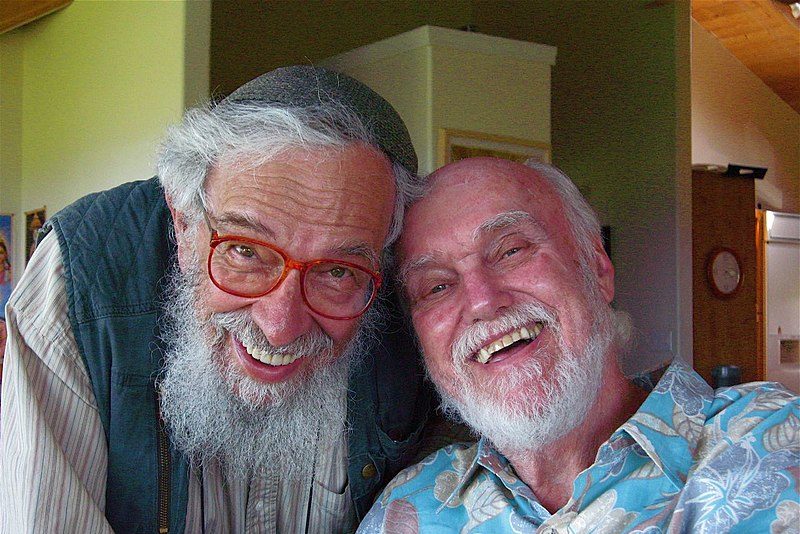
Ram Dass, the pioneering New Age spiritual leader, best-selling author, academic and clinical psychologist formerly known as Richard Alpert, has died of unknown causes. He was 88.
“With tender hearts we share that Ram Dass (born Richard Alpert) died peacefully at home in Maui on December 22, 2019 surrounded by loved ones,” read Alpert’s official Instagram account. “He was a guide for thousands seeking to discover or reclaim their spiritual identity beyond or within institutional religion.”
Tweeted filmmaker Judd Apatow: “RIP Ram Dass. The conversation Garry Shandling and I had with him had an enormous impact on my life. He spoke about living in your heart and not in your head. He repeated the phrase ‘I am loving awareness.'”
Singer Belinda Carlisle called Alpert a shining light. “Ram Dass, you will be so missed,” she tweeted. “thank you for everything you’ve given us … “
A native of Newton, Mass., Alpert was born to a prominent Jewish family, the youngest of three sons. His attorney father, George Alpert, was president of the New Haven & Hartford Railroad and the first board president of Brandeis University.
During the early part of his life, Richard Alpert considered himself an atheist and had little involvement with the Jewish community. He once wrote that he came from “a Jewish anxiety-ridden high-achieving tradition” and lamented that his bar mitzvah was devoid of spiritual meaning.
After receiving his doctorate in clinical psychology from Stanford University, Alpert taught at Harvard University, where he met his colleague and kindred spirit, Timothy Leary. The two founded the Harvard Psilocybin Project and gained notoriety for experimenting with psychedelic drugs.
“The rug crawled and the pictures smiled, all of which delighted me,” Alpert wrote of his first experimentation with psilocybin, the compound responsible for the hallucinogenic properties of some mushrooms. at a party.
Leary and Alpert were fired from their positions at Harvard in 1963 after faculty members discovered that they were sharing hallucinogenics with undergraduate students. As a result, they became counter-culture icons and went on to continue experimenting with drug exploration at the Hitchcock Estate retreat in Millbrook, N.Y., hanging out with the likes of poet Allen Ginsberg, activist Abbie Hoffman and author William S. Burroughs.
In 1967, Alpert undertook a pilgrimage to India in search of long-lasting enlightenment and self-awareness. While visiting a Hanuman temple in the northern Indian village of Bhumiadar, he met the man who would become his guru, the Hindu mystic Neem Karoli Baba, who taught him yoga, meditation, Sufism and Buddhism, and gave Alpert the name Ram Dass, which means “Servant of God.”
“When I met Maharajii, it was unconditional love,” Alpert recalled, using his term of respect for Neem Karoli Baba. “It was wonderful, to be loved that way. I said, ‘I’m home, I’m home …’ Every time I would sit with Maharajii, time would stop. It was like the moment expanded. He lived in eternity.”
Alpert returned to the United States wearing flowing white robes and sporting a long beard, and began teaching Eastern meditation and practices to young students and seekers, many of whom were born Jewish. He also started foundations and nonprofits to help the blind, prison inmates and the dying.
In 1971, he wrote the book “Be Here Now,” an exploration of positive thinking and mindfulness employing Eastern values, practices and beliefs. The book became an international best-seller and a New Age touchstone for Western readers.
Former Beatle George Harrison even wrote a song of the same name for his 1973 album, “Living in the Material World.” Among the book’s admirers was the late Apple founder Steve Jobs
Over the years, Alpert’s other books have included “Polishing the Mirror: How to Live from Your Spiritual Heart,” “How Can I Help? Stories and Reflections on Service,” “Compassion in Action: Setting Out on the Path of Service,” “Still Here: Embracing Aging, Changing, and Dying,” and “Paths to God: Living The Bhagavad Gita.”
Among Alpert’s best-known quotes are “You’ve got to become somebody to become nobody,” “As soon as you give it up, you can have it all,” “If you think you’re enlightened, go spend a week with your family,” and “Treat everyone you meet as if they are God in drag.”
In the early 1990s, Ram Dass – who was always open about his Jewish background — began seriously exploring Judaism.
“I have always said that often the religion you were born with becomes more important to you as you see the universality of truth,” he said in an interview with Religion News Services. “The one you start with is often the one you come back to, once you learn to go beyond the negative experiences you have as a child.”
In 1997, Alpert suffered a severe stroke which left him partially paralyzed, wheelchair-bound and unable to speak. He eventually regained his speech and continued to teach and host spiritual retreats and classes, often using his stroke as a teaching tool.
“The stroke itself was not grace, but my reaction to the stroke was grace,” he told the National Institute for the Clinical Application of Behavioral Medicine. “I was positive from it, I was fascinated by it. And it was changing my philosophy on life.”
In recent years, Alpert suffered several bouts of illness. Last September, Alpert told the New York Times Magazine that he accepted his imminent death and was not afraid.
“Soul doesn’t have a fear of dying,” he said. “Ego has very pronounced fear of dying. The ego, this incarnation, is life and dying. The soul is infinite.”
At the age of 78, Alpert, who never married and was openly bisexual, discovered through a DNA test that he unknowingly fathered a child while having an affair during his student days at Stanford. His son, Peter Reichard, is now an investment banker who lives in North Carolina. Alpert is also survived by a granddaughter.
Alpert was the subject of a 2018 Netflix documentary, “Ram Dass, Going Home,” which was shortlisted by the Academy of Motion Picture Arts and Sciences as a contender for the 2018 Academy Awards in Documentary Short Subject.
He was also the subject of the 2001 documentary, “Ram Dass: Fierce Grace,” and “Becoming Nobody,” which was released in September.
“How perfect that he left this plane on the first night of the Festival of Lights,” wrote author, spiritual leader, activist and 2020 Democratic presidential contender Marianne Williamson. “‘Be Here Now’ shifted my world when I was young, as it did for millions of others. Praise & thanks to a huge & radiant soul. May he be forever blessed.”

Jewish community activist Jay Bernstein calls on the governor to reprimand Carter, a Maryland State Board of Contract Appeals judge, for sharing age-old tropes against the Jewish community.
Jmore is giving away two pairs of tickets to the Orioles' Jewish Heritage Night on May 26. Enter now for your chance to win.
An appeal to New York's Jewish Museum for help cites President Trump’s record of demolition as a real estate developer and history of preservation failures.

Dara Bunjon talks with Joe Lertch and Mark Robinson, co-founders of The Wine Matrix and co-authors of "The Art of Spice & Wine Pairing."