
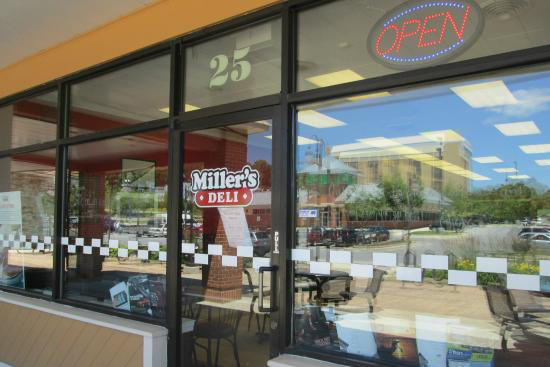
I’m sorry to hear about the impending closing of Miller’sDeli at the Greenspring Shopping Center, because I like the place.
I think of Miller’s, and I think of the kosher hot dogwrapped in bologna, and the matzoh ball soup, and the holiday platters.
But mainly, I think of “Nookie the Bookie” Brown and Marvin “Hawk” Albom, Harry “Hold the Phone” Landsman and “Haircut” Jones, and guys with no known last names, including “Fat Herby,” “Abe the Conk,” “The Mole” and “Eats.”

The nicknames alone tell you something, because nicknamesimply a kind of intimacy. They stick to people who have hung out together for along time and know how to wing it conversationally.
A deli’s distinguished by more than the cut of its cornedbeef, or it’s just another place to gluttonize. Customers should arrive with ahunger not merely to eat but to congregate, to kibitz, to exchange the wisecrack. Such people have perfected theart of hanging out.
And they give the place an atmosphere, as Miller’s has hadfor more than half a century. But at the end of March, Miller’s will close itsdoors for the final time, joining other Baltimore deli closings of the pastyear or so — Suburban House, Gourmet Again and the Edmart Deli.
Over the years at Miller’s, you had those such as Hawk Albom sitting in a cluster of guys, most of them around 80, watching the girls go by.
Did the girls watch back?
“Oh, sure,” Hawk would laugh. “Especially when I say,‘Honey, I want to buy you a house.’”
He’d sit there with the usual gang of retirees, such asFrank Landsman, Harold Tabb, Phil Rosenberg, Manny Magram, Dave Hoff, HalLipsitz, Jerry Cohen, Leon Goldberg, Morris Zweigel, Dave “Poopsie” Zandick andLeon Goldberg, who’d walk into Miller’s and ask the eternal question, “Who’sfinished eating? I’ll take what’s left.”
One afternoon around 1990, at the old Miller’s in the little commercial strip across from the Reisterstown Road Plaza, I hung out with Haircut Jones and Danny Sheelds. The place was crowded and loud, but you could hear Sheelds’ voice above all others, owing to his background in radio.
Sheelds was one of the first Baltimore talk show guys. Hewas temporarily between radio jobs, the last one ending approximately 22 yearsearlier. In his day, the hookup was pretty crude.
Nobody had the equipment to pick up the caller’s voice, soDanny would listen and repeat what the caller was saying virtually as the wordswere coming into his ear. So Sheelds became one of those people who can keeptalking without coming up for air.
Miller’s was filled with such people. Haircut Jones, for example, had a flair for show business. At the old Piccadilly Club on West Fayette Street, he worked as a tap dancer on roller skates.
“Gave up a lucrative career to do it, too,” he said.
“That’s right,” Sheelds agreed. “Before that, Haircut was one of the finest door-to-door linoleum salesmen of our time.”
He nodded sagely, as though there’d been a ratings system.
For a lot of years, Miller’s was filled with such people.They were mostly working-class guys who’d come up during the Depression, whenpeople hustled and rolled the dice with their lives and never got over it.
Like Daniel Brozowsky, also known as Nookie The Bookie Brown.
“Nookie knew about life,” said Haircut Jones. “Everything had to do with scuffling, and with beating the check.”
“That was always the common denominator,” said DannySheelds. “No money.”
“Well, we made our fortunes,” Hawk Albom joked one day. “Butwhen the check came for a buck-and-a-half, you never saw so many guys run sofast.”
But first, they’d run straight into Miller’s. The food wasfine. But the real secret to such places is the kibitz, the hanging out, thelaughs that never run out.

A former Baltimore Sun columnist and WJZ-TV commentator, Michael Olesker is the author of six books. His most recent, “Front Stoops in the Fifties: Baltimore Legends Come of Age,” was reissued in paperback by the Johns Hopkins University Press.
Michael Olesker pays tribute to WJZ’s retiring Marty Bass, a longtime fixture on local TV screens.
The Orioles' weak defense plays a major role in the nightly carnage, writes Michael Olesker.

Jmore Publisher Scott Rifkin, M.D., reacts to President Donald Trump's latest poll numbers and the real force behind the growing decline of the Trump movement.

Last weekend's Flower Mart once again demonstrated that there's nothing to fear about downtown Baltimore, writes Michael Olesker.