
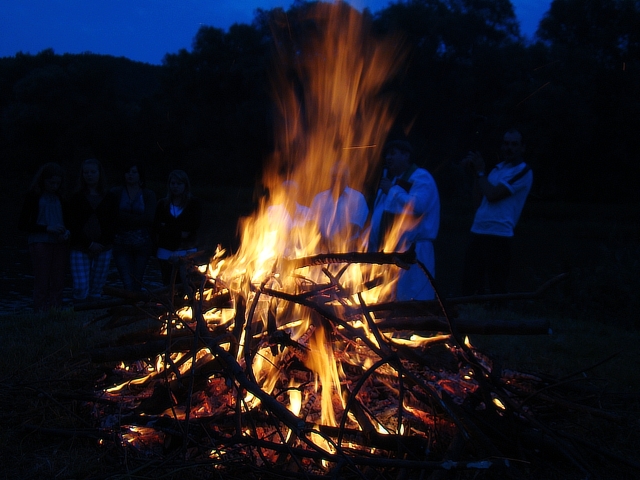
Mention to someone that Monday, May 11, at sundown was the start of Lag B’Omer and they might respond with, “Um, Lag what?”
While some might be unfamiliar with it, Lag B’Omer, which concluded Tuesday night, May 12, has been observed by Jews of all backgrounds for millennia and was celebrated during the coronavirus pandemic.
Lag B’Omer is a festive minor holiday that occurs on the 33rd day of the Omer, which is the 49-day period between the second day of Passover and Shavuot. (Shavuot this year will be observed May 28-30.)
During the semi-mourning Omer period, Jews are forbidden from holding Jewish weddings or other celebratory events, as well as listening to music or getting haircuts — except on Lag B’Omer, which is observed on the 18th day of the Hebrew month of Iyar.
The roots of Lag B’Omer — and the Omer itself — remain shrouded in mystery.
“To this day, no Jewish scholar can state with certainty exactly what Lag B’Omer celebrates,” Rabbi Joseph Telushkin writes in his seminal work, “Jewish Literacy: The Most Important Things to Know About the Jewish Religion, Its People and Its History” (William Morrow and Co.).
The most oft-cited explanation comes from the Talmud, which contends that a plague killed thousands of Rabbi Akiva‘s students during this season due to their lack of respect and civility toward each other.
According to tradition, the plague ceased on Lag B’Omer, which stands for the Hebrew letters lamed and gimel, combining for the numerical value of 33.
Some commentators also contend that Lag B’Omer was the day on which the Bar-Kochba Rebellion may have achieved a crucial victory against Rome in the second century of the Common Era.
As a result, Lag B’Omer became recognized as a joyous communal day, interrupting the solemnity of the Omer period for a 24-hour respite.
On Lag B’Omer, Jews are permitted to have weddings, parties, parades, bonfires, picnics and other outside outings, as well as get haircuts and listen to music. Children traditionally go out to the fields with bows and arrows, possibly as a reminder of the fierce battles fought by Rabbi Akiva’s students in the Bar-Kochba Rebellion.
In Israel during non-pandemic times, tens of thousands of Jewish pilgrims traditionally visit the final resting place of the great Mishnaic sage and mystic Rabbi Shimon bar Yochai on Lag B’Omer in the northern village of Meron. Lag B’Omer is the anniversary of Rabbi bar Yochai’s death in the second century.
(The Israeli Cabinet recently banned the lighting of bonfires on Lag B’Omer this year to prevent the transmission of the COVID-19 virus. Hundreds of haredi Orthodox residents of Jerusalem ignored the ban and gathered for large bonfires on Monday night. In the Israeli city of Bnei Brak, police used a water cannon to put out a bonfire and break up a crowd of hundreds of haredim, according to the Jerusalem Post. Illegal bonfires also were reported to have been lit in Beit Shemesh, a city about 20 miles west of Jerusalem.)
A disciple of Rabbi Akiva, Rabbi bar Yochai was reportedly the first spiritual leader to publicly teach the mystical dimension of the Torah known as Kabbalah, and is believed to be the author of the classic text of Jewish mysticism known as the Zohar (Book of Splendor). Tradition holds that on the day of his passing, Rabbi bar Yochai instructed his disciples to mark the date as “the day of my joy.”
A hallmark of Lag B’Omer celebrations at congregations is usually the lighting of bonfires, carnivals and the singing of songs. Among the virtual Lag B’Omer local observances this year were:
- A concert presented by Beth Tfiloh Synagogue featuring the Israeli musical duo Yonina on May 11 at 7 p.m. (https://www.bethtfiloh.com/event-detail—cong?pk=8085948&fromId=247470)
- A Zoom celebration of Lag B’Omer presented by the Goldsmith Early Childhood Center and Young Families of Chizuk Amuno on May 12 at 12:30 p.m. (https://www.chizukamuno.org/learning/gecc/)
- A live “gratitude concert” performed by New York-based Jewish pop/soul recording artist Eli Schwebel on May 12 at 7 p.m. and presented by Congregation Shromrei Emunah. Featured speakers included Rabbi Moshe Hauer, Dovid Kaplan, Nisan Andrews, Binyamin Marwick and Elisha Friedman. (https://www.elischwebel.com/)
- A virtual discussion group on the Jewish folk tales of I.L. Peretz on May 12 at 7 p.m. was presented by Congregation Beit Tikvah. (https://beittikvah.org/event/beit-tikvah-discussion-group/).
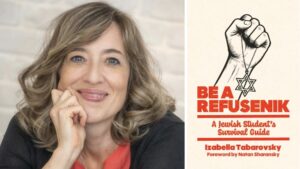
Scholar Izabella Tabarovsky will speak at the “Generations of Courage” program on Apr. 26 at The Associated's Goldsmith campus.
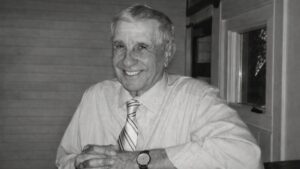
A Baltimore native and Pikesville resident, Freedman had the distinction of being the longest-serving employee in the history of the State of Maryland.

House Bill 661 is the culmination of a collaborative effort led by Del. Sarah S. Wolek (D-16th), Del. Jared S. Solomon (D-18th) and Sen. Shelly L. Hettleman (D-11th).
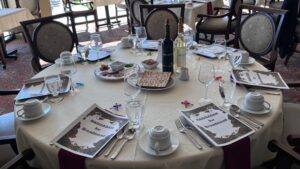
More than 100 Broadmead residents and team members recently gathered to celebrate the festival of Passover with a meaningful seder dinner.