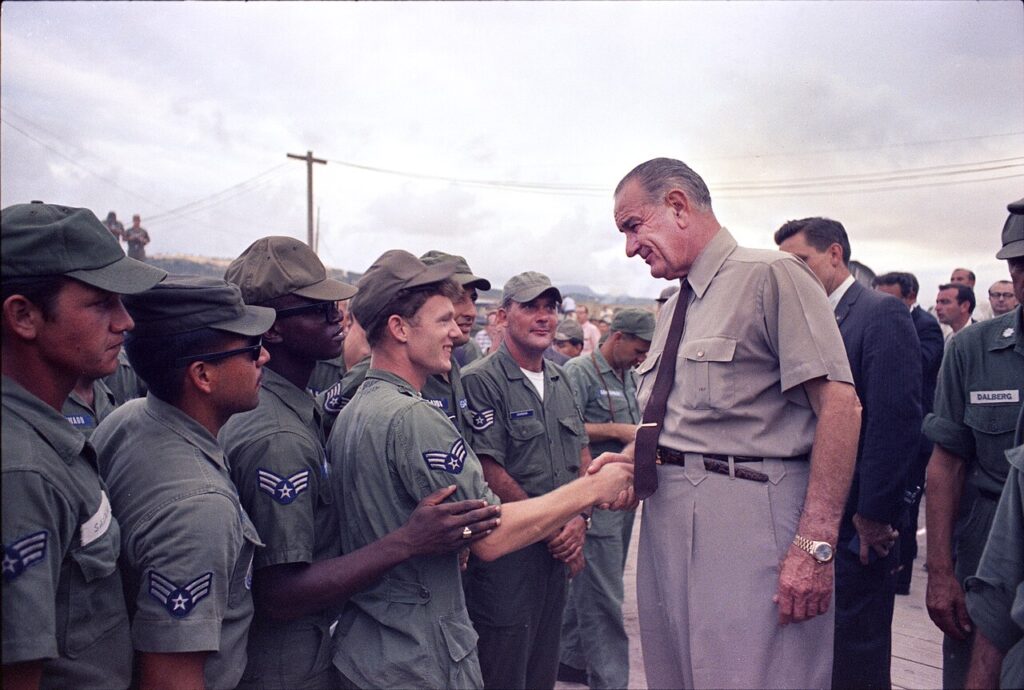
Let the record show that President Dwight D. Eisenhower, in one of the most stirring speeches seeking to bring an end to an unpopular war, declared, “I shall go to Korea.”
Let the record also show that Donald J. Trump, in one of the looniest decisions made by a wartime president, declared over the weekend, “I shall go to Miami to watch a mixed martial arts fight.”
As the New York Times’ Katie Rogers reported last Sunday, Apr. 12, “As Vice President JD Vance took a podium in Pakistan and said no deal had been reached to end the war in Iran, President Trump … sat and impassively watched blood and saliva sprayed out from the fighters beating each other silly in front of him.
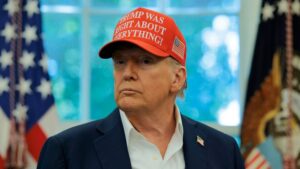
“It was unclear,” wrote Rogers, who was there, “whether the president knew that negotiations had failed by the time he entered the arena for the U.F.C. [Ultimate Fighting Championship] event to a Kid Rock song and thunderous applause.”
What are we to say about this president’s sheer insensitivity and cluelessness as the dying and the destruction mount in the Middle East?
Well, we could say that if Joe Biden exhibited such behavior, Trump and his sycophants would be shouting that Biden should be removed from office for clearly visible signs of an addled brain.
Leaving aside Trump’s lifetime record of callousness, you would think that a man with his mass media background, his insider’s knowledge of TV optics, and his growing unpopularity as this war spins further out of control each day might realize how uncaring he looks attending a mixed martial arts fight surrounded by fans expressing bloodlust.
Is there no one in the Trump White House who could say to this man, “It doesn’t look nice if you’re watching a murderous sport while there’s real killing going on half a world away because of your solitary decision to start dropping bombs.”
Usually, there are grown-ups offering advice on such matters. Their job is to choreograph the president’s public image.
Consider Vietnam, when the body count mounted and President Lyndon Johnson’s popularity plummeted. There were “candid” photos taken in the Oval Office of a visibly anguished Johnson on the telephone, getting the latest bad news from the war.
The message was clear: Johnson might be making the wrong moves as he prolonged the war and extended the killing, but at least he cared enough to be agonized about it.
Or Richard Nixon, as the war dragged on and demonstrations mounted around the country. As dawn broke over Washington on May 9, 1970, and protesters staged a vigil in front of the Lincoln Memorial, Nixon showed up to explain his wartime decisions.
The demonstrators were there to protest the war’s spread into Cambodia, and to protest the killings at Kent State five days earlier. Nixon stayed and talked with them for two hours.
He didn’t spend two hours watching a mixed martial arts fight.
Are we saying presidents shouldn’t have relaxation time during a war? Nope. Franklin Roosevelt was asked if Major League Baseball should continue during World War II.
Absolutely, Roosevelt decided. The people needed their diversions, especially in such a trying time.
Of course, it was “the people” who were sending their sons off to save the country, knowing many of them would never come home again.
Nobody’s sent any draft orders yet for Baron Trump.
For the record, six months after Eisenhower stirred the country by declaring, “I shall go to Korea,” representatives from the United Nations, South Korea and China signed the agreement bringing the war in Korea to an end.
As Katie Rogers reported Sunday in The Times, “[Trump] offered tight smiles for the cameras and a thumbs-up for the winners. In fact, on his way to Florida, Mr. Trump had told reporters that it did not matter to him if a deal with Iran was reached, or not.
“‘We win, regardless,’” he said. “We’ve defeated them militarily.”
Oh, really? Maybe he was confusing Iran with one of the U.F.C. fighters.
A former Baltimore Sun columnist and WJZ-TV commentator, Michael Olesker is the author of six books, including “Journeys to the Heart of Baltimore” (Johns Hopkins University Press) and “Michael Olesker’s Baltimore: If You Live Here, You’re Home” (Johns Hopkins University).
What does it mean to be fully present with each other and the sacred, asks Maryland-born cultural anthropologist Alanna E. Cooper.
As millions mourn the passing of Stephen Colbert from the airwaves, Michael Olesker looks back on the "institution" of late-night TV.

As he gets ready to leave for California, Rabbi Daniel Cotzin Burg looks back on his time in Baltimore and his 10 years writing for Jmore.