
We might have less occasion to play it nowadays but in pre-pandemic times, it was almost impossible to walk into a social gathering with other Jews present and not be drawn into a wicked game of “Jewish geography.”
For those requiring a definition, “Jewish geography” is when you meet another Jewish person and immediately try to figure out which other Jews you know in common. Once the interlocutors realize that, for instance, one attended the same camp or college as the other’s sister’s husband, this typically provides sufficient fodder for conversation for the rest of the evening.
“Jewish geography” was recently featured on the television show “Crazy Ex-Girlfriend,” the arbiter of all Jewish pop cultural references, with characters playing the game, hilariously unsuccessfully as it turned out. Israeli backpackers call it pitsuchim, based on a 1980s television quiz show. It is based on the six degrees of separation that purportedly connect everyone on the planet.
Frigyes Karinthy, an author of Hungarian Jewish descent, first developed the idea a century ago. It was elaborated by the Jewish social psychologist Stanley Milgram in his path-breaking “small-world” experiment. (Yes, there is actually a “small world theory” in scientific research!)
Because I find myself in the midst of a pandemic-induced period of unemployment, I spend many hours each day engaged in a variant of “Jewish geography.” As I conclude one “informational interview” after another, I ask not for the names of those whom we know in common (that would be useless) but for the names of those who are known to my interviewee but not to me.
In this way, I continually expand my circle of acquaintances, finding new people to meet who may know about upcoming job opportunities. (Of course, as the old joke goes, Jews never meet each other for the first time — we were all together at Mount Sinai!)
Networking is well-established in Jewish history. When Jews were dispersed across the Mediterranean Basin after the destruction of the Temple in 70 C.E., they forged sophisticated transnational networks that facilitated the transportation of goods, information and religious rulings.
Networks later sprang up among 9th-century Jewish merchants known as Radhanites who imported the art of papermaking from Asia to Europe, among 16th-century Venetian Jews who sold gemstones in the Levant, and among mid-19th-century Central European Jews who became peddlers in the United States.
(Israeli novelist A.B. Yehoshua’s “A Journey to the End of the Millennium,” is set among Jewish and Muslim traders of spices, perfumes, leopard skins, and other exotic commodities, circa 999.)
Eastern European immigrants who arrived in Baltimore through the Locust Point piers and remained here typically found jobs in the flourishing garment industry, rather than immediately traveling West on the B&O Railroad. Then, as now, networking depended on Jews maintaining a distinctive subculture and fostering a sense of connection — even obligation — to each other, even if they had never met and perhaps lived across the world from each other.
To this day, observant Jews know that they can depend on other observant Jews, who will welcome them to their synagogues, host them for Shabbat or holidays, and help them to gain access to kosher food.
Sociologist Charles Kadushin has argued that up until the establishment of the modern State of Israel, Jewish social networks were the “main sources of social organization and control of Jewish life.” In 1995, Kadushin mapped these networks by drawing lines among American Jewish organizations and their Jewish leaders (much like an airline route map that shows how the hubs are linked to all of the other cities where the airline flies).
Kadushin discovered, among other things, that AIPAC had the largest number of board members that overlapped with those of other organizations, and that the late Baltimore activist and philanthropist Shoshana S. Cardin was one of the few women who occupied a central position in our nation’s Jewish organizational life. It would be interesting to repeat this study today and to see how the Jewish community could potentially be more tightly woven together as it begins the slow process of emerging from the pandemic.
My own situation has been made more bearable by Rise, an initiative of the Jewish Federations of North America that furnishes free career coaching and support groups to out-of-work Jewish communal professionals. Still, what I could really use is a Jewish version of LinkedIn. JDate was founded in 1997 as a way of helping Jews meet and marry each other. Facebook contains lots of Jewish-oriented groups. Instagram promotes many influential Jews and popular Jewish hashtags.
But although one can follow a number of Jewish federations on LinkedIn (including the Associated, which had 899 followers the last time I checked), it isn’t really geared to connecting with other Jews.
So I guess that I’m stuck playing the same old game, hoping against hope that the next person I meet will have the inside scoop on a yet-to-be-posted job.
“Jewish geography,” anyone?
Ted Merwin, Ph.D., has worked in the Jewish nonprofit world for two decades. He resides in Pikesville with his wife and three daughters.
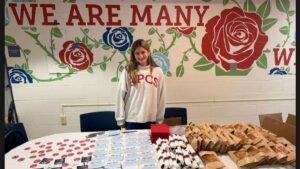
A junior at Roland Park Country School, Katie Grossman writes about a recent experience that spurred her to take action to fight antisemitism.

At a time when many Jews fear appearing Jewish in public, seeing Judaism depicted correctly onscreen is reassuring, writes Jewish content creator Rabbi Yael Buechler.

Cruel, inappropriate, egomanical, outrageous and bullying are all attributes that pass for presidential these days, writes Michael Olesker.