
Jewish parents are notorious for kvelling endlessly about their children’s accomplishments. But only rarely do Jewish children take the time to kvell about their parents.
Today, I feel compelled to do so.
You see, over the past six weeks, both of my parents, Ruth Grill, 83, and Neil Grill, 81, have published books. This is the first book for my mother, a retired psychotherapist and avid reader and writer, and the first poetry book for my father, a retired psychoanalyst and former English professor.
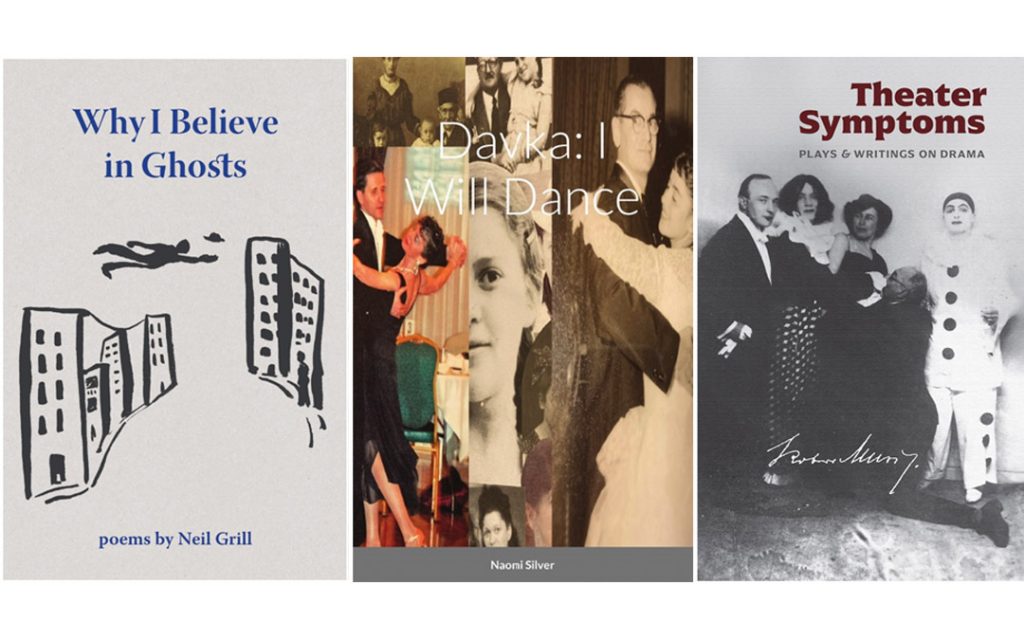
My mother’s book is called “Davka: I Will Dance.” Davka is a Yiddish word meaning “in spite of.” In this context, it means that she dances in spite of the traumas she suffered as a hidden child during the Holocaust. Mom published the book under an alias — Naomi Silver — to not embarrass anyone. But since the book’s publication, she’s taken credit for her work.
After a lifelong passion for dance, Mom, in her late 60s, began studying ballroom dancing and tango, and quickly became obsessed. Nowadays, she takes daily lessons and has a closet full of sparkly, risqué and (kind of tacky) dresses, many pairs of expensive dance shoes, a purple wig (which I’ve seen her wear), drawers full of costume jewelry, hair accessories and all sorts of interesting undergarments.
Pre-pandemic, Mom performed in dance showcases twice a year. She’s itching to get back to them and still practices her dance routines daily.
My mother’s dance stories are interspersed with tales about her marriage, divorce, love affairs and, especially, her childhood experiences in Germany and Belgium during World War II. In my humble opinion, she does a wonderful job of keeping the memoir light and entertaining, without papering over the sadness of many of her childhood experiences.
I feel grateful to have a record of those experiences. Many years ago, I read “Children of the Holocaust,” by Helen Epstein, and was relieved to learn that like me, many second generation Holocaust survivors have difficulty remembering their parents’ stories. That is certainly the case with me, so having this memoir to look back at is really valuable. I’m also learning some things about Mom’s life — some painful and some delightful — that I never knew before. I’m filled with admiration and love for this woman, who remains so determined to get all she can out of life.
My sister, Genese Grill, gets major kudos for helping my mother edit the memoir, and I contributed the cover, taken from a collage made during a collaging workshop sponsored by the Jewish Museum of Maryland and Jewish Community Services for children of Holocaust survivors.
“Davka: I Will Dance” is a story of hope, resilience and the importance of following our dreams — at every age.
My father wrote poetry when I was a child. He co-edited a literary magazine called Inprint, gave poetry readings around town and had poems published in small magazines and journals.
Yet he gave up writing for decades, returning to it about three years ago after retiring from his psychoanalytic practice. These days, Dad teaches poetry to seniors in Fair Harbor, N.Y. and also belongs to a poetry-writing group at the 92nd Street Y in Manhattan.
About a year ago, Dad was encouraged by a fellow poet to enter his poetry in a contest sponsored by Finishing Line Press, a small publisher specializing in short poetry books known as chapbooks.
His collection was chosen from many entries. The prize was the publication of his new book, “Why I Believe in Ghosts.” Dad says the collection “explores family conflict and love, aging and mortality, love and divorce and art and music.” Most of the poems take place in the Bronx, where Dad spent his childhood and the book is dedicated to his parents — my beloved grandparents.
I received my copy of my father’s book today. I read it cover to cover and I cried. I remembered being a kid at my father’s poetry readings. It was a strange feeling. When he read poetry, my father seemed like he was in a trance, not like the dear old dad I knew. Sometimes it was uncomfortable. The poems were so intimate, so raw… It was like that when I read them today as well. But reading the poems as an adult made me feel so close to him, and love him even more than I thought possible.
My sister gets credit for the cover image, while her friend Alessandro Segalini did the typography.
Speaking of my sister, Genese is the author of “The World as Metaphor in Robert Musil’s The Man without Qualities: Possibility as Reality” (Camden House, 2012). She is also the translator of a collection of Musil’s short prose, “Thought Flights” (2015); his short story collection “Unions” (2019); and “Theater Symptoms: Robert Musil’s Plays and Writings on Theater (2020), all published by Contra Mundum Press.
If you’re keeping track, that means I’m the only one in my family of origin who has not published a book. But who knows? Seeing my parents publish in their 80s certainly gives me hope that it’s never too late.
For information about “Davka: I Will Dance,” click here.
For information about “Why I Believe in Ghosts, click here.
For information about “Theater Symptoms,” click here.
Michael Olesker pays tribute to WJZ’s retiring Marty Bass, a longtime fixture on local TV screens.

The Orioles' weak defense plays a major role in the nightly carnage, writes Michael Olesker.

Jmore Publisher Scott Rifkin, M.D., reacts to President Donald Trump's latest poll numbers and the real force behind the growing decline of the Trump movement.

Last weekend's Flower Mart once again demonstrated that there's nothing to fear about downtown Baltimore, writes Michael Olesker.