
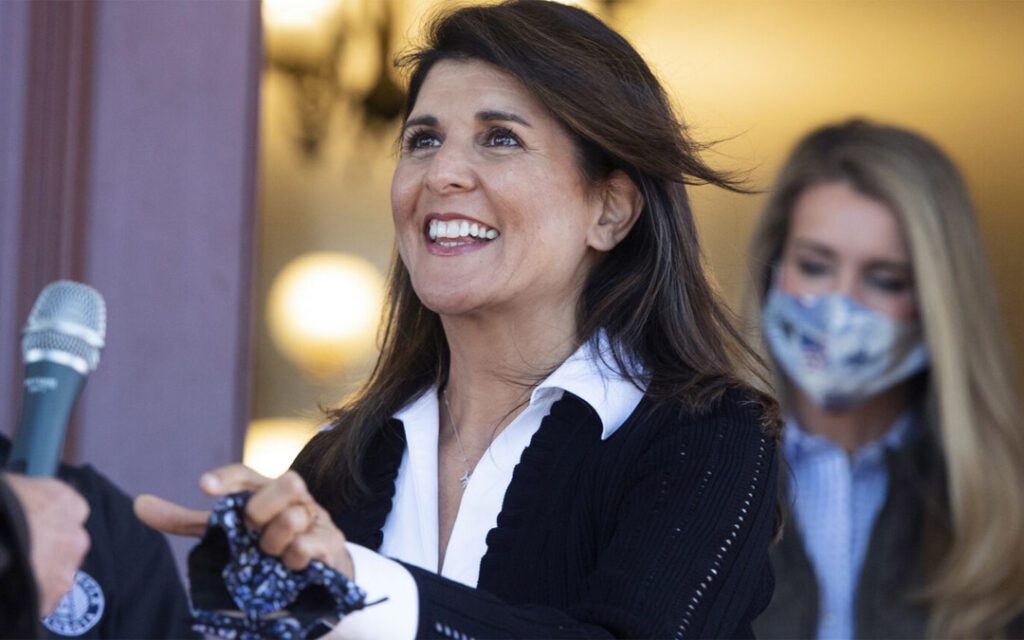
As a 5-year-old daughter of Indian immigrants living in rural South Carolina, Nikki Haley says she learned quickly how to stand up to bullies and fend for herself. That experience served her well in her role as U.S. ambassador to the United Nations, she said Mar. 9 during Beth Tfiloh Congregation’s seventh annual Dahan Lecture.
“We were the only Indian family living in this small southern town. My father wore a turban and my mother wore a sari. People didn’t know who we were or what we were,” recalled Haley, 49. “But my mother told me, ‘Your job is not to show your differences but your similarities.’ I saw that when you have a challenge in front of you, you talk about what you have in common and then try to get the situation to a better place.
“There were tough times and discrimination, but that small town came to understand and love us,” she said. “That’s the same state that elected me as governor. … Our country is not perfect. We’re a work in progress.”
During a wide-ranging, hour-long conversation with Beth Tfiloh’s Rabbi Mitchell Wohlberg, Haley, who served as U.N. ambassador from 2017 to 2019, spoke about her career in public service and views on the challenges facing the United States.
Among those challenges is the rise of white supremacy and racism, said Haley, who as South Carolina’s governor called for the removal of the Confederate flag from statehouse grounds after the 2015 Charleston church shooting that claimed the lives of nine African-Americans.
“It’s important to call out hate every time we see it,” she said. “We cannot get comfortable with it or complacent. … It wasn’t an easy decision [to remove the Confederate flag] but at that moment I told the people of South Carolina where we wanted to go and how we wanted to get there, and I’ll always be grateful for their support. …
“Hate is always a threat,” Haley said. “Extremist groups on both the left and the right are a threat. It’s important to understand that hate and racism are not rampant in America, but it’s there and we have to always call it out. You have to relate to the pain people feel, and you have to have the courage to call it out. We have to bring back that emotional tie back to America.”
During her tenure as U.N. ambassador, Haley said she was constantly stunned by the anti-Israel actions and positions taken by members of the international body, while turning a blind eye to such countries as Iran and North Korea.
She credited former President Donald Trump for taking stands to defend Israel’s interests, isolate Iran and help negotiate peace accords in the Middle East.
“The Emiratis came to trust us because they saw we wouldn’t back down on our support for Israel, and they saw things were better when they were allies with Israel,” Haley said. “They realized it was strategically smart to be Israel’s allies. I hope President Biden understands that we need to build on that success. It’s pretty miraculous.”
Rabbi Wohlberg asked Haley about continuing American support for Saudi Arabia when considering that country’s human rights record, especially in light of the 2018 assassination of Saudi dissident and journalist Jamal Khashoggi.
“You have to stay true to your values,” she said. “I called out Saudi Arabia on its human rights record, but that doesn’t mean I can’t work with Saudi Arabia on Iran. You call them out on their values, and you try to encourage every country to be better. We have to find our allies when we can.”
Similarly, Haley defended the Trump administration’s decision to pull out of the Iran nuclear deal originally made by the Obama administration. She said the Iranian regime refused to grant full access to investigators to inspect laboratories or universities, as well continued to test ballistic missiles and sell arms to other dangerous groups.
“I recommended that the president get out of the deal,” she said. “When the Obama administration did the deal, I believe they did it in good faith. But when a deal is done, if it’s not working, you have to change it. We saw that there was an influx of cash going into Iran [as a result of the deal], and the Iranians weren’t using it for good. By pulling out of the deal, the money stopped. …
“Don’t arm them to do this again. Make them do good. We have to see good before we do anything for them. We need transparency on everything Iran does and not give them a dollar until the region is safe.”
Haley praised Trump for moving the U.S. embassy in Israel from Tel Aviv to Jerusalem in 2018.
“Everyone said the sky would fall and there would be war,” she said. “But the president said, ‘If not now, when?’ The president showed great courage. Now, we know there wasn’t a war.”
She also lauded the administration’s decision to pull out of the U.N.’s Human Rights Council. “I told the president it’s time to get out because it was a farce of a council,” Haley said. ‘People said we weren’t for human rights. Quite the contrary. But sometimes you have to do things that are unpopular to do the right things.”
While praising the administration’s foreign and economic policies, Haley admitted she was dismayed with Trump’s actions in the aftermath of the 2020 election, particularly regarding the U.S. Capitol riot on Jan. 6.
“I was disappointed in the president’s post-election actions, especially with [former Vice President] Mike Pence and the run-up to the Georgia elections,” she said. “But I think President Trump was one of the best presidents we’ve had in a long time and everyone benefitted from his policies. … Why do I have to be all Donald Trump all the time or not pro-Trump all the time? When someone has a view that’s different than yours, try to understand why they feel that way.”
Haley said she believes Trump will continue to play a leading role in the Republican Party.
“My hope is he’s a force of good and will return to the policies he oversaw,” she said. “I never got a [scathing Trump] tweet because I always told him the truth, and he always made me feel heard. That’s why I could work with him. My job was to make sure he was successful and we put America in the best light possible. He respected and appreciated that.”
When asked if she plans to run for the Republican presidential nomination in 2024, Haley was politely evasive.
“I don’t have to make that decision yet,” she said. “I think I have two years to make that decision. I just want to be a loud voice for things that are important. I want to be a source of good. I think I have two years to really sit down and think about that one.”
In her final comments, Haley asked her listeners to “have faith. Even on our worst day, we are blessed to be in America. But you have to keep fighting for that.”
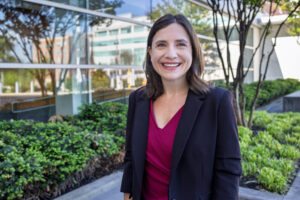
Leslie Simmons, executive vice president and chief operating officer of LifeBridge Health, will serve as interim president of Sinai and Grace Medical while a national search is conducted for Shlossman’s successor.

An ambitious new educational initiative seeks to emphasize personalized learning and strengthen Israeli society.
Schwab currently serves as president of Cumberland's historic B'er Chayim Congregation.

Meanwhile, the Jewish announcer Andres Cantor will be calling his 12th straight tournament.