
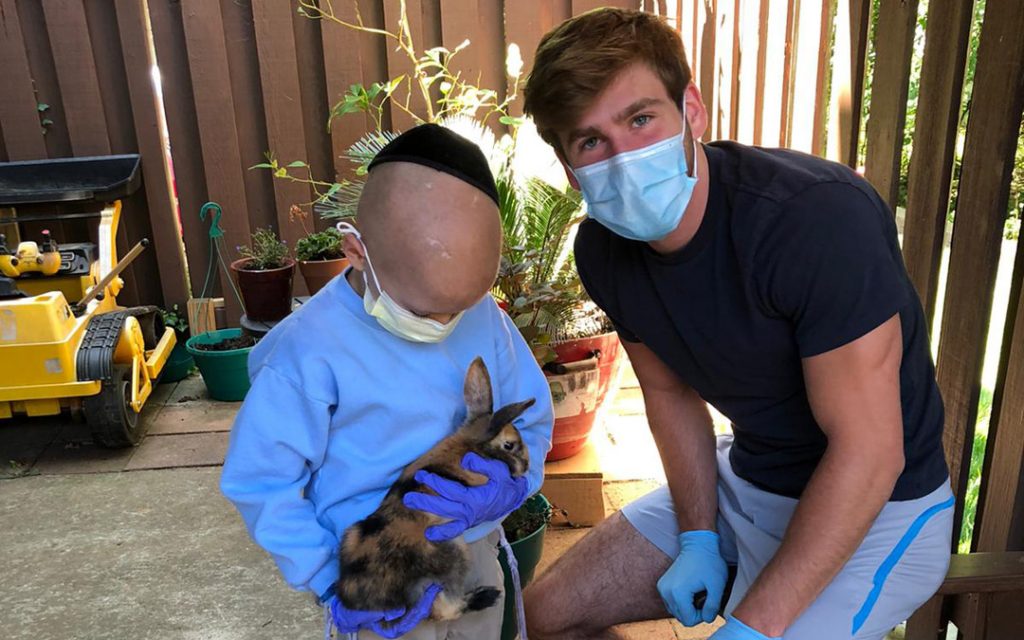
Evan Flaks is a Pikesville High School basketball player. But it’s his time spent on the football field at Wellwood Elementary School with Chai Lifeline kids and volunteers that stands out most in his mind.
“There was one time when we hadn’t seen a lot of kids for a while, so we bought a glow-in-the-dark football and invited them to the school,” he recalls. “We had shirts made and planned to play a football game, and when we got there it started pouring rain. But we didn’t stop. We had a bunch of kids there, including one in a wheelchair, and it was disgustingly muddy. But it didn’t matter because we were having so much fun.”
Chai Lifeline is a New York-based nonprofit that provides critical and comprehensive support to Jewish families with children facing lifelong or life-threatening illnesses.
Evan, 18, got involved with the organization when he was in the seventh grade, and became an official volunteer during his junior year of high school.
“When I first started volunteering with Chai Lifeline, I was doing it to help the kids,” he says. “I did it because I thought it would bring joy to these kids’ lives without realizing I would build relationships with them. I have so much fun with them, and they become like cousins to me.”
The Pikesville-based Chai Lifeline Mid-Atlantic regional chapter is currently celebrating its fifth anniversary, a particularly meaningful milestone for its director, Tzvi Haber.
“Chai Lifeline is the largest health support network in the world and provides year-round support to families,” he says. “Yet before 2013, there was no home base in the Baltimore-Washington area, which has one of the largest Jewish communities.”
Haber came to this realization after attending Chai Lifeline’s Camp Simcha in New York as a counselor and speaking to a mother who lives in this area. He decided to create the Mid-Atlantic chapter.
Five years later, the organization now has five professional staff members supporting 113 families, with nearly 200 active high school volunteers. They hold activities or events at least once a week with families that have a seriously ill child.
“There are volunteers from Pikesville High School, Beth Tfiloh, Park, Bais Yaakov and Talmudical Academy,” says Haber. “Our volunteers are from different walks of life and different communities who would have never met or spent more than 10 seconds together had it not been for Chai Lifeline. There aren’t any organizations in our area that really bridge that gap and have volunteers from so many different Jewish backgrounds.”
From crisis intervention to family programming, Chai Lifeline strives to make the lives of families a little easier. The organization’s social workers act as case managers, helping families get medical appointments, organizing babysitting if there are other children in the family, and providing meals.
Chai Lifeline Mid-Atlantic has formal partnerships with local medical institutions such as Johns Hopkins, the University of Maryland and Sinai. Last year, Chai Lifeline worked with the Ronald McDonald House Charities of Maryland to open a kosher food pantry at the latter organization’s East Baltimore facility.
Chai Lifeline volunteers spend hours at hospitals with kids when they are sick, and hang out at them at home with them when they are feeling better.
But perhaps the most fun element of Chai Lifeline is the family programming. “Our family programming is legendary,” says Haber. “We hold an average of eight programs a month, which is more than three other regional offices combined in three months.”
It’s that programming that has made an impact and difference for Ariella Stein, whose family got involved with Chai Lifeline after she was diagnosed with Ewing’s sarcoma.
“It was amazing to see them take Ariella under their wing,” says David Stein, Ariella’s father. “They treated her like a person and didn’t see her illness. When she finished chemotherapy, they treated her like a princess and took her to a professional studio where she sang and recorded the song ‘Fight Song’ by Rachel Platten.
“One time, Tzvi filled a swimming pool up with a million water beads and Ariella invited a few friends over. It was the middle of winter and they just jumped right in the pool. We also got to go bowling at the White House and met Ivanka Trump. Ivanka personally called me to send her condolences after Ariella passed away. And Chai Lifeline did whatever they could to make Ariella happy.”
But for Ariella’s family, seeing these high school volunteers treat her like a friend made all the difference.
“They text back and forth with these kids constantly,” says Stein. “Ariella would ask for them to come over, and watching them interact was special. These kids aren’t volunteering at Chai Lifeline for service hours. They truly believe in what they are doing, and that’s hard to find that these days.”
With extensive training for volunteers on sensitivity and etiquette, as well as mental health check-ins, Haber says he is working to “create a culture of kindness.” And that culture is what’s helping the organization thrive even during the pandemic.
“We aren’t able to visit kids in the hospital right now, which is the biggest change since COVID hit,” he says. “But every kid we serve has his or her own COVID-adapted plan. Some volunteers go into the homes with masks on, while others stay outside.
“A month ago, we had volunteers buy a drone for a little boy with brain tumor, and they set up hula hoops outside and had the kid fly the drone through the obstacle course, safe from inside his house. We have other kids who will sit by the window, and volunteers will do stuff outside with lasers at night. We are getting creative and adapting our home visits.”
The creativity allows volunteers like Evan Flaks to continue bringing joy to kids who need it the most.
“Doctors care about medicine, but everyone needs emotional healing and friendship and companionship,” he says. “Tzvi dedicates his life to helping children, and I see the kids’ transformations. They go from being depressed to not wanting to say hi to us and hiding behind their parents’ legs to a year later banging at a door when they see us coming and asking when we are coming back to spend time with them.”
For information, visit chailifeline.org/region/midatlantic.
Leslie Simmons, executive vice president and chief operating officer of LifeBridge Health, will serve as interim president of Sinai and Grace Medical while a national search is conducted for Shlossman’s successor.

Schwab currently serves as president of Cumberland's historic B'er Chayim Congregation.
A former U. S. Marine, Pat Young has served as a Baltimore County Council member representing District 1 since 2022.
Mansoor Shams is known for carrying around a sign proclaiming, “I’m a Muslim and a U.S. Marine. Ask anything.” Now the Baltimore County Department of Recreation and Parks community engagement and outreach officer is running for Baltimore County Executive.