
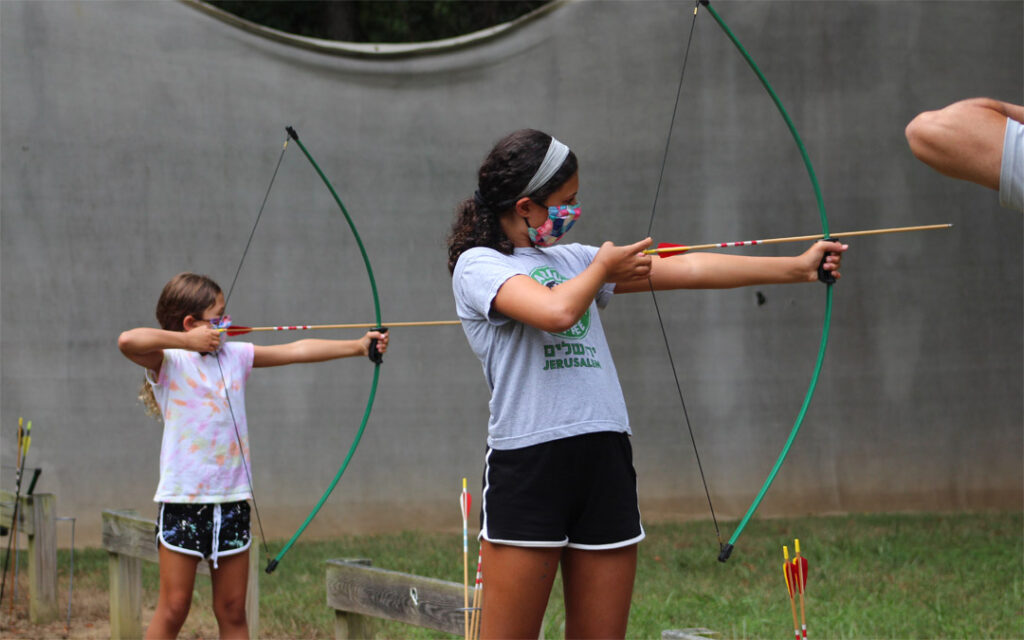
Last summer, many camps across the state cancelled their regular seasons due to the COVID-19 pandemic.
But more than a year later, most area camps are preparing to open again, with strict health and safety guidelines in place.
“We are excited and we want camp to open,” says Neil Berlin, director of operations for Camps Airy and Louise in Western Maryland. “Kids need summer camp with their friends. They need to be outside and off screens.”
Lisa Handelman, director of Capital Camps in Waynesboro, Pa., agrees. “Kids and young adults really need to get back to camp,” she says. “There are valuable life skills they learn here that they can’t get over Zoom.”
Still, Jewish camping professionals are aware that the collective psychological trauma of the pandemic may make adjusting to camp more difficult than in previous years.
“We know it will be challenging,” says Berlin. “For some kids, moving from virtual to real life will be tough. That’s why we’ll have a wellness team with social workers, guidance counselors and other adults for campers and camp staff.”
Handelman shares Berlin’s concerns.
“Kids have not been in big groups for over a year,” she says. “They need to reacquaint themselves with living with others.”
As a result, Capital has increased the number of social workers at camp this year to ensure that the emotional needs of staff and campers are well served.
At the Jewish Community Center of Greater Baltimore’s J Camps, Emily Peisach Stern, senior director of camping, says “creating bonds” at summer camp is essential.

“The social-emotional piece of the pandemic has been hard for kids and staff. It’s more important than ever before,” she says.
Unlike Airy/Louise and Capital, the JCC held a modified camp season last year called Summer at the J.
“We found out about three to four weeks before the start of the season that day camps were allowed to open,” says Peisach Stern. “We had a lot of different health and safety policies, and we had less capacity and fewer options. We had a lot of training for staff about COVID, and they really rose to the occasion. They did a fantastic job, and they will again.”
More than a year after the pandemic started, Stern says her staff knows how to keep campers safe and happy. This summer, J Camps will offer comprehensive and robust programming that includes general day camp offerings, Maccabi sports, a tennis academy and its Habimah arts camps.
To keep campers and staff safe, all three camps have instituted a variety of health and safety policies. In addition, camp administrators will keep close tabs on evolving guidelines established throughout the summer by the state health department and the Centers for Disease Control and Prevention.
At Airy and Louise, campers and their families are being asked to quarantine for 10 days prior to coming to camp.
“We recommend a PCR [polymerase chain reaction] test 10-12 days before camp. That way if someone is positive, there is time to quarantine before camp,” says Berlin. “We’re asking families to be really careful … low-risk activities, no big groups, no restaurants.”
Three to four days before camp opens, campers will be required to take another PCR test, and they must bring proof of a negative test to camp. Upon arrival, each camper will receive a rapid test before being admitted.
“Kids will be unmasked in their bunks. The bunks will be the new household,” says Berlin. When campers are with other bunks or in public areas, they will be required to wear masks. In the dining hall, only every other table will be used, windows will be kept open and air conditioning will be running.
“There are three keys — being outside, distanced and mask wearing,” says Berlin.
Depending on how the summer progresses, campers may eventually be able to participate in activities with other children in their units. Dances and off-campus trips will not take place this summer.
At Capital, campers will begin camp sessions in “bunk-level cohorts. They’ll have all the traditional activities, but they’ll be moving with their bunks,” says Handelman.
Counselors at Capital — the majority of whom will already be fully vaccinated — will be required to stay on the campus during days off and in between sessions to avoid contact with people outside the “camp bubble,” she says. Campers who take medication will not go to the health center to pick up their prescriptions. Instead, camp nurses will bring medicine to them in their bunks. And outside groups will not be able to visit the campus, as they have in the past.
Handelman says she’s been pleased by how local camps have supported each other during this time as they develop plans to reopen safely. “There’s a real sense of collaboration,” she says.

At the JCC, safety precautions will be similar to last summer. In addition to keeping bunks separate from one another and staggering lunchtime and swimming instruction, the JCC has created additional outdoor spaces to keep campers outside as much as possible.
The JCC’s popular TNT (Top Notch Teens) program will operate this summer. But due to COVID-19, the program will not include the usual volunteering at the preschool. As usual, the JCC will offer pre-and post-camp options before and after the regular camp season.
While many families are thrilled their children will be able to return to camp this summer, some parents may still be concerned. Each camp has its own health and safety policies and protocols detailed on their websites.
Parents are encouraged to review them and reach out to camp officials with any questions. “If you’re feeling hesitant, just pick up the phone,” says Handelman.
For information about Camps Airy and Louise, visit airylouise.org. For information about Capital Camps, visit capitalcamps.org. For information about J Camps, visit jcc.org.
A former resident of Baltimore and central Florida, Ritt was active in the Soviet Jewry movement of the 1970s and 1980s.

The Orioles' weak defense plays a major role in the nightly carnage, writes Michael Olesker.
For more than four decades, Goldman played a vital role in the supervision of elections in the city.

Educators, ethicists and Jewish leaders are debating the question as content mills slop on.