
Sometimes, all it takes is a good hug to make things right.
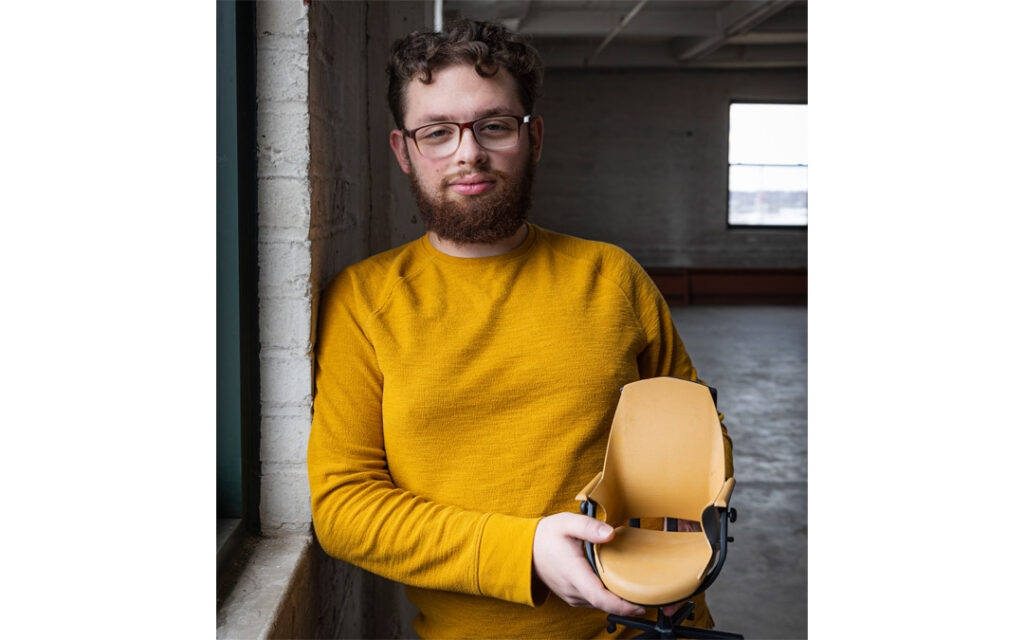
That’s the basic idea behind Herschel Ruben’s Compressent desk chair. He designed the chair as part of his senior thesis at the Maryland Institute College of Art.
A Bolton Hill resident, Ruben, 27, graduated from MICA last year with a bachelor’s degree in product design and participated in the school’s 2022 UP/Start Venture Competition, which offers winners up to $100,000 to launch creative and socially responsible businesses.
Ruben’s Compressent Co: Designing for Neurodiversity was recently selected as one of the winning ventures. He will receive $30,000 in start-up funding to help bring the Compressent chair to market.
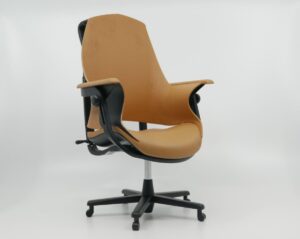
The Compressent chair “hugs” or applies pressure to the thighs and shoulders of users, helping them to feel calm and focused throughout the work day. It was designed specifically with the needs of autistic and neurodiverse individuals in mind.
Many of these individuals have proprioceptive sensory disorders. Proprioception — often referred to as the sixth sense — makes us aware of our bodies in space and tells us how our body parts are moving. It lets us know how much pressure and force is required to complete a physical task, and protects us from sensory overload.
Growing up in Pikesville’s Orthodox community, Ruben says he always knew he was different. He struggled in school and was expelled from several academic institutions.
At 12, Ruben received an autism diagnosis. He says it wasn’t until his later teens when his world opened up.
“I started playing video games — a lot of video games. I played video games morning to night,” says Ruben. “Since I have Asperger’s syndrome, my understanding of how people interact and communicate was very tough.”
Through video games, Ruben met others with similar interests. He initially communicated with virtual friends by typing but one day, at the prompting of a pair of video gaming pals, began communicating verbally on a microphone.
“I went from not really talking to people or understanding how that worked to understanding how to communicate with people, at least using my words to general effect, then using my words verbally,” says Ruben. “Eventually, it got to a point where I went from [verbalizing] during video games to being in charge of some of these social groups within the video games. I went from this nonverbal guy who was just kind of there on the sidelines to being in a position of control within that sphere of people. It was from there that I went to community college.”
At the Community College of Baltimore County, Ruben became an interactive media major. One of Ruben’s teachers was particularly encouraging.
“She said, ‘Hey, show up to the art club,’” he recalled. “So I went there and a few weeks in, she said, ‘Why don’t you become the president of the art club?’ [Through that club] I developed a whole friend group and ended up doing everything under the sun and the stars, and then got into sculpture by the end of it.”
Ruben loved sculpture but when transferring to a four-year college, he decided to pursue a more practical field.
“One of my professors put me in touch with a guy who was a product designer. I had never heard of product design before,” he says. “We were slated to have a 15-minute meeting, and it ended up becoming an hour-and-a-half-long. I said, ‘OK, this is what I’ve got to do.’ I had already applied to all the schools, so I started inquiring, ‘Do you have a product design major?”
When acceptances rolled in, Ruben says he was bombarded with scholarship offers.
“Essentially, I failed all of grade school and got my GED because I got kicked out of everywhere,” he says. “I ended up accumulating between $300,000 to $400,000 in scholarship money if I combined all the offers.”
Ruben decided to attend MICA, where he double-majored in product design and sculpture. The concept for the Compressent chair came in part from Ruben’s personal experiences with proprioceptive dysregulation.
“Sometimes when I had to write a paper, I would lie under all these clothes and blankets and have one of my siblings sit on me while I dictated the paper to my mother,” he recalls.
He spoke to other neurodiverse individuals who also experienced the need for proprioceptive feedback to calm and focus themselves. He learned that after their workdays, some people on the spectrum “spend hours detoxing.”
Ruben wanted to find a way to avoid that detox. He knew about the popularity of weighted blankets, which are designed to provide proprioceptive feedback.
“But you can’t bring your weighted blanket to the office,” he says. “What if there was a chair that provided that sensation? What if you were able to do that while you were working? What if you didn’t have to go home and detox because your body received [proprioceptive feedback] all day?”
The idea for the Compressent chair became the focus of Ruben’s senior thesis.
After graduating from MICA, Ruben earned money driving an Uber in Baltimore and shared his Compressent chair idea with customers. “People were really engaged,” he says.
In November, Ruben read about a competition offered by the Ratcliffe Center for Creative Entrepreneurship at MICA. The center helps students create socially conscious businesses to thrive in the modern creative economy.
Competition finalists participate in a four-month incubator program that teaches them how to launch projects and businesses.
“Every week, we had different modules, and different speakers came in to teach about the things you need to do to start a business,” says Ruben. “I’ve met some really cool people along the way.”
Ruben says he is now talking with lawyers about patents and executing his business plan. He joined forces with Maryland-based American Bully Manufacturing to produce the chairs.
“In the next three or four months, I’m working to get this to a fully functioning, full-scale prototype that people can sit in and experience and preorder it,” Ruben says. “Right now, we’re aiming to have a minimum run of 250 chairs by March of 2023.”
But Ruben’s business plan doesn’t end with the chair.
“The chair is the launching product,” he says, “but then there’s Compression LLC, the company which will create other products to help people manage sensory overload in ways that won’t stigmatize them. There are so many people who have anxiety, ADHD, PTSD, and there are no products made for them. I want to get in there and actually change the environment, make it accessible for all. That’s where the company’s mission is going.”
For information about the Compressent Chair and Compressent LLC, visit compressent.net.

'It's Classic!" featured rock climbing, food, live entertainment and more.
A Norfolk native, Frankle worked at Sinai Hospital, Camp Airy and privately for five decades.
Esther Greenberg, Leora Match, Kathlleen St. Villier Hill and Ben Gershowitz will be recognized for the contributions to the community.

For more than five decades, Dr. Rosenstein was known by local families as a trusted and caring physician for their children.