
Are we facing a critical nursing shortage in this country?
In eight years, the United States could be short by as many as 1.9 million nurses, according to the U.S. Bureau of Labor Statistics. Maryland is not immune from this dire projection, nor from a current nursing shortage. A recent Maryland Hospital Association report indicates the state’s hospitals face the most critical staffing shortage in recent memory.
But an innovative initiative at the University of Maryland Medical System may be part of the solution in growing the nursing workforce.
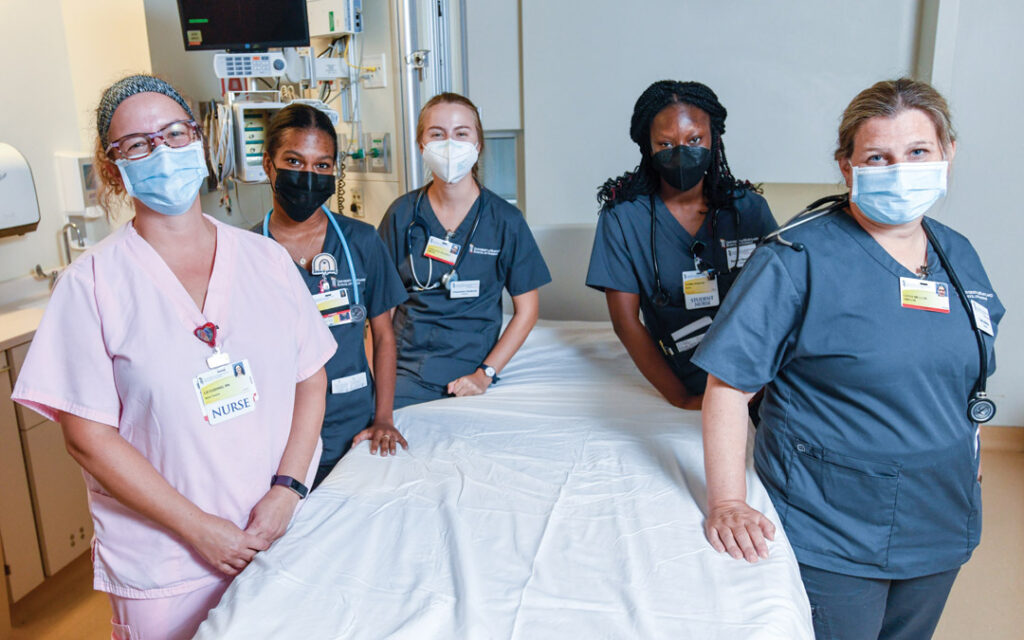
Developed by Lisa Rowen, chief nurse executive for UMMS, the new Academy of Clinical Essentials program places a cohort of nursing students at patients’ bedsides under the instruction of an experienced hospital-based nurse.
Rowen says this academic-practice partnership model “reimagines” the preparation of student nurses and their transition to hospital practice, while providing integrated and innovative patient care. Following its successful pilot last spring, UMMS this fall welcomed its first full class of nursing students who will participate in the ACE program.
“This is a significant opportunity for nursing students to get a realistic clinical experience, be immersed in clinical care for a full shift and have accountability for patients from the beginning of their shift until handing off to the oncoming nurses at the end of their shift,” says Rowen, a Pikesville resident who has been a member of the nursing profession for four decades. “Caring for a patient for a full 12 hours allows nursing students to experience the continuum of care, engage with a patient’s family members, and fully understand the patient care experience.”

Rowen says the multi-pronged goals of ACE include improving the student nurse’ educational experience with experiential learning by embedding them in hospital culture, bolstering the nursing workforce, recruiting students to join the UMMS workforce as new nurse graduates, decreasing orientation costs over time, and providing opportunities to diversify the roles of UMMS nurses to ensure they stay more engaged within the organization and enable their professional advancement.
ACE cohorts are assigned to hospital units for the duration of their clinical course, which reinforces the skills that nursing students are taught in their first or second year of nursing school.
For one 12-hour shift per week, small cohorts of four nursing students each are paired with a UMMS-funded clinical nurse who serves as their instructor and who is experienced with the patient population of the specific unit, team members assigned there, policies, protocols, procedures and equipment.
UMMS piloted ACE — believed to be the first such program in the country — last spring with seven cohorts of 28 second-semester medical/surgical students from the University of Maryland School of Nursing.
An additional 11 students in their first semester fundamental course joined the cohorts at mid-semester and were able to practice basic nursing skills. The cohorts were located at the University of Maryland Medical Center (Downtown Campus) and the University of Maryland St. Joseph Medical Center.
This fall, the program was expanded to include nursing students from all three campuses of the Community College of Baltimore County and from Chesapeake College in the Eastern Shore community of Wye Mills.
ACE students will also now be found at the University of Maryland Medical Center (Midtown Campus), UM Baltimore Washington Medical Center in Glen Burnie, UM Upper Chesapeake Health’s two hospitals serving Harford County, UM Shore Regional Health facilities, and UM Rehabilitation and Orthopaedic Institute, totaling 32 cohorts comprised of 128 students.
Rowen says her impetus for developing the ACE program was a report by the American Association of Colleges of Nursing that concluded nursing students are not receiving the amount of clinical experience they require.
“Historically, nurses received hands-on training under the guidance of an experienced hospital nurse,” she says. “The UMMS ACE teaching model returns the profession to its roots.
“Modern health care demands rigorous, in-class education for all nurses, and ACE blends the modern approach with real-world experience that will result in graduates who are far more prepared to begin caring for patients, who may be the biggest beneficiaries of this approach that adds more hands and resources to hospital units,” Rowen says.
Nursing students who are enrolled in Medical-Surgical Nursing for an associate’s degree in nursing, a bachelor of science nursing and entry-to-practice clinical nurse leader classes are eligible for the program.
During their clinical rotation, the student nurses are part of the care team on their assigned unit and considered an integral part of the care team. Rowen says an especially important aspect of the program is the inclusion of clinical instructors in staffing numbers at hospitals.
She adds that early pilots of the model have also shown that instructors also benefit greatly from the ACE initiative by creating opportunities for experienced nurses who are passionate about teaching to have a diversified role and be more engaged at the hospital.
“This is a win-win model for nursing schools, nursing overall and UMMS,” says Rowen, who has been approached by other health care systems interested in replicating the model.
Rasheda Dukhin was an ACE initiative student last spring on UMMC’s Thoracic Intermediate Care Unit.
“This was an amazing experience that made me feel ready to practice nursing upon graduation,” she says. “I got experience with all patient care, assisted physicians with medical procedures, administered medications, documented assessments, drafted reports and more. During the semester, I was able to directly align lecture material to clinical practice, and it allowed me to better understand and absorb the material. The clinical instructors were a great part of my success because they challenged me, gave me autonomy, and were patient and willing to teach me.”
Says Rowen “Nursing students participating in the ACE program will undoubtedly be better prepared for their nursing careers because this education offers them the reality of being a nurse in health care right now. Adding this immersive type of hands-on experience will be invaluable and will help nursing students become more confident and proficient in clinical skills and in their professional relationships with multi-disciplinary team members. The goal is for these students to require less orientation time on their unit when they are hired so they can practice independently sooner.”
Rowen adds that it is hard for her to imagine a profession that is more meaningful than nursing.
“You have the privilege of caring for individuals at the most vulnerable time in their life. You can make all the difference to them,” she says. “To have that much meaning in someone’s life … there’s not much that can be better than that.”
A former longtime Baltimore resident, Carol Sorgen is a freelance writer based in Portland, Oregon.
Colorectal cancer rates are climbing among young people and Ashkenazi Jews.

The donation will be directed to help foster research conducted by faculty at the University of Maryland School of Medicine and to advance innovative treatments.
The founder and owner of Catonsville Dental Care, "Dr. B" maintains a spirit of optimism that inspires friends, colleagues and patients.

The Northwest Baltimore hospital was recognized for its initiative to strengthen safety, enhance care coordination and build a deeply engaged workforce.