
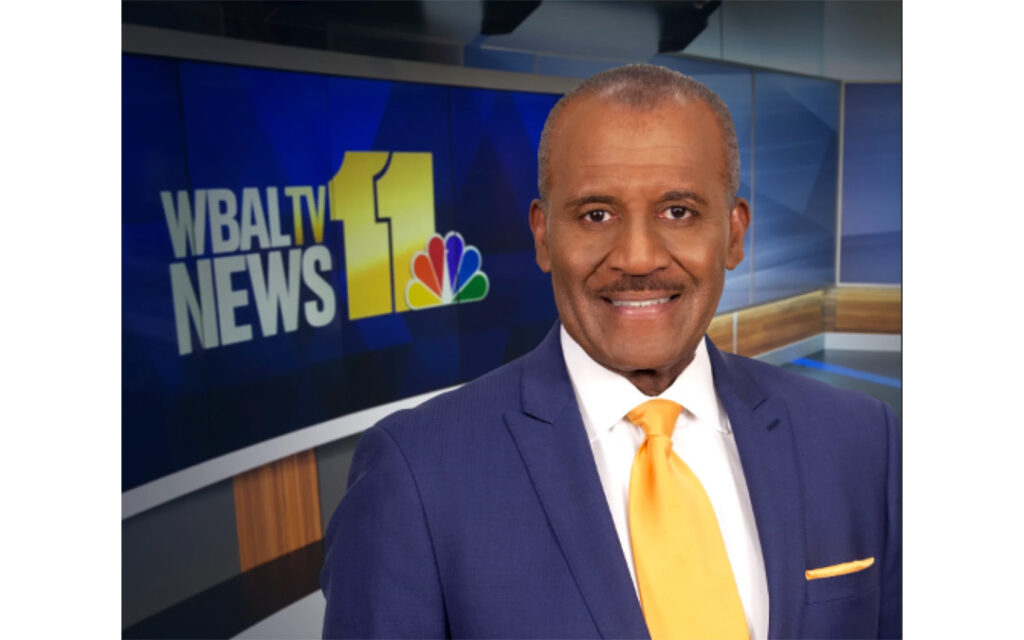
Half a century after he started his television career in a far sillier broadcasting era, TV news anchor Stan Stovall put away his microphone the other day and bid farewell to WBAL viewers.
You stick around long enough, you witness the changes in TV’s star players and in the medium itself.
Stovall retires as he’s pushing 70. He was a 17-year-old high school senior in Phoenix, Arizona, when he broke into TV. After a dozen years working in several U.S. cities plus a brief overseas tour, he arrived here in 1978, billed by the marketing geniuses at WBAL as “one of the strongest newsmen in the country.”
The billing came for precisely the wrong reason: Stovall was a competitive bodybuilder.
“Strong,” get it?
The station ran commercials showing him lifting weights. If that wasn’t demeaning enough for a news anchor — the serious authority figure of any TV news operation, after all — the spots showed Stovall attired in a loincloth.
“Stan Stovall is one of the strongest newsmen in the country,” a voice-over declared. “He pulls his weight and then some.”
This was the sound of a medium unintentionally declaring its very own dumbbell mentality.
As the New York Times columnist Frank Rich put it back then, it was a time when local TV news operations majored in “jokes and casual repartee. … No one even pretended that journalism was a required skill.”
Careers were either created or crushed by such marketing. Stovall survived because he was smarter than any of those marketing authorities, and steadier, and he insisted on standards when it came to the heart of his job: telling it straight when delivering the important events of the day.
He did it at WBAL, and he did a stint at WMAR and ultimately he went back to TV Hill. Viewers knew he’d been around for a while when he anchored WBAL’s coverage of the Freddie Gray riots, and while the national cable operations were losing their grip on reality, Stovall kept his composure and perspective and distinguished between actual troublemakers and those who simply happened to be on the street.
It was a measure of his experience in Baltimore and in life. When he started his career in Phoenix, he was the first African-American TV reporter in the state. When he arrived in Baltimore, he was one of only a handful of on-air news people who were Black.
He’s watched the evolution of news coverage all around him.
When Stovall arrived at WBAL in 1978, local TV news looked like the future. Ratings were stratospheric, advertising rates enormous, and what did it matter if the medium never seemed to get serious about actual news?
The times have changed. The internet arrived and so have phones that can tell us tomorrow’s weather so we don’t have to stick around for the 11 o’clock TV broadcast. Ratings in every market in America, overwhelmed by ever-newer technologies, have plummeted.
Only the strong have survived. Stovall retires as the longest-tenured anchor in Baltimore TV news history. Those early commercials did him no favors, with that primitive loincloth look. But they got the “strong” TV newsman part exactly right.
Michael Olesker’s latest book, “Boogie: Life on A Merry-Go-Round,” was recently published by Apprentice House. It’s the life story of Baltimore legend Leonard “Boogie” Weinglass, an original “Diner” guy who grew up to create the Merry-Go-Round clothing chain and contribute millions to charity.
A Baltimore native, Sweren was a collector of artists' books whose own works were displayed in national galleries.
Allow me a few paragraphs of time travel, and let’s go back to Johnny Carson’s monologue the night after Neil Armstrong became the first man to set foot on the moon. I’m paraphrasing here, but I think the joke still works 57 years after Carson first delivered it. “The good Read more
The BCO, founded in 1984, will perform the works of Frank Zappa, Beethoven, Mason Bates and Karena Ingram.

For more than 130 years, Sol Levinson & Bros. has been woven into the fabric of Baltimore’s Jewish community.