
By Lisa Keys
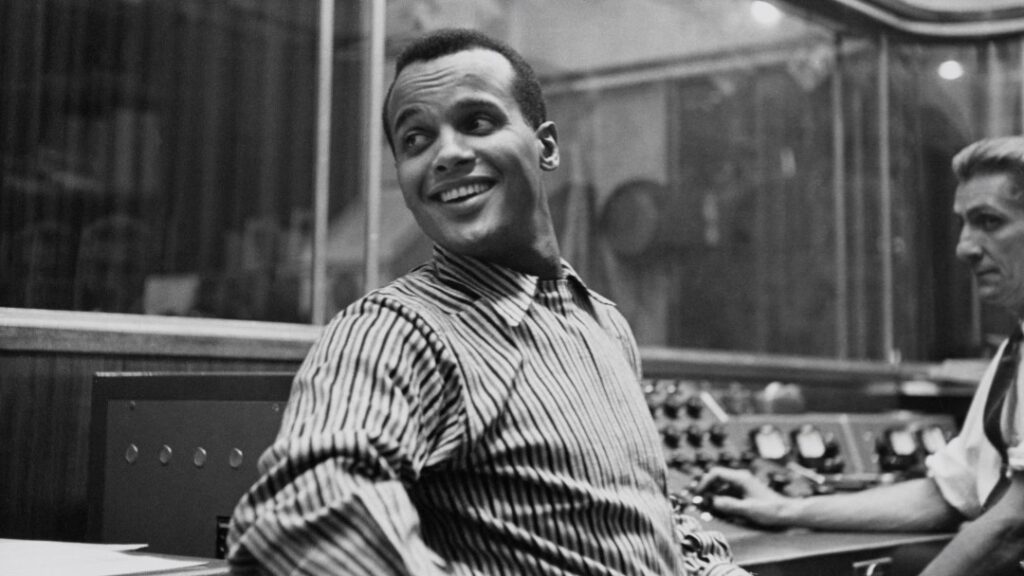
Barrier-smashing singer, actor and humanitarian Harry Belafonte — who once boasted jokingly of being “the most popular Jew in America” because of his rendition of a Hebrew classic — died Tuesday, Apr. 25, at his longtime Upper West Side home. He was 96.
A New York City native, Belafonte, an acolyte of singers Paul Robeson and Josh White, was the one of the first Black artists to achieve widespread commercial success in the United States. While he was raised a Catholic, his life frequently dovetailed with Jewish causes, values and individuals.
Among Belafonte’s many Jewish connections — which included brokering a meeting between Nelson Mandela and Jewish leaders in 1989 — was his marriage to his Jewish second wife, dancer Julie Robinson. The couple, who were married from 1958 to 2004, raised two children, Gina and David.
In 2011, Belafonte revealed in his autobiography, “My Song: A Memoir,” that his paternal grandfather was Jewish. Belafonte’s parents were both Jamaican immigrants: his mother, Melvine, was the child of a white mother from Scotland and a Black father, and his father, Harold George Bellanfanti, who later changed the family surname, was the son of a Black mother and white Dutch-Jewish father.
In his book, Belafonte describes his Sephardic paternal grandfather, whom he never met, as “a white Dutch Jew who drifted over to the islands after chasing gold and diamonds, with no luck at all.”
Belafonte was born Harold George Bellanfanti Jr., in Harlem on Mar. 1, 1927. His father was largely absent during his childhood; his mother, who struggled with finding work, forged a relationship with a Jewish tailor who taught her how to mend garments.
“That tailor gave me my first sense of kinship with Jews, which would deepen over time,” Belafonte wrote in his memoir.
He spent a portion of his childhood with his grandmother in Jamaica, but he returned to New York to attend George Washington High School in Washington Heights — where Alan Greenspan and Henry Kissinger were also educated — before dropping out.
Following a stint in the U.S. Navy during World War II, Belafonte was bitten by the acting bug while working as a janitor’s assistant and given a pair of tickets to the American Negro Theater as a gift.
“It was there that the universe opened for me,” he told NPR in 2011. “I decided with any device I could possibly find, I wanted to stay in this place. What I had discovered in the theater was power: power to influence, power to know of others and know of other things.”
Calypso King
In the late 1940s, Belafonte enrolled in acting classes, where he met his lifelong friend Sidney Poitier. The impoverished pair would often share a single theater ticket, trading places at intermission.
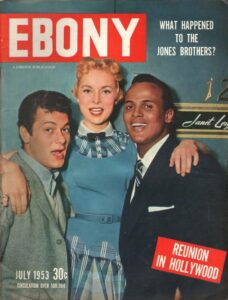
He also befriended Jewish actor Tony Curtis, writing in his memoir: “He lived in the Bronx with his family; why live downtown, he’d say, when he could live uptown for free? And who cared if they still greeted him up there as Bernie Schwartz?”
He and Curtis frequently went to parties together, he wrote, sometimes with the actress Elaine Stritch, “who swore more colorfully than any sailor I’d known,” and “the blunt Jewish comic” Bea Arthur, “who’d start matching wits with Elaine until the two of them had everyone in uncontrollable laughter.”
To pay for acting classes, Belafonte began dabbling in singing at nightclubs, and it was there that a true superstar was born. One of Belafonte’s early successes were his performances of the Hebrew standard “Hava Nagila” at the classic downtown folk club the Village Vanguard. His rendition, Belafonte joked to The New York Times in 2017, made him “the most popular Jew in America.”
In that same interview, Belafonte recalled the tough uptown streets of his childhood, and of how he was drawn to the fast money his uncle’s number-running business earned.
“Everybody in that world were role models in how to survive, how to be tough, how to get through the city, how to con, the daily encounters,” he said. “But my mother saw to it that unless I wanted to live life absent of testicles, she wasn’t going to have me follow her brother Lenny. Somewhere in there is a Sholem Aleichem — a rich story to be told of the lore of that time.”
With his 1953 breakthrough album, “Calypso” — which included his most iconic work, “The Banana Boat Song” — Belafonte “almost single-handedly ignited a craze for Caribbean music,” according to The New York Times’ obituary. “Calypso” climbed to the top of the Billboard album chart shortly after its release and stayed there for 31 weeks; it is reported to be the first album by a solo artist to sell more than a million copies.
By 1959, Belafonte, considered a leading sex symbol and matinee idol, was the most highly-paid Black performer in history, according to the Times.
Known around the world as the “King of Calypso,” Belafonte recorded and performed a wide range of global and folk classics throughout his wide-ranging musical career, with Jewish standards among them. In 1959, he performed “Hine Ma Tov” in England, with what appears to be an Israeli military choir; his 1963 album, “Streets I Have Walked,” includes a rendition of “Erev Shel Shoshanim,” a popular Jewish wedding song.
In addition, Belafonte in April of 1961 gave a young Jewish folk singer from Hibbing, Minnesota, named Bobby Zimmerman, aka Bob Dylan, his professional recording debut. Dylan played a raw and raucous blues harmonica solo on the title track of Belafonte’s 1962 album, “The Midnight Special.”
“Harry was the best balladeer in the land and everybody knew it,” Dylan wrote in his 2004 memoir, “Chronicles: Volume 1.” “He was a fantastic artist, sang about lovers and slaves — chain gang workers, saints and sinners and children. … He was a movie star, too, but not like Elvis. Harry was an authentic tough guy, not unlike Brando or Rod Steiger. He was dramatic and intense on the screen, had a boyish smile and a hard-core hostility. …
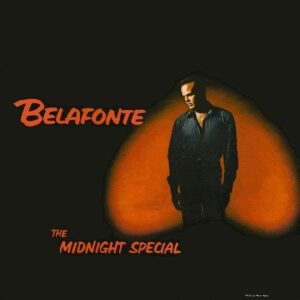
“To Harry it didn’t make any difference. People were people,” Dylan wrote. “He had ideals and made you feel you were part of the human race. There never was a performer who crossed so many lines as Harry. He appealed to everybody whether they were steelworkers or symphony patrons or bobby-soxers, even children. He had that rare ability.”
Changing the Culture
Belafonte’s greatest passion, however, was neither acting nor singing — it was civil rights activism. There, too, he worked closely with many Jewish activists as part of the historic Black-Jewish civil rights alliance of the 1950s and ’60s. But as he recalled in his memoir, it was racism delivered by a Jewish TV executive that first inspired him to take on racial segregation in the United States.
The executive, a Jew from Montreal named Charles Revson, asked Belafonte to stop hosting white dancers on his performance show, citing the preferences of Southern viewers. Belafonte said he rejected the instruction and let Revson cancel the show. He realized, he wrote, that TV could only reflect societal attitudes, not change them. “To change the culture, you had to change the country,” he concluded.
Through his civil rights activism, Bellafonte befriended Dr. Martin Luther King Jr. in 1956; the pair remained close until King’s assassination in 1968. “My apartment was a retreat for him,” Belafonte told NPR of King and his 21-room apartment in 2008. “He had his own entrance, his own kitchen. The home became, for him, a place where he could think and reside, take his shoes off, have his collar open and be him.”
Belafonte helped provide the seed money to launch the Student Nonviolent Coordinating Committee, and he was one of the lead fundraisers for that organization and King’s Southern Christian Leadership Conference. He was “deeply involved” in the 1963 March on Washington and helped fund the Freedom Rides.
Belafonte’s commitment to social justice endured throughout his long life and career. In the 1980s, he helped organize the Live Aid concert and conceived the idea for the “We Are The World” charity recording, and he served as UNICEF’s goodwill ambassador after Jewish entertainer Danny Kaye pioneered the role. He was also a co-chairman of the Women’s March on Washington in January of 2017, along with Gloria Steinem, though ill health kept him from attending.
Though primarily famous for his singing, Belafonte continued to make movies throughout his career. In 1970, he produced and co-starred in “The Angel Levine” alongside Eli Wallach and the original “Fiddler on the Roof” star, Zero Mostel. Based on a story by Bernard Malamud, Belafonte starred as the titular Jewish angel. (The “project had a sociopolitical edge,” the Times noted, as the entertainer’s Harry Belafonte Enterprises hired 15 Black and Hispanic apprentices to work on the film’s crew.)
The cause of Belafonte’s death was congestive heart failure. He is survived by his two children with Robinson; the two children he had with his first wife Marguerite Byrd, Adrienne Biesemeyer and Shari Belafonte; and eight grandchildren.
After divorcing Robinson in 2004, he married photographer Pamela Frank in 2008. Frank also survives him, along with stepchildren Sarah Frank and Lindsey Frank and three step-grandchildren.
“There’s just so much left that’s in my basket of possibilities,” Belafonte told The New York Times ahead of his 90th birthday in 2017. “I’m not as young as I feel, or as young as I would consider myself to be. The 90 figure is a blur. But I do know that if there’s anything left for me to do, I had best hurry up and do it, because time is not an ally.”
Lisa Keys wrote this article for the New York Jewish Week, which was provided by the JTA global Jewish news source. Jmore staff contributed to this report.

A former college campus activist, Veksler will speak at Chizuk Amuno on June 8 at the Ruth and Jay Lenrow Visiting Scholar-in-Residence for Combating Antisemitism.

A lifelong Baltimorean, Judge Rosenberg served as a U.S. magistrate judge from 1973 to 1998.

Container vegetable gardening is a terrific option for people with limited space and/or time. Rebecca Brown and Norman Cohen share some tips.
A former resident of Baltimore and central Florida, Ritt was active in the Soviet Jewry movement of the 1970s and 1980s.