

By Candice White
In recent years, many workers have experienced a great deal of relentless stress. The “2022 Alight International Workforce and Well-Being Mindset Study Report” found that more than 70% of employees feel affected by job-related stress, with almost half admitting to at least one symptom of job burnout.
What exactly is burnout? The Mayo Clinic defines it as “a state of physical or emotional exhaustion that also involves a sense of reduced accomplishment and loss of personal identity.” It comes from feeling a lack of meaning or impact in your work (or a “why”) and doing work that isn’t aligned with your skills, capabilities and resources.
This means that in addition to finding the “why” of what motivates you to work (such as the mission of your organization and its values), research shows the “what” that you do plays an important role in avoiding burnout, i.e., what your daily tasks are, the day-in and day-out activities you do most of the time.
Ask yourself this: do you feel you are using your strengths and are competent at your job?
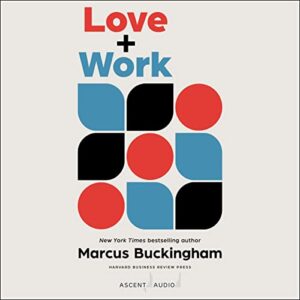
The concept of the “what” you do daily being important in finding the things you love in your work is explained by Marcus Buckingham in his book “Love + Work” published last year. Buckingham leads people & performance research at the ADP Research Institute and is a prominent researcher on strengths and leadership at work.
According to Buckingham, the key to avoiding burnout comes down to being able to do what you love during your day. Your ability to curate your job to incorporate more of what you love can determine if you feel burned out or lit up by your work.
Buckingham’s research explains that the most powerful predictors of retention, performance, engagement, resilience and inclusion are:
- If people were excited to work every day during the last week
- If people had a chance to use their strengths every day
- If people had a chance to do what they’re good at and something they love
This suggests people join companies for the “why,” but they stay because of the “what.”
If organizations want to retain an engaged workforce, it makes sense to connect what people love to their actual activities to achieve higher performance, engagement, resilience and experience lower turnover.
This is where it gets really interesting: a study at the Mayo Clinic found the threshold to avoid burnout is being able to do what you love for just 20% of your day — just an hour and 36 minutes out of an eight-hour day to be precise! That seems doable, doesn’t it?
According to Buckingham, if leaders want their employees to be high performing, to stay with the organization, and to be engaged and resilient, they should be intentional in helping them consistently find love in some of what they do. It’s important, too, for people to understand what they enjoy doing and what their strengths are.
Buckingham recommends we should all pay attention as we go through our days to notice when we feel like we’re in a flow state, to think how we can incorporate more of those into our days, and delegate work so that people can do the pieces that excite them the most.
Managers can help by getting to know their employees to understand what drives them. Regular meetings are essential for this, so supervisors can find out what their employees enjoyed about their recent work, what their priorities are, and how they as a supervisor can be supportive. This builds trust and helps connect what employees love to the work that needs to get done; they feel more fulfilled and less stressed, and the company gains engaged employees.
Candice White, CARW, is manager of the Ignite Career Center, a program of Jewish Community Services. Whether you are new to the job market or a seasoned professional, the Ignite Career Center can help you go further and get there faster. The center’s highly experienced career coaches provide individuals of all backgrounds and abilities with the customized services and tools they need to stand out from the competition. To learn more, visit ignitecareercenter.com or call 410-466-9200.

Jmore Editor-in-Chief Alan Feiler remembers Temple Emanuel's longtime spiritual leader, who passed away earlier this week at age 91.

Camp and youth group experiences have the ingredients for true, deep, lifelong transformation, writes Rabbi Jessy Dressin.

Proposed legislation in Israel would transfer authority of the entire Kotel to the Chief Rabbinate, writes Rabbi Robyn Fryer Bodzin.

In Italy, the Jewish Brigade's flag has unfairly become a flashpoint in today’s battles over Zionism and anti-fascism, writes Dr. Ginaluca Fantoni.