

By Sam Idas
Fifty-two years ago this month, the world lost legendary guitarist Duane Allman of the Allman Brothers Band. The “Skydog,” as he was known, died on Oct. 29, 1971, following a motorcycle crash in Macon, Georgia.
Allman — who in 2003 was ranked second to Jimi Hendrix on Rolling Stone’s list of the 100 greatest guitarists of all time — was only 24.
When I turned 67 a few years ago, I thought most of my exciting years were behind me. When friends would call, we usually talked about our Social Security checks and latest ailments. Slowly, my peer group seemed to be moving off the “center stage” to allow the next generation to take the spotlight.
But all of a sudden, bam! — like an episode of “American Pickers” — something old and forgotten suddenly becomes discovered and pushes itself right into that bright spotlight again.
That’s exactly what happened to me, and the result was the Allman Brothers Band’s release three years ago of a CD titled, “The Final Note.” Brilliantly restored, this CD is a live concert that I recorded at Owings Mills’ long-gone Painters Mill Music Fair on Oct. 17, 1971, using my $29 Panasonic cassette tape recorder, powered with 4-C size batteries and a 33-cent, 60-minute Compact Cassette tape.
Little did I know that this recording would become a historic document.
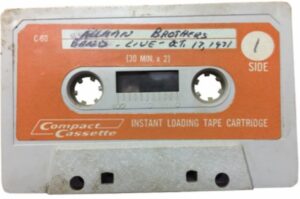
Forty-seven years after the Painters Mill concert, I emailed the recording to my cousin, Simon Ritt, a musician in Boston. He wrote back, “Sam, do you know what you have here? Do you know the importance of this tape? This is the holy grail of the Allman Brothers legacy. This is something that no one ever thought could exist!
“This is beyond amazing! You have to get this incredible piece of history out there!”
I was astounded by this revelation. Simon went on to explain that this concert was Duane Allman’s final performance, recorded only 12 days before his death.
One Way Out
Duane Allman was a phenomenal guitarist who, with his younger brother Gregg and the Allman Brothers Band, created what was described as a new form of Southern rock. To their large base of fans and followers, Duane’s tragic death left a multitude of future great music unrealized. It’s a terrible thing when a genius is suddenly gone, snapped away from life, leaving one only to imagine what could’ve been.
This is how I’ve come to understand the feelings among Duane’s legions of fans after the issuing of my recording of his last concert. I actually couldn’t believe there wasn’t already a fully produced record of such a significant performance.
The Allman Brothers family was stunned when I came forward with this recording. I recall the phone conversation with ABB manager Bert Holman when he realized he was talking to someone who had the only known existing recording of Duane’s last concert.
“Sam, please tell me this cassette has not been sitting on your car’s Florida sun-baked dashboard for the last 30 years?” he said. I replied, “Ha, yeah, I know people like that. But no. As a former radio disc jockey, I know better than that.”
Ain’t Wastin’ Time No More
Things then started moving pretty quickly. Within days, Bert and I wrapped up a contract. I was quite excited to now be partners with the last two surviving ABB members as well as the families of those who’d passed, including Gregg and Duane’s heirs. My cousin Simon remarked, “That is pretty cool, seeing a contract with the ABB logo on it!”
Next came an interview by ABB archivist John Lynskey for the CD’s liner notes. Shortly thereafter, my 33-cent cassette was handed off to a restoration specialist and Bert reported back a big thumbs-up, satisfied with its fidelity. They not only saved it, but through modern technology enhanced it. Amazing times we live in. I kept thinking if that concert happened today, there probably would be no less than a thousand people in the audience capturing not only the audio but also the video of that performance on their smartphones.
So how did all of this come about? In my interview with Lynskey, I explained:
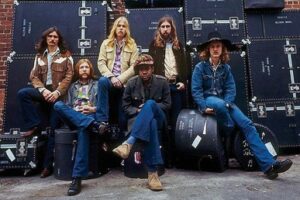
“I was 18 years old and had just graduated high school when I recorded the Allman Brothers Band at Painters Mill. Two years prior, I had worked part-time at a couple of radio stations in the Baltimore area where I grew up. In October of 1971, I worked at one station on Saturday, and the other one on Sunday. … Being a kid in the radio business at that time, it seemed the only way to get ahead was to get a first-class commercial radio telephone license, which would allow you to operate the equipment. It’s one thing to be a disc jockey, but it’s even more important to have that license. I was advised to go to a vocational school for a six-week course to get that license, and I ended up going to the Elkins Institute of Radio Broadcasting, which was in Atlanta.
“So in the summer of 1970, I enrolled there, and I stayed at a place called the Southern Club for Men. I was assigned a roommate named Mitchell Faulk, who was from Dublin, Ga. At the time, I didn’t know anything about the Allman Brothers or Macon or anything like that. Mitch and I became friends, and during that summer, I learned of free concerts at Piedmont Park in Atlanta. Of course, anything that is free to a 17-year-old kid –- I mean, why not? So we would go over to the park and listen to whoever was playing, and that was the first time I ever heard the Allman Brothers Band. I saw them twice that summer. I had no idea who Duane or Gregg or Dickey [Betts] were, but I really liked listening to them. …
“When I returned home at the end of the summer, I was an absolute fan of the Allman Brothers Band. Shortly thereafter, I go back to working in radio again in Baltimore. Lo and behold, in October, here comes the Allman Brothers Band, playing at Painters Mill. In addition, I was given access to interview Gregg after the show, which was incredibly cool. I obtained great seats, maybe 10 or 12 rows from the stage, left-center. I had a cassette recorder with me for the interview with Gregg, and my only intention was to record the interview. This was a brand new cassette recorder with an internal microphone, and I had one 60-minute cassette tape. I was sitting there with the recorder in my lap, and I remember thinking, ‘Why don‟t I try this out? I can record the concert!’ It was a totally spontaneous decision. I’d been to many concerts, but this was the only time I had the thought — and the motivation — to record a show. Who would have thought that in a few weeks Duane would be gone forever.”
Ramblin’ Man
In the CD’s booklet, I related the tape’s journey over the ensuing decades:
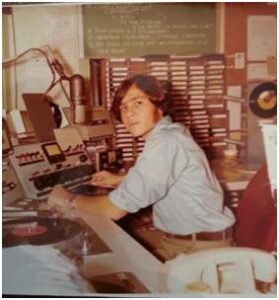
“I stayed in the radio business as a DJ, and eventually drifted towards the business side of the profession. I ended up being in sales, and I actually owned a few radio stations for a while. I’m also a historical guy and a collector of things.
“Then in 2014, Mark Gunderson, who I used to hang around with in high school, reached out to me over Facebook. Mark is now a professor of English at Citrus College out in Glendora, California, and he’s all about music -– it’s his passion. He reminded me of all the concerts we went to, and then asked if I still had the tape I made of the Allman Brothers. I couldn’t believe he remembered that. I told him that I’d have to take a look, so I rummaged through where I thought it might be, and I found it. I sent it to Mark, and to a few other friends, and they thought it was cool.
“Then I sent it to my cousin, Simon Ritt … Simon then gets me in contact with a former ABB family ‘insider’ named Richard Price, who goes on to put me in contact with Richard Brent, who runs the Allman Brothers Band Museum at the ‘Big House’ in Macon. Brent, in turn, got me in touch with Bert Holman, the manager of the ABB and that brings us to its official release.”
As John Lynskey so appropriately ended his liner notes, “Savor every note. Wail on, Skydog!”
A Baltimore native and 1971 graduate of Randallstown High School, Sam Idas lives in Fort Lauderdale, Florida, and on the Greek island of Samos. His late father, Leon S. Idas, was a Jewish partisan fighter in Nazi-occupied Greece during World War II.
Jmore Editor-in-Chief Alan Feiler remembers Temple Emanuel's longtime spiritual leader, who passed away earlier this week at age 91.
Camp and youth group experiences have the ingredients for true, deep, lifelong transformation, writes Rabbi Jessy Dressin.
Proposed legislation in Israel would transfer authority of the entire Kotel to the Chief Rabbinate, writes Rabbi Robyn Fryer Bodzin.
In Italy, the Jewish Brigade's flag has unfairly become a flashpoint in today’s battles over Zionism and anti-fascism, writes Dr. Ginaluca Fantoni.