
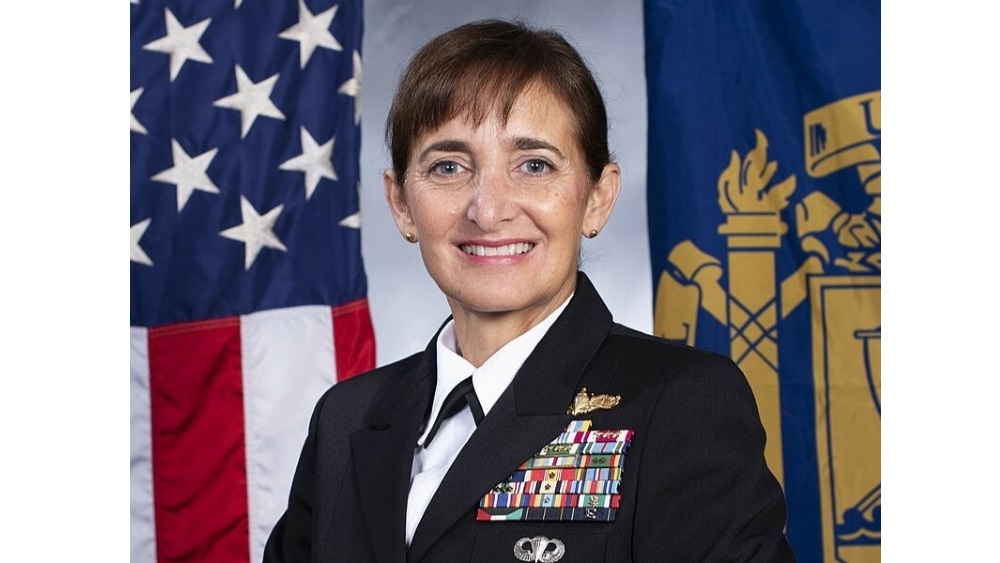
I saw the news about Vice Admiral Yvette M. Davids, the first female to take command at the U.S. Naval Academy, and it made me think of my old friend Jo Ann Boyarsky.
The 56-year-old Davids arrives at the academy after 178 years of male leadership. As it happens, she is a Mexican-American and the first Latina to hold the post of superintendent, as well as the first female. There was a time when such a development would have been unthinkable.
My old friend Jo Ann and I know each other for 70 years. She grew up on Groveland Avenue, off Rogers Avenue, in Northwest Baltimore. I lived around the corner on Crawford Avenue.
For a full decade, we lived a few hundred yards from each other, went mostly to the same public schools, the same Hebrew school, had many of the same friends and classmates. And we barely knew each other.
Such was the culture of the time.
Yvette Davids’ promotion to superintendent at Navy is one more sign of the changing of that culture.
In our mid-20th century youth, my friend Jo Ann and I lived in two separate worlds, separated by gender, and by expectations.
By the time the new Naval Academy leader was coming of age, that separation was changing. Girls who’d once been raised thinking they could become nurses (but not doctors) and secretaries (but not lawyers) and WACs (but not Naval Academy students, much less superintendents) were now learning about the new America.
It was an America where we finally realized we were short-changing half the population.
In post-war America, my friend Jo Ann and I picked up on the usual cultural signals. Boys and girls were kept at a distance. At Garrison Junior High, we couldn’t even sit on the same side of the cafeteria, nor occupy the same side of the building at recess.
Such signals carried into our own neighborhood where the boys headed for the local schoolyard, Grove Park Elementary, every afternoon to play ball, and the girls — well, where were the girls?
As it happens, Yvette Davids was taking over in Annapolis as Jo Ann and I happened to bump into each other recently. We spent more than an hour talking about that distant world where we lived so nearby, from childhood all the way through adolescence, and yet barely knew each other.
“Every day,” I said, “the guys were all gathering to play ball at the schoolyard, but what were the girls doing?”
“Talking on the phone,” she laughed. “Probably about boys.”
She was kidding, but not entirely.
The boys were acting out our macho aggressiveness at the schoolyard, while the girls were getting intimate with household domesticity. Jo Ann and I both went to College Park’s University of Maryland campus. But ours was an era when many young women — as the old joke went ––went to college aiming for an “an MRS, not a BS.”
Jo Anne was a school case worker for a few years after graduation, but then got married, raised a few children, grieved over her husband’s death and went to work for a law firm for the next 30 years.
In a non-legal position.
Women of our generation rarely became lawyers. That was considered man’s work. In the post-war years, women who worked outside the home mostly had female-only jobs. They worked in the typing pool. They worked the cash register at Read’s. Only about 3 percent of all doctors were female in the ‘50s. Only 4 percent were attorneys. Virtually every member of the U.S. Congress was male.
Yvette Davids went to the U.S. Naval Academy when things were finally changing. She graduated in 1989. She earned a master’s degree in national security and strategic studies and another master’s in national resource strategy.
She was the first Hispanic American woman to command a Navy warship. She married another rear admiral, Keith David, a 1990 Academy grad who now leads the Naval Special Warfare Command. The rest of Yvette Davids’ professional bio could fill an encyclopedia.
She’s evidence that America learns slowly, but sometimes learns well.
A former Baltimore Sun columnist and WJZ-TV commentator, Michael Olesker is the author of six books, including “Journeys to the Heart of Baltimore” (Johns Hopkins University Press) and “Michael Olesker’s Baltimore: If You Live Here, You’re Home” (Johns Hopkins University Press).

Jmore Editor-in-Chief Alan Feiler remembers Temple Emanuel's longtime spiritual leader, who passed away earlier this week at age 91.

Camp and youth group experiences have the ingredients for true, deep, lifelong transformation, writes Rabbi Jessy Dressin.

Proposed legislation in Israel would transfer authority of the entire Kotel to the Chief Rabbinate, writes Rabbi Robyn Fryer Bodzin.

In Italy, the Jewish Brigade's flag has unfairly become a flashpoint in today’s battles over Zionism and anti-fascism, writes Dr. Ginaluca Fantoni.