
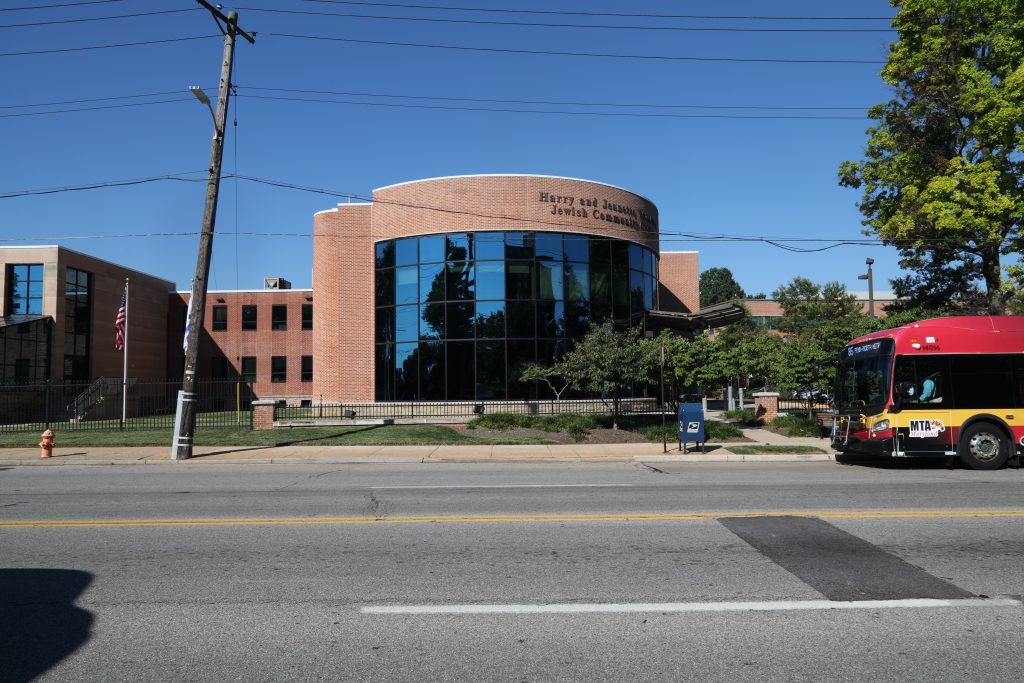
In my hands is a list of 46 racquetball players at the Weinberg Park Heights Jewish Community Center, and boy, are they angry.
They’re all dressed up with no place to play.
Without any prior discussion, an entire history of games and good cheer is being erased from the Park Heights JCC, which once had four courts for racquetball, handball and squash. Several years ago, two were renovated for other uses. Now, the last two are set to be torn apart May 21.
Leaving none.
When rumors of the renovation reached longtime JCC member Michael Friedman, he posted notices around the Park Heights building, asking players to get in touch with him to protest the changes.
Every notice was removed within 24 hours, Friedman said. He was told the notices “had to be cleared by staff.”
But Friedman quickly put together a list of 46 active racquetball players, and last month about a dozen of them met with JCC Chief Executive Office Barak Hermann and several staff members.
“You want to take away the only courts left in the Northwest Baltimore area,” Friedman said. “For what? More aerobics area, more office space? As if there are no other alternatives.
“Your decision was reached without consulting or even asking anyone that uses these courts. Why didn’t the ‘J’ or The Associated contact any of the players? After all, this is the Jewish ‘Community’ Center, isn’t it?”
(Last January, The Associated: Jewish Federation of Baltimore announced it will move its headquarters to the campus of the Park Heights JCC.)
According to Friedman, Hermann told the group, “I don’t want to get your hopes up. I know your complaints. We’ll think about it over the weekend and let you know. But it’s a done deal.”
In a telephone interview last week, Hermann said the same thing: it’s a done deal, even with none of the active players knowing anything in advance.
And they’re furious about it.
Scott Cooper, a longtime racquetball player at the JCC, said he’s had a family membership there since the late 1980s.
“When I became a member,” he said, “there were seven courts. Then, when they took down the previous two courts, there were reassurances these last two courts would remain. … Racquetball isn’t offered everywhere and should be promoted appropriately. To suggest we maintain our JCC memberships and play racquetball elsewhere, which requires another membership, is completely ridiculous.”
Another player, Hershel Schabes, said, “The JCC didn’t treat us badly. They simply ignored us, as though we didn’t exist. I have remained a JCC member for the last 40 years because of racquetball. It’s more than just a game. It has provided me the opportunity to develop interaction and friendship with members of the Jewish community that I wouldn’t otherwise know.”
In last week’s telephone interview with Hermann, he said, “We just feel, as we set up for the future, and evaluated the opportunity, we felt converting to a real group fitness studio allows us to keep enriching our current fitness program.
“Obviously, we care a lot about our members, but the number of players we do have, we could serve a lot more people [with the planned changes]. There’s a lot that goes into strategic planning. We feel badly that we didn’t engage these guys sooner, but we did a lot of analysis.”
Hermann noted that racquetball is “a sport with declining interest. It’s a group of very special guys who like to use it [for racquetball] but we’re looking for other ways to serving. We’re renovating the gym for pickleball. Sometimes, change is hard.”
But Michael Friedman believes maintaining the status quo is possible.
“They ignored us, and they’re going to lose a whole bunch of members,” he said. “This decision doesn’t have to be final. It can be changed.”
Failing that, he said, “Some of us have already said goodbye. We’ve joined L.A. Fitness in Towson.” He said those are the closest racquetball courts to Northwest Baltimore.
A former Baltimore Sun columnist and WJZ-TV commentator, Michael Olesker is the author of six books, including “Journeys to the Heart of Baltimore” (Johns Hopkins University Press) and “Michael Olesker’s Baltimore: If You Live Here, You’re Home” (Johns Hopkins University Press).

Jmore Editor-in-Chief Alan Feiler remembers Temple Emanuel's longtime spiritual leader, who passed away earlier this week at age 91.
Mansoor Shams is known for carrying around a sign proclaiming, “I’m a Muslim and a U.S. Marine. Ask anything.” Now the Baltimore County Department of Recreation and Parks community engagement and outreach officer is running for Baltimore County Executive.

Camp and youth group experiences have the ingredients for true, deep, lifelong transformation, writes Rabbi Jessy Dressin.

Proposed legislation in Israel would transfer authority of the entire Kotel to the Chief Rabbinate, writes Rabbi Robyn Fryer Bodzin.