

By Nathan Myhrvold
The secret to the perfect bagel is a subject of heated discourse. After trying bagels from New York City to Seattle, we can tell you one thing: it’s not the water source; it’s the baker. One of our biggest breakthroughs was a starch slurry, which not only helps toppings stick but also makes it possible to use larger items — sunflower seeds, chopped nuts — that otherwise wouldn’t cling well.
Why are bagels first boiled or steamed? Because either method of applying heat pregelatinizes the starch on the crust; this is why bagels are so shiny after they bake.
Cooking Notes:
• If using a 4.5 qt or 8 qt stand mixer, sometimes the ingredients are not enough for the dough hook to mix them well; use a paddle attachment initially to get all the ingredients uniformly mixed. Once you have a shaggy mass (the dough is sticky and wet, but there are no visible clumps of flour or unincorporated water in the bowl), switch to a hook attachment.
• Because bagel dough is stiff, mixing it in a stand mixer can cause the machine to struggle and possibly burn out. If your stand mixer is dancing on the table, it either has too much dough or too stiff of a dough (or both) for it to handle.
• For a 4.5 qt bowl, you can mix on the lowest possible speed, which will double the mixing time. You can also mix the dough to a shaggy mass, divide the dough in half, and mix it to full gluten development in two batches.
• The final mix time at higher speeds may vary from machine to machine. The goal is to achieve full gluten development. Consider our suggested times as guidelines only. Let your visual assessment and the windowpane test determine the dough’s stage of gluten development.
• To make the dough easier to handle, add 0.05% fresh pineapple juice or 0.8% fresh kiwi juice.
• Keep the dough covered as you weigh out the pieces; this dough dries out easily because of its low hydration.
• Make sure that the hole in the middle of the bagel is centered, or it will proof and bake unevenly.
• Although bagels are proofed and baked on a half sheet pan, we recommend placing the half sheet pan on a baking stone that is on the middle shelf of the oven. This will provide the dough with a good oven spring and will reduce baking time. Alternatively, you can slide the parchment paper the bagels are on directly onto the baking stone.
Storage Note: If you aren’t going to eat the bagels the same day, let them cool, and then immediately slice them in half, wrap each half, and freeze them for up to 2 months. Frozen bagels can be dropped into the toaster without thawing.
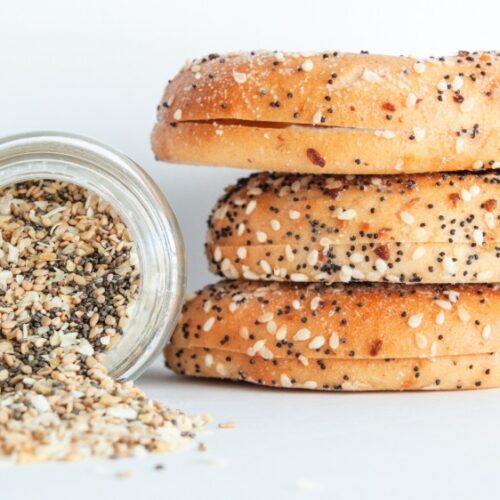
The Best Everything Bagel Recipe

Ingredients
For the dough:
- 1 1/3 cups water
- 1/2 tsp instant dry yeast
- 4 2/3 cups high-gluten flour
- 2 Tbsp + 3/4 tsp sugar
- 1 Tbsp + 3/4 tsp vegetable oil
- 2 1/4 tsp fine salt
- 1 3/4 tsp malt syrup
For the malt solution:
- 4 1/4 qts water
- 2/3 cup malt syrup
For the everything bagel mix:
- 1/4 cup dried onion
- 1/4 cup dried garlic
- 1/4 cup celery seeds
- 1/4 cup caraway seeds (optional)
- 1/4 cup poppy seeds
- 1/4 cup sesame seeds
- 2 tsp sea salt or celery salt (optional)
For the starch slurry:
- 7 Tbsp Ultra-Tex 3 (modified tapioca starch)
- 4 1/3 cups water
Instructions
- For the dough, combine the water and the yeast in the mixer’s bowl, and stir to dissolve the yeast.
- Add the flour, sugar, oil, salt and malt syrup.
- Mix on low speed to a shaggy mass, about 5 min.
- Mix on medium speed to full gluten development, 4-6 minutes.
- Perform the windowpane test to assess gluten development. Take a portion of dough in your hands and stretch it: the dough will hold the window for at least 8-10 seconds and can be stretched to the point that it is nearly see-through when it has reached full gluten development.
- Transfer to a lightly oiled tub or bowl, and cover well with a lid or plastic wrap.
- Bulk ferment, covered, for 1 hour at 21°C/70°F. Do not fold-if you fold the dough, it will not bind to itself.
- Divide into seven equal pieces.
- Press down on each piece of dough, flattening it into a disk with your fingers.
- Mentally divide each piece of dough into quarters. Fold each corner into the center of the dough.
- Turn the dough over, and use your hands to round it into a ball. Surround the ball with your fingers as if you’re making a cage for it.
- Rest the dough, covered, 20 minutes.
- Use the handle of a wooden spoon to make a hole in the center of the roll, keeping the seam side down.
- With your hands, stretch the dough from the center hole out, until the diameter of the bagel is 7 ½-10 cm/3-4 inches.
- Arrange the bagels on half sheet pans lined with lightly oiled nonstick silicone mats or parchment paper and dusted with cornmeal. Keep in mind that they will expand as they proof; give them enough space so they will not come in contact with each other.
- Proof the shaped bagels at 21°C/70°F, covered, for 1½-2 hours.
- Test for proof using the fingertip test. Gently press the exposed surface of the dough for 2 seconds; the pressure should leave a small dent in the dough; it will slowly spring back, but the indentation should remain clearly visible after 1-2 seconds.
- For the malt solution, dissolve the malt syrup in the water in a saucepot using an immersion blender or a whisk. Bring the liquid up to a rolling boil.
- Place the bagels in the boiling water, three or four at a time.
- Boil for 1 minute total, flipping the bagels after the first 30 seconds.
- Return the boiled bagels to the half sheet pans, and place them bottom side down to bake.
- Bake in a 230°C/450°F oven for 12-15 minutes.
- Remove the bagels from the oven, and cool to room temperature.
- For the everything bagel mix, stir together the dried onion, dried garlic, celery seeds, caraway seeds (if using), poppy seeds, sesame seeds, and sea salt or celery salt (if using) thoroughly in a bowl.
- For the slurry, while the bagels are cooling, mix the modified tapioca starch (Ultra-Tex 3) into the water using an immersion blender until there are no starch clumps.
- Allow the slurry to thicken for 2-3 hours at room temperature before you dip the bagels into it. It needs to be thick enough to cling to the surface of bagels. Reserve in an airtight container at room temperature if not using right away, or refrigerate for 4-5 days.
- Gather your garnishes, and place them in a bowl large enough to also accommodate the bagel you’ll be coating.
- Submerge the bagel in the slurry coating using a skewer, remove, and allow the excess to drip off.
- Coat both sides of the bagel with the garnishes.
- Place the garnished bagels on a lightly oiled wire rack or on a half sheet pan lined with lightly oiled parchment paper.
- Return the bagels to the oven, and bake them at the same initial baking temperature for 5 minutes more with the door slightly cracked.
- Remove the bagels from the oven, and cool them completely on the wire rack.
Recipe reprinted with permission from “Modernist Bread at Home,” courtesy of The Cooking Lab, LLC, courtesy of The Nosher via JTA.
For more articles like this, visit MyJewishLearning.com/The-Nosher/

Dara Bunjon talks with award-winning author Monica Saigal (Bhide) about her "Modern Spice" cookbook, "Papa's Butter Chicken" children's book, and more.
It doesn't get much easier than this cucumber and purple cabbage salad from Elite Jakob, perfect for a warm spring day.

Dara Bunjon talks sustainable farming, chocolate, and more with farmer, chef, educator and chocolatier Mark Mills of Chocolates and Tomatoes Farm in Middletown.

Dara Bunjon talks with cook, writer and television host Monti Carlo about her new cookbook, "Spanglish: Recipes & Stories," and more.